


What Is More Difficult Than Making a Slim Patient Look Extremely Sculpted?2026.03.24
The real challenge is how beautifully a patient with more fat volume can be contoured
When people think about liposuction, many assume that patients with more fat are easier to treat because the change can be larger.
However, that is not always true.
In fact, making a naturally slim patient look even sharper is not necessarily the most difficult part.
What is often much more difficult is how to create a refined result in patients with larger fat volume without causing skin laxity or irregularities.
At AVAN TOKYO, we do not think of liposuction as a procedure that simply removes fat.
We think of it as a procedure that asks:
how far can we safely go while still creating the most beautiful possible contour for that individual patient?
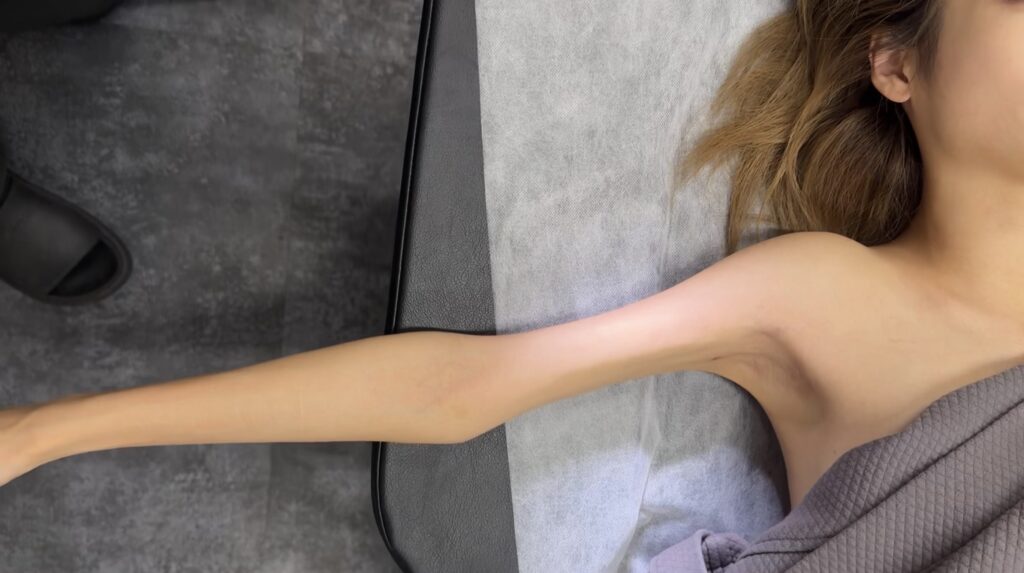
Slim patients may sometimes have better potential for a very sharp result
When a patient already has a low BMI, good skin quality, and relatively little risk of loose skin after fat removal, it may actually be easier to create a very sharp and sculpted result.
In these patients, it may be possible to achieve:
- very angular upper arms
- a sharper facial contour
- a thinner abdomen or thighs
- a more “crisply sculpted” overall appearance
This is because their skin often adapts better after fat removal, and the body line is less likely to collapse into looseness or irregularity.
Of course, this depends on skin quality, fat distribution, and anatomy.
Being slim alone does not automatically guarantee the same outcome for everyone.
Patients with more fat volume often require a higher level of judgment
At first glance, patients with more fat may seem easier because there is more volume to remove.
And while the visible change can be very impressive, these cases are often much more complex.
For example, when a patient has:
- a BMI over 23
- more than 80cc removable in the face
- more than 700cc removable from the arms
- more than 1000cc removable from the abdomen
- more than 2000cc removable from the thighs
the issue is no longer simply “remove more fat.”
In these cases, many other factors become important, including:
- skin laxity
- fat stored within or around muscle planes
- skin ischemia caused by over-resection
- postoperative contracture-related unevenness
- balance between connected body areas
In other words, liposuction becomes more difficult—not easier—when the amount of removable fat increases.
Removing a larger amount is not always the right answer
What matters is how far we can go safely and beautifully
Patients often focus on numbers such as how many cc can be removed.
However, numbers alone do not create a beautiful result.
If too much fat is removed, it may increase the risk of:
- compromised skin circulation
- visible laxity
- contour irregularity
- unnatural texture
On the other hand, if too much is left behind, the result may become too conservative and may fail to meet the patient’s ideal.
That is why the true skill in liposuction lies in deciding:
- where fat should be removed aggressively
- where fat should be preserved
- how far the contour can be pushed safely
- when to stop
At AVAN TOKYO, this balance is one of the most important parts of our design philosophy.
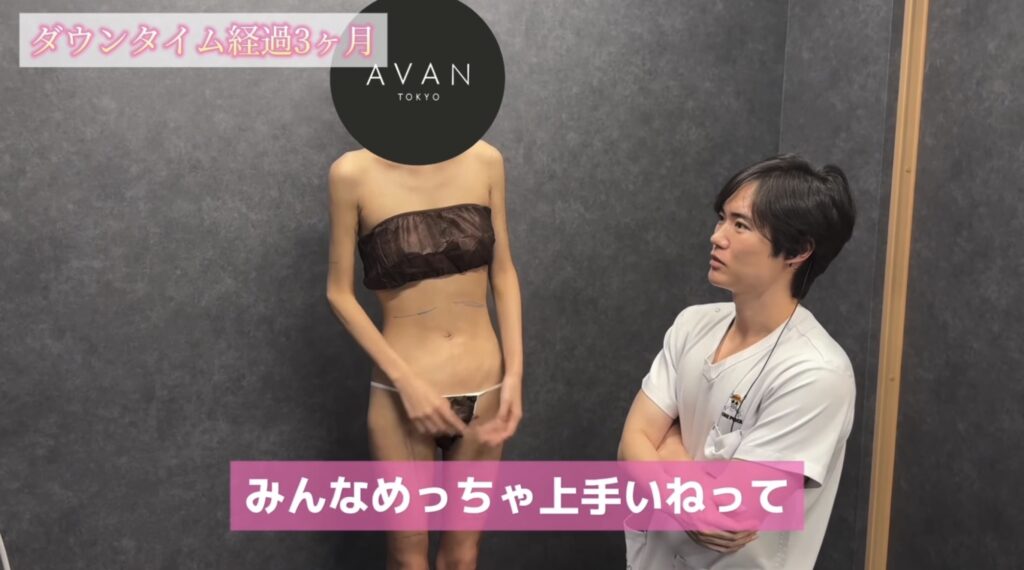
Revision cases require even more advanced judgment
One of the most challenging categories in liposuction is revision surgery after treatment at another clinic.
In revision cases, it is common to see:
- areas where fat has already been partially removed
- visible scars
- tissue adhesion
- uneven treatment across different layers
Even so, many patients still come in hoping for:
- an even slimmer contour
- a more aggressively sculpted full-body look
- a higher level of refinement than before
In these cases, simple re-suction is not enough.
The surgeon must evaluate the remaining fat, skin reserve, scar condition, tissue quality, and overall balance before deciding how far improvement is realistically possible.
At AVAN TOKYO, even in revision cases, we continue to work creatively and carefully to come as close as possible to the patient’s ideal.
Liposuction should not be merely “safe and average”
It should aim to realize the patient’s ideal as much as possible
A conservative, average liposuction can be performed almost anywhere.
But what truly matters is whether the treatment can come close to the patient’s real goal.
Some patients want:
- simply to be slimmer
- a very angular contour
- a softer natural result
- the maximum visible change, even if that comes with trade-offs
These are very different goals.
That is why treatment should not be based only on what is generally safe, but also on how to come as close as possible to the patient’s ideal while maintaining safety.
That philosophy is central at AVAN TOKYO.
What AVAN TOKYO values
Liposuction should be planned by the final shape, not by the number alone
At AVAN TOKYO, we do not judge liposuction based only on how much fat can be removed.
We evaluate:
- how much fat is present now
- the elasticity and reserve of the skin
- the risk of postoperative laxity
- which fat layer is actually the problem
- what kind of final contour the patient truly wants
In other words, liposuction is not simply a procedure to decide how many cc to remove.
It is a procedure to decide what kind of final shape should be created.
That is why slim patients, patients with larger fat volume, and revision patients all require different strategies.
Conclusion
If the conditions are right, making a slim patient look extremely sculpted may be relatively achievable.
But creating a beautiful result in patients with more fat volume—while minimizing laxity and irregularity—requires much more comprehensive judgment.
The true challenge in liposuction is not simply removing fat.
It is deciding:
- where to remove it
- where to preserve it
- how far to push the contour
- and where to stop
At AVAN TOKYO, we aim for liposuction that does not settle for an average result, but instead pursues the most refined body line possible while preserving safety.