


Why Can Upper Arm Liposuction Leave Asymmetry? Understanding Deltoid Prominence and Arm Botox2026.10.17
“Could you remove a little more fat from my upper arms?”
That remaining fullness may not be fat—it may be muscle.
When considering upper arm liposuction, many people want more than smaller arms. They are looking for a smoother transition from the shoulders to the upper arms, with a balanced contour on both sides.
However, liposuction removes fat beneath the skin. It does not reshape the underlying muscles or bones. This distinction matters when the rounded contour near the shoulder is partly created by the deltoid muscle rather than excess fat.
The important question is not simply, “How much fat can be removed?” It is, “What is creating this particular contour?”
This article explains why asymmetry or shoulder fullness may remain after upper arm liposuction, how the deltoid muscle affects the appearance of the arms, and what to consider before combining liposuction with arm Botox.
Why Perfect Symmetry Cannot Be Guaranteed After Upper Arm Liposuction
Upper arm liposuction aims to improve contour and balance, but it cannot guarantee that both arms will become identical.
Natural differences may already exist before surgery. Research comparing the arms of right-handed young adults found that the dominant arm was often heavier than the nondominant arm, although the degree of asymmetry varied between individuals.
Asymmetry and contour irregularities are also recognized potential outcomes of liposuction. Realistic expectations should therefore be discussed before treatment.
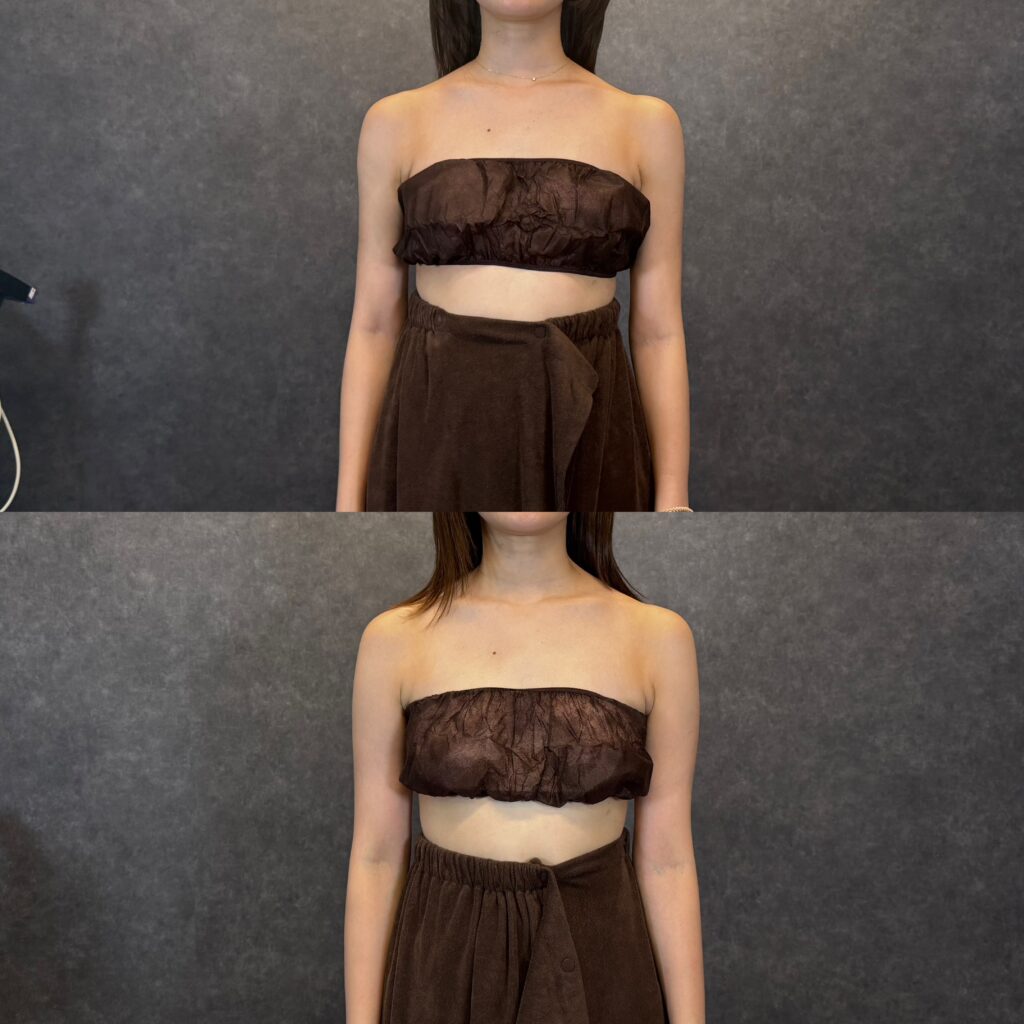
However, “perfect symmetry cannot be guaranteed” does not mean that postoperative asymmetry should be dismissed.
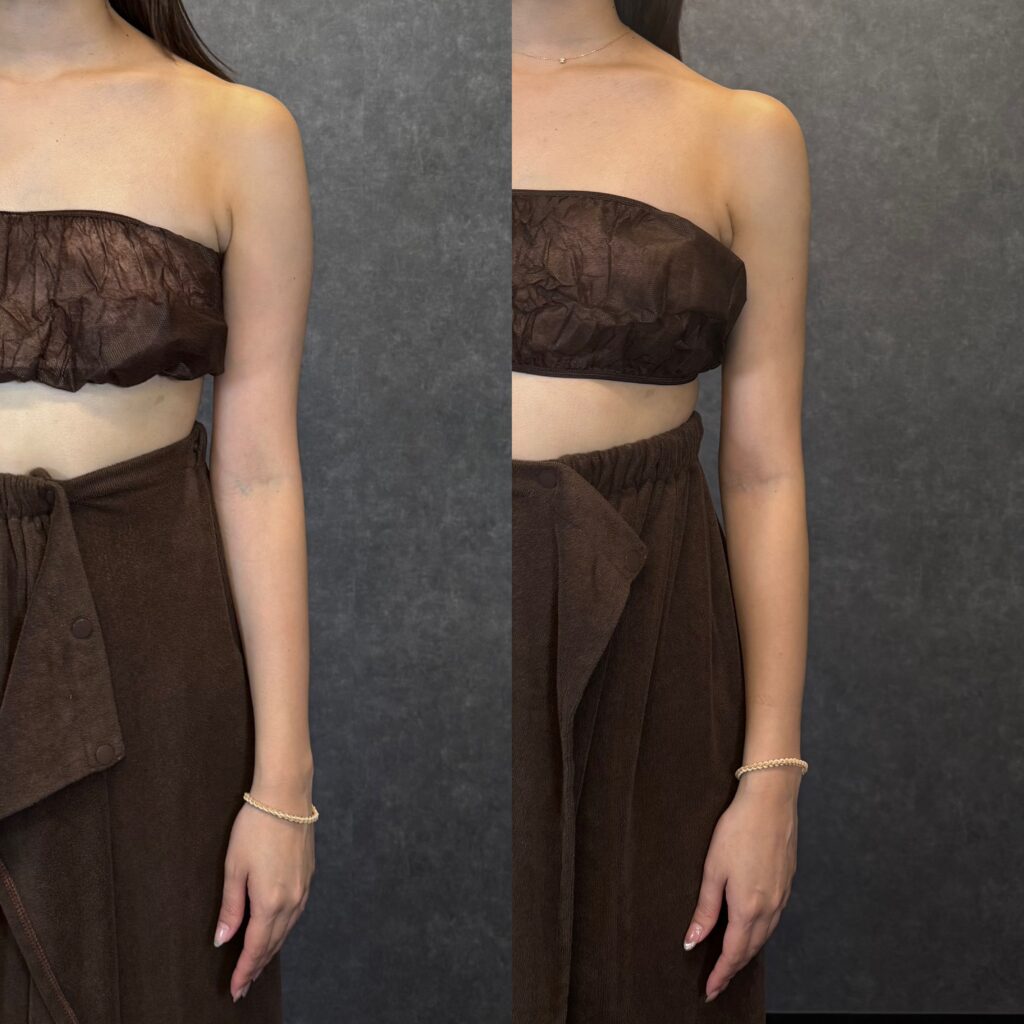
When a difference between the arms is noticeable, the next step is to assess its cause. Pre-existing anatomy, residual fat, swelling, skin laxity, and postoperative tissue changes need to be considered rather than automatically attributing everything to the dominant arm. Comparing preoperative photographs with the current examination can help guide this assessment.
The Rounded Contour Near Your Shoulder May Be the Deltoid Muscle
The deltoid is the muscle that covers the shoulder and contributes to its rounded shape. It helps raise and move the arm. Although commonly described as having anterior, middle, and posterior portions, its internal anatomical and functional organization is more complex.
The prominence along the outer shoulder and uppermost part of the arm may therefore reflect muscle volume as well as overlying fat. Anatomical research on shoulder and arm contouring identifies the deltoid as a distinct muscle target, separate from other structures such as the trapezius and triceps.
From an anatomical perspective, reducing the fat surrounding a muscle may also make its existing outline more noticeable. This is a possible explanation—not proof that liposuction has caused the muscle to grow.
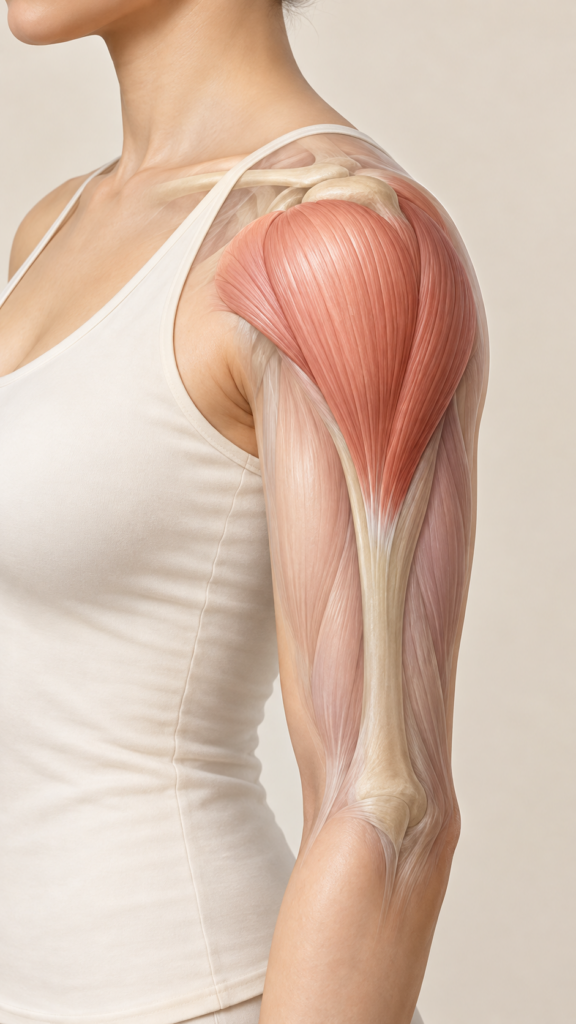
When the upper arm becomes slimmer but the shoulder remains rounded, removing more fat is not automatically the right solution.
Is the Deltoid Always Larger on the Dominant Side?
No. The dominant arm may be larger, but this is not a rule that applies equally to everyone.
Research showing differences in total arm mass does not establish that every right-handed woman has an enlarged right deltoid. Arm mass and the size of one specific muscle are different measurements.
For that reason, treatment should not be planned solely on the assumption that the dominant side needs more liposuction or a larger dose of botulinum toxin.
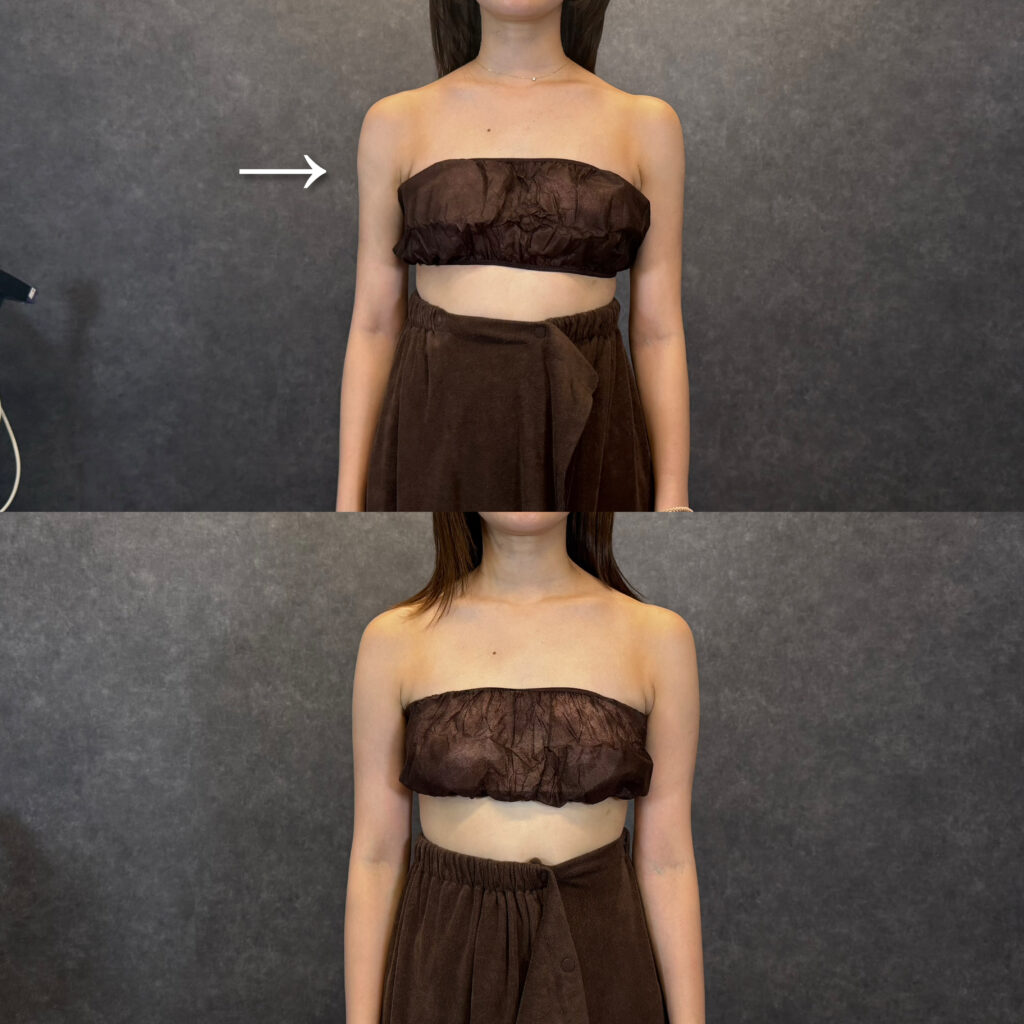
Assessing Fat, Muscle, Skin, and the Underlying Framework
A useful starting point is to separate the structures that contribute to the visible contour. Liposuction and muscle-directed treatments act on different tissues, even when both are discussed as options for making the arms appear slimmer.

The goal is appropriate contour adjustment—not simply the maximum possible fat removal.
Can Arm Botox Help With Deltoid Prominence?
Botulinum toxin treatment may be considered when muscle prominence contributes to the shoulder or upper arm contour.
Botulinum toxin reduces the release of acetylcholine at the neuromuscular junction, weakening muscle activity. It is not a treatment that removes fat.
In this article, “arm Botox” refers to the commonly used treatment term. Botox is a brand name; the exact botulinum toxin product used should be specified during consultation.
When Might It Be Considered Alongside Liposuction?
When both fat and muscle contribute to the appearance of the upper arm, the clinical rationale is to address each tissue separately: liposuction for the fat component, and a carefully selected muscle-directed treatment for the muscle component.
However, arm Botox should not be treated as a routine addition for everyone undergoing upper arm liposuction. The intended target muscle and relevant anatomy need to be identified, rather than relying on a general label such as “arm slimming.”
The potential aesthetic benefit also needs to be weighed against the importance of preserving comfortable, functional arm movement.
What Does the Research Show?
A 2023 pilot study by Koh and colleagues included 12 Korean women with bilateral deltoid hypertrophy and compared two doses of botulinum toxin over 12 weeks. Upper arm circumference decreased in both groups, while a statistically significant reduction in muscle thickness was observed in only one group.
Patient satisfaction did not consistently match the objective measurements. The study was small and did not directly compare liposuction alone with liposuction plus botulinum toxin. It therefore does not establish that combining the treatments produces a better result or guarantees a straight, symmetrical contour.
Arm Function Matters as Much as Appearance
The deltoid is a functional muscle involved in raising the arm. Weakening it may affect how easily the shoulder and arm can be used. Muscle weakness is a recognized concern with botulinum toxin treatment.
During consultation, explain whether your work or daily activities involve lifting, frequent overhead movement, carrying children, sports, or strength training. These considerations should be part of the treatment decision.
Aesthetic treatment should not focus on a photograph alone. It should also account for how you use your arms every day.
Is Deltoid Botox an Approved Cosmetic Indication in Japan?
Cosmetic reduction of the deltoid is not an approved indication in the Japanese prescribing information for Botox Vista. Using an approved product for this purpose is therefore outside its approved indications. The regulatory status of the specific product being offered should also be checked.
Before treatment, the clinician should explain the product name, its approval status, the intended off-label use, expected limitations, and relevant risks.
Is Asymmetry at Two Months After Liposuction the Final Result?
Not necessarily.
At two months after upper arm liposuction, the tissues may still be recovering. The American Society of Plastic Surgeons notes that swelling can take several months to fully subside, with the contour continuing to develop during that time.
A photograph taken at this stage should therefore be interpreted as a progress image rather than automatically as the final result.
Before deciding on additional treatment, it is important to compare the current appearance with the preoperative condition and assess the area in person. The question is not simply whether fullness remains, but what is causing it.
Severe pain or unexpected symptoms should not be left until the final result is assessed. Contact the clinic that performed the procedure promptly.
AVAN TOKYO’s Approach: Considering the Shoulder and Upper Arm Together
At AVAN TOKYO GINZA LIPOSUCTION CLINIC, we consider the relationship between the shoulders, upper arms, and adjacent areas rather than treating arm circumference as the only measure of the result. Our approach also considers how the contour appears during movement, not only in a static position.
Aesthetic preferences differ. Some patients prefer to retain a softly rounded shoulder, while others are seeking a straighter transition into the upper arm.
The consultation is an opportunity to discuss that preference clearly and distinguish the desired change from what the anatomy and available treatments can realistically achieve.
Our guiding principle is:
Understand the cause of the contour, identify what can be changed, and avoid adding treatment without a clear reason.
The aim is not simply to remove more fat. It is to develop an individualized plan that considers proportion, treatment limitations, and everyday function.
Frequently Asked Questions About Upper Arm Liposuction, Asymmetry, and Deltoid Botox
Will removing the same amount of fat from both arms make them symmetrical?
Not necessarily. Equal removal does not account for differences that may already exist between the arms. Research demonstrates that arm mass can differ from side to side; identical treatment volumes should not be assumed to produce identical shapes.
Can I tell whether the remaining fullness is fat or muscle?
Appearance alone may not provide a reliable answer. A clinical assessment can help distinguish the contributing tissues. Ultrasound may be useful in selected cases; it was used to measure deltoid thickness in the clinical study discussed above.
Can arm Botox make the shoulder bones narrower?
No. Botulinum toxin treatment targets muscle activity, not the bones. Any intended contour change relates to the soft-tissue component rather than a reduction in the width of the underlying skeleton.
Are shoulder Botox and deltoid Botox the same treatment?
Not necessarily. “Shoulder Botox” does not identify one specific muscle. Research on shoulder and arm contouring considers the trapezius, deltoid, and triceps as separate targets. Ask which muscle is being treated and what change the treatment is intended to produce.
Should asymmetry at two months be corrected immediately?
Not automatically. Swelling may still be affecting the appearance, so the cause and recovery stage should be assessed first. However, severe pain or unexpected symptoms warrant prompt contact with the treating clinic rather than waiting.
Important Risks and Treatment Limitations
Upper Arm Liposuction
Potential risks include swelling, bruising, contour irregularities, asymmetry, pigmentation changes, altered sensation, loose skin, infection, and poor wound healing. More serious complications can include anesthesia-related problems, deep vein thrombosis, and cardiac or pulmonary complications. Revision surgery may sometimes be needed.
Arm Botulinum Toxin Treatment
Potential risks include injection-site reactions and muscle weakness. Serious adverse effects involving swallowing or breathing have also been reported with botulinum toxin products. The applicable warnings depend on the product, indication, and treatment circumstances.
Treatment suitability, results, and recovery vary between individuals. An in-person consultation and informed consent are essential before proceeding.
Conclusion: Identify the Cause Before Removing More Fat
When assessing the line from the shoulder to the upper arm, the first question should be:
“What is creating the fullness?”
The answer may lead to a discussion about fat reduction, muscle prominence, skin quality, or simply the need to assess recovery over time. The assessment should come before the decision to add another procedure.
Rather than asking only, “Can more be removed?” ask, “What needs to be adjusted—and why?”
At AVAN TOKYO GINZA LIPOSUCTION CLINIC, our goal is to help patients understand their options and make a treatment decision that reflects both their preferred appearance and the practical limits of treatment.