


What Is the Most Important Factor for Fat Graft Survival in Breast Augmentation? The Answer May Surprise You.2026.06.11
What truly determines fat graft survival?
Patients considering fat transfer breast augmentation often ask:
- Does Condensed Fat improve survival?
- Do exosomes increase retention?
- Are growth factors necessary?
While these technologies may provide benefits, AVAN TOKYO believes the single most important factor affecting fat graft survival is often overlooked:
The quality of your nutrition during the recovery period.
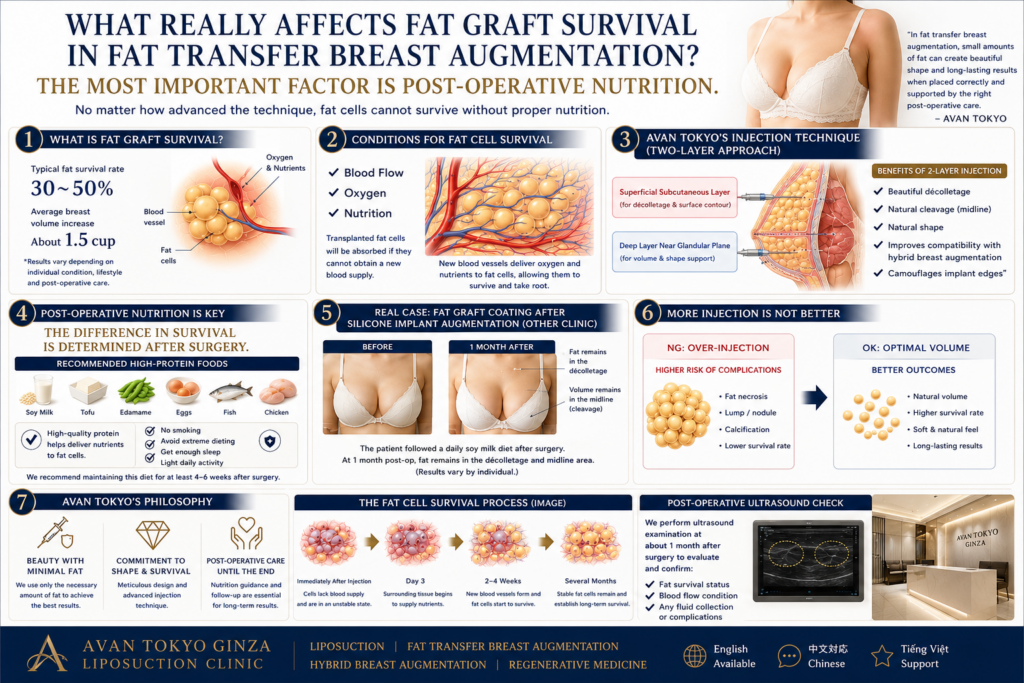
Fat cells survive through blood supply
After fat transfer, each transplanted fat cell must establish a new blood supply.
Without oxygen and nutrients, fat cells cannot survive—regardless of how advanced the harvesting or purification process may be.
This means that creating an environment where blood flow and nutrition are optimized is essential for long-term retention.
The most difficult areas: cleavage and upper breast fullness
Certain areas are notoriously challenging for fat graft survival:
- Cleavage (midline chest)
- Décolletage
- Upper pole fullness
These regions naturally have thinner soft tissue and less favorable blood supply.
For this reason, AVAN TOKYO focuses not on injecting more fat, but on placing fat strategically in areas and layers where survival is most likely.
AVAN TOKYO’s approach to improving fat survival
Our recent technique involves placing fat into two separate layers:
- Superficial subcutaneous layer
- Deep layer near the glandular plane
This layered approach helps achieve:
- Natural cleavage enhancement
- Improved upper breast fullness
- Softer contours
- Better camouflage of implant edges in Hybrid Breast Augmentation
However, even the most sophisticated technique cannot overcome poor postoperative nutrition.
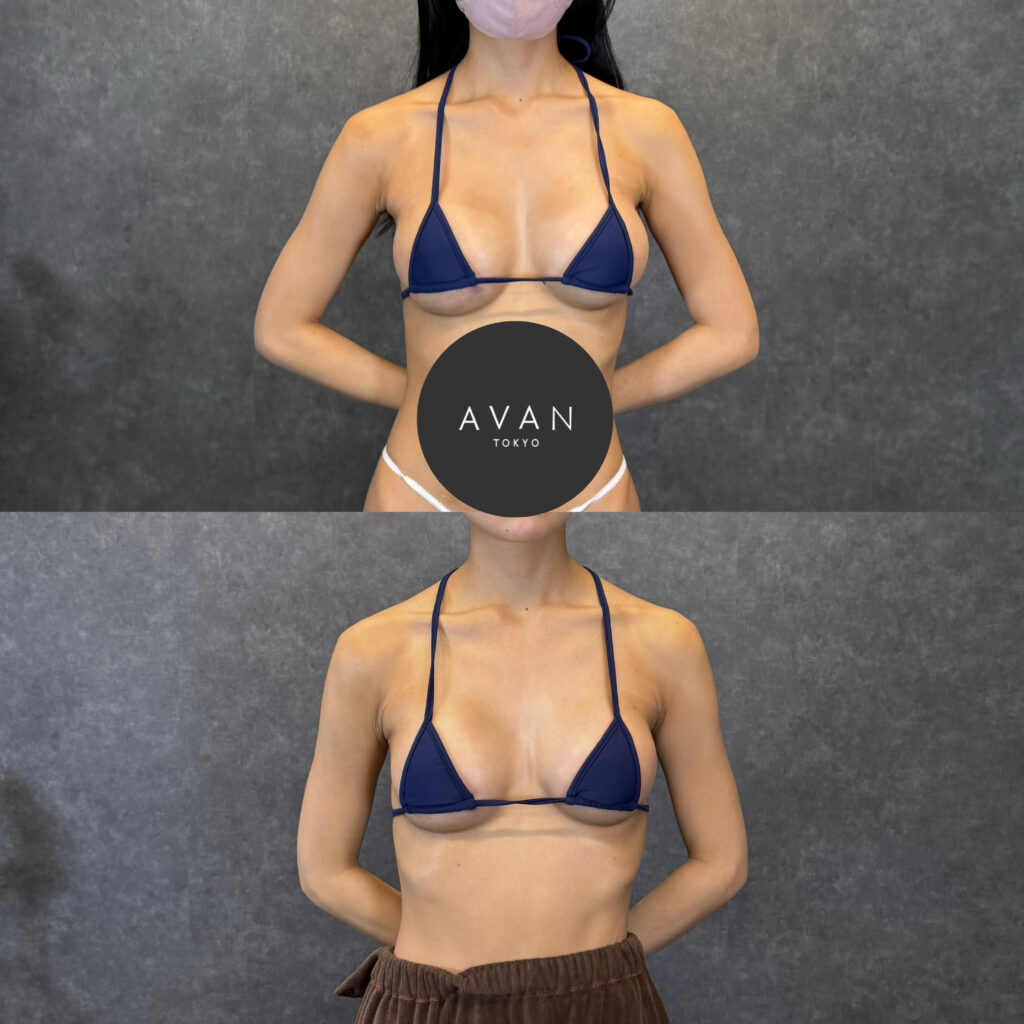
Real Case Example
The patient featured in this case previously underwent silicone implant augmentation at another clinic and later received fat graft coating at AVAN TOKYO.
She consistently consumed soy milk daily throughout recovery.
At just one month postoperatively, fat retention was already visible in the areas where survival is typically most difficult:
- Décolletage
- Cleavage
Although individual results vary, nutritional optimization likely played a significant role.
Why we recommend soy-based foods
During the first 4–6 weeks after surgery, we commonly recommend:
- Soy milk
- Tofu
- Edamame
- Fish
- Eggs
- Lean chicken
These foods provide high-quality protein and nutrients necessary for tissue healing and fat cell survival.
We also strongly recommend:
- No smoking
- Avoiding aggressive dieting
- Light daily activity
More fat is not always better
One of the biggest misconceptions in fat transfer breast augmentation is that larger injection volumes automatically produce better results.
Excessive injection can increase the risk of:
- Fat necrosis
- Oil cysts
- Calcification
- Poor survival rates
The true goal is not to inject the most fat possible.
The true goal is to create the most beautiful shape while maximizing survival with the least necessary volume.
What if you want a larger increase?
Patients seeking more than a two-cup increase may achieve more predictable results through:
- Secondary fat grafting procedures
- Hybrid Breast Augmentation
Rather than simply increasing injection volume.
The AVAN TOKYO Philosophy
Successful fat transfer breast augmentation begins long before surgery and continues long after surgery.
Harvesting technique, fat purification, injection design, postoperative care, and nutritional management all contribute to the final outcome.
At AVAN TOKYO, we prioritize:
- Natural aesthetics
- Long-term fat survival
- Patient safety
Because the success of fat transfer breast augmentation is not determined on the day of surgery alone—it is built throughout the recovery process.
Risks and Side Effects:
Swelling, bruising, infection, fat necrosis, calcification, asymmetry, variable fat survival, scarring, and lump formation.