


Hardness Around the Accessory Breast Area After Arm and Axillary Liposuction2026.07.01
Understanding Firmness, Tightness, and Postoperative Fibrosis Around the Armpit
After circumferential arm liposuction, axillary fat liposuction, or accessory breast liposuction, some patients may notice symptoms such as:
● Firmness around the armpit
● Tightness near the accessory breast area
● A pulling sensation when raising the arms
● Hardness around the side of the breast after breast augmentation
These symptoms are relatively common during the downtime period, especially after arm liposuction, accessory breast liposuction, silicone breast augmentation, or Hybrid Breast Augmentation.
In many cases, this firmness is similar to postoperative fibrosis or contracture that occurs during the normal healing process.
At AVAN TOKYO, we support patients not only through surgery, but also throughout the recovery period.
Why Does the Accessory Breast Area Become Firm?
After liposuction, the body begins to heal the treated area.
During this healing process, temporary inflammation and tissue remodeling occur beneath the skin.
This can lead to fibrosis, which may feel like firmness, tightness, or pulling.
The accessory breast and axillary area are anatomically complex because the skin, subcutaneous fat, fascia, lymphatic flow, and arm movement are all closely related.
For this reason, this area may be more likely to feel tight, firm, or restricted after surgery.
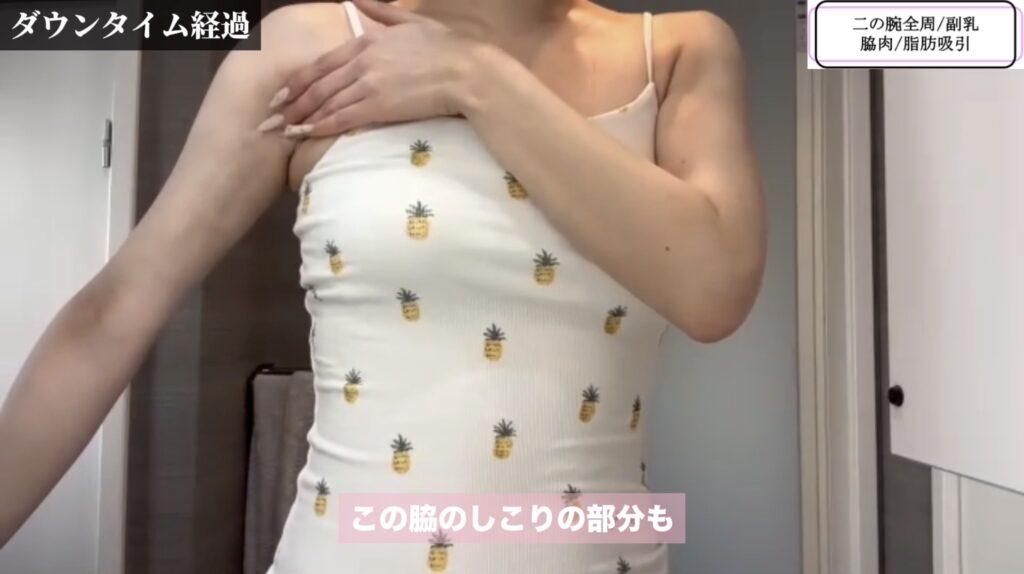
Firmness Around the Armpit Can Also Occur After Breast Augmentation
Firmness around the accessory breast or axillary area may occur not only after liposuction, but also after breast augmentation.
This may be seen after:
● Silicone breast implant augmentation
● Hybrid Breast Augmentation
● Combined arm liposuction and breast augmentation
● Combined accessory breast liposuction and breast augmentation
Swelling, inflammation, tissue healing, and temporary restriction of movement can all contribute to firmness around the armpit and outer breast area.
In most cases, this gradually improves with time.
Around 19–20 Days After Surgery Is a Common Time to Feel Firmness
This case shows a patient who underwent:
● Circumferential arm liposuction
● Axillary fat liposuction
● Accessory breast liposuction
At 19–20 days after surgery, the armpit and accessory breast area may still feel firm, tight, or difficult to move.
This is not the final result.
Rather, this is still an early healing phase when fibrosis and tissue remodeling may be developing.
In the same patient at 6 months after surgery, the firmness and tightness have improved, and the line from the arms to the axillary area and side of the breast appears more natural and refined.
Liposuction is not a procedure that is completed within a few weeks. The final contour develops gradually over several months.
How to Care for Firmness Around the Accessory Breast Area
Firmness around the accessory breast area is usually managed in a similar way to postoperative fibrosis after liposuction.
- Massage
Gentle massage may help improve tightness and firmness, depending on the healing stage.
However, strong massage too early after surgery may worsen pain or inflammation.
The timing and intensity of massage should be guided by your doctor. - Appropriate Movement
If the arms are not moved at all for a long period, tightness may feel stronger.
Gentle arm and shoulder movement within a comfortable range can help restore mobility around the axillary area.
Intense exercise or heavy training should be resumed carefully according to the recovery stage. - Sauna, Hot Springs, and Bathing
Heat therapy, such as bathing, hot springs, or sauna, may help promote circulation.
However, these should be avoided if the wounds are not fully closed, or if swelling, pain, or inflammation is still strong.
Please confirm with your doctor before restarting these activities. - Avoid Smoking
Smoking reduces blood flow and may negatively affect wound healing and recovery from fibrosis.
During the downtime period after liposuction or breast surgery, smoking should be avoided as much as possible. - Vitamins and Minerals
Tissue healing requires adequate nutrition.
Vitamin C, vitamin E, zinc, and iron are important nutrients that support recovery.
Supplements may be helpful, but a balanced diet should be the foundation. - High-Quality Protein
Protein is essential for repairing skin, fascia, blood vessels, and collagen.
We recommend including high-quality protein sources such as chicken, fish, eggs, soy products, lean meat, and yogurt.
Extreme dieting or fasting may interfere with postoperative recovery. - Gentle Radiofrequency Care such as INDIBA or InMode FORMA
Depending on the postoperative condition, gentle radiofrequency treatments such as INDIBA or InMode FORMA may be used to support circulation and lymphatic flow.
These treatments may help improve swelling and firmness.
However, strong treatment or treatment started too early may be too much for the healing tissue, so timing should be decided carefully.
How Long Does It Take to Improve?
Firmness and tightness around the accessory breast area usually improve gradually over 1 to 3 months.
However, recovery varies between individuals.
The healing speed depends on the amount of fat removed, skin thickness, swelling, constitution, smoking status, nutrition, lifestyle, and postoperative care.
By around 6 months after surgery, the line from the upper arm to the axillary area, accessory breast area, and side of the breast often becomes more natural.
Symptoms That Require Medical Attention
Firmness around the accessory breast area is often part of normal recovery.
However, please consult your doctor if you experience:
● Worsening severe pain
● Strong redness or heat
● Fever
● Sudden swelling on one side
● Pus-like discharge
● A lump that suddenly becomes larger
● Firmness that does not improve over time
Infection, hematoma, seroma, fat necrosis, or a persistent lump may need to be ruled out.
AVAN TOKYO’s Approach to Arm, Axillary, and Accessory Breast Liposuction
At AVAN TOKYO, we do not consider arm liposuction to be a procedure only for making the arms thinner.
We design the entire upper-body line, including the arms, axillary fat, accessory breast area, side of the breast, and back.
Accessory breast and axillary fat can make the upper body look heavier if they remain.
At the same time, this area is also prone to firmness and tightness during recovery.
That is why postoperative care, fibrosis management, nutritional support, lifestyle guidance, and appropriate radiofrequency care are also important parts of treatment.
Understanding the Recovery Process Is Important
Arm, axillary, and accessory breast liposuction are not completed immediately after surgery.
At 19–20 days after surgery, swelling, firmness, and fibrosis may still be noticeable.
With appropriate care and time, the contour gradually becomes more natural over 3 to 6 months.
At AVAN TOKYO, we carefully follow patients throughout the recovery process and support them until the final result becomes stable.
Case Information
Procedure
Circumferential arm liposuction, axillary fat liposuction, and accessory breast liposuction
Follow-up
19–20 days and 6 months after surgery
Risks and Complications
Swelling, bruising, pain, fibrosis, firmness, tightness, asymmetry, contour irregularities, pigmentation, numbness, skin tethering, scarring, infection, hematoma, seroma, fat necrosis, palpable lumps, and other possible surgical complications.
This article is intended for medical education purposes. Results and recovery vary between individuals.