


Why Diet Matters After Fat Transfer Breast Augmentation2026.07.06
Postoperative lifestyle is also important for fat retention
Fat transfer breast augmentation is a procedure that uses the patient’s own fat to create a natural breast enhancement.
Because it does not use silicone implants, it can provide a soft and natural feel. However, one of the biggest characteristics of fat transfer breast augmentation is that fat retention varies between individuals.
Even when the same amount of fat is injected, some patients retain it very well, while others may experience more absorption than expected.
For this reason, fat transfer breast augmentation should not be considered a procedure that ends when the fat is injected.
At AVAN TOKYO, we believe that surgical technique, fat harvesting design, fat processing, injection layer, injection volume, nutrition, blood flow, and postoperative lifestyle all affect the final result.
Why diet is important after fat grafting
After fat is injected into the breast, the fat cells need oxygen and nutrients from the surrounding tissue.
New blood vessels must gradually grow into the grafted fat for the fat cells to survive.
For fat retention, the following are important:
● Blood flow
● Oxygen
● Protein
● Vitamins
● Minerals
● Sufficient energy intake
● A lifestyle that does not increase unnecessary inflammation
Not paying attention to diet after fat transfer breast augmentation is similar to doing strength training without taking protein, or planting seeds in a field without giving them water.
Even if fat is injected carefully during surgery, poor nutrition after surgery can make it difficult to create an environment where fat can survive.
Habits to avoid after fat transfer breast augmentation
After fat grafting, it is important to avoid extreme dieting and nutritional deficiency.
Habits to be careful about include:
● Excessive dieting
● Sudden weight loss
● Protein deficiency
● A diet mainly consisting of junk food
● Lack of sleep
● Smoking
● Frequent secondhand smoke exposure
● Strong pressure on the breasts during the early recovery period
● Starting weight-loss medication without medical guidance
A diet centered on junk food can easily lead to nutritional imbalance and may negatively affect systemic inflammation.
Smoking may reduce blood flow and can negatively affect fat retention and wound healing.
After fat transfer breast augmentation, it is important to create an environment where the transferred fat cells can survive.
Rapid weight loss after fat transfer breast augmentation should be avoided
Recently, more patients are using medical weight-loss treatments such as GLP-1 receptor agonists or GIP/GLP-1 receptor agonists.
However, rapid weight loss immediately after fat transfer breast augmentation is generally not recommended.
Fat transfer breast augmentation is a procedure that transplants fat cells into the breast.
If strong appetite suppression or rapid weight loss occurs soon after surgery, the body may lack the nutrition and energy needed for fat retention.
For this reason, at AVAN TOKYO, we carefully consider the timing and content of weight management and medical weight-loss treatments after fat transfer breast augmentation.
Trying to reduce fat during the period when we want the grafted fat to survive may work against the purpose of the procedure.
Nutrition to focus on after surgery
After fat transfer breast augmentation, simply eating a lot is not the goal.
The important point is to choose nutrient-rich foods that support healing and fat survival.
Nutrients we recommend paying attention to include:
● Protein
● Healthy fats
● Vitamin C
● Vitamin E
● Zinc
● Iron
● Omega-3 fatty acids
● Fiber
● Adequate water intake
Protein supports tissue repair and wound healing.
Vitamins and minerals are related to blood flow, inflammation control, collagen production, and immune function.
Healthy fats and sufficient energy intake are also important during the recovery period.
At AVAN TOKYO, we encourage patients undergoing fat transfer breast augmentation to pay attention to postoperative nutrition as part of the treatment.
Fat transfer breast augmentation is a delicate procedure
Fat transfer breast augmentation is not simply “removing fat and injecting it into the breasts.”
It is very important to decide which layer to inject into, how much fat to inject, and how finely the fat should be distributed.
If too much fat is injected at once, blood flow may not reach the center of the grafted fat. This can increase the risk of fat necrosis or palpable lumps.
For fat transfer breast augmentation, it is necessary to consider:
● Injection volume
● Injection layer
● Injection pressure
● Fine distribution of fat
● Skin stretchability
● Blood flow inside the breast
● Original breast volume
● Quality of the harvested fat
In some Western countries, fat transfer breast augmentation is approached carefully because fat retention and lump formation can vary greatly between individuals.
In some regions, fat grafting is performed more commonly for the buttocks than for the breasts.
This is why fat transfer breast augmentation should be considered a delicate treatment.
Both surgical precision and postoperative care are important.
Case Introduction: Arm Liposuction, Accessory Breast Liposuction, and Fat Transfer Breast Augmentation
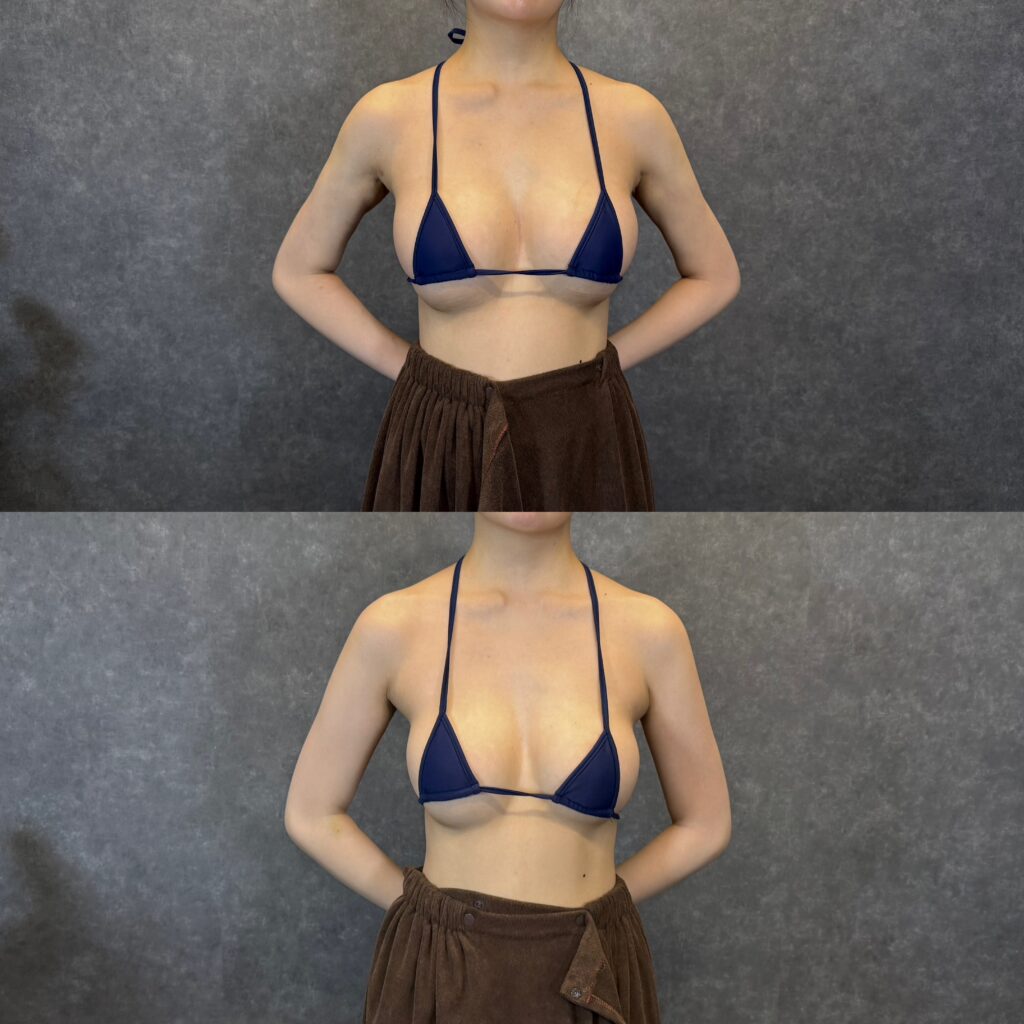
This case is a patient who originally had some breast volume and had favorable conditions for fat retention.
The injected fat volume was:
● Right breast: 230cc
● Left breast: 190cc
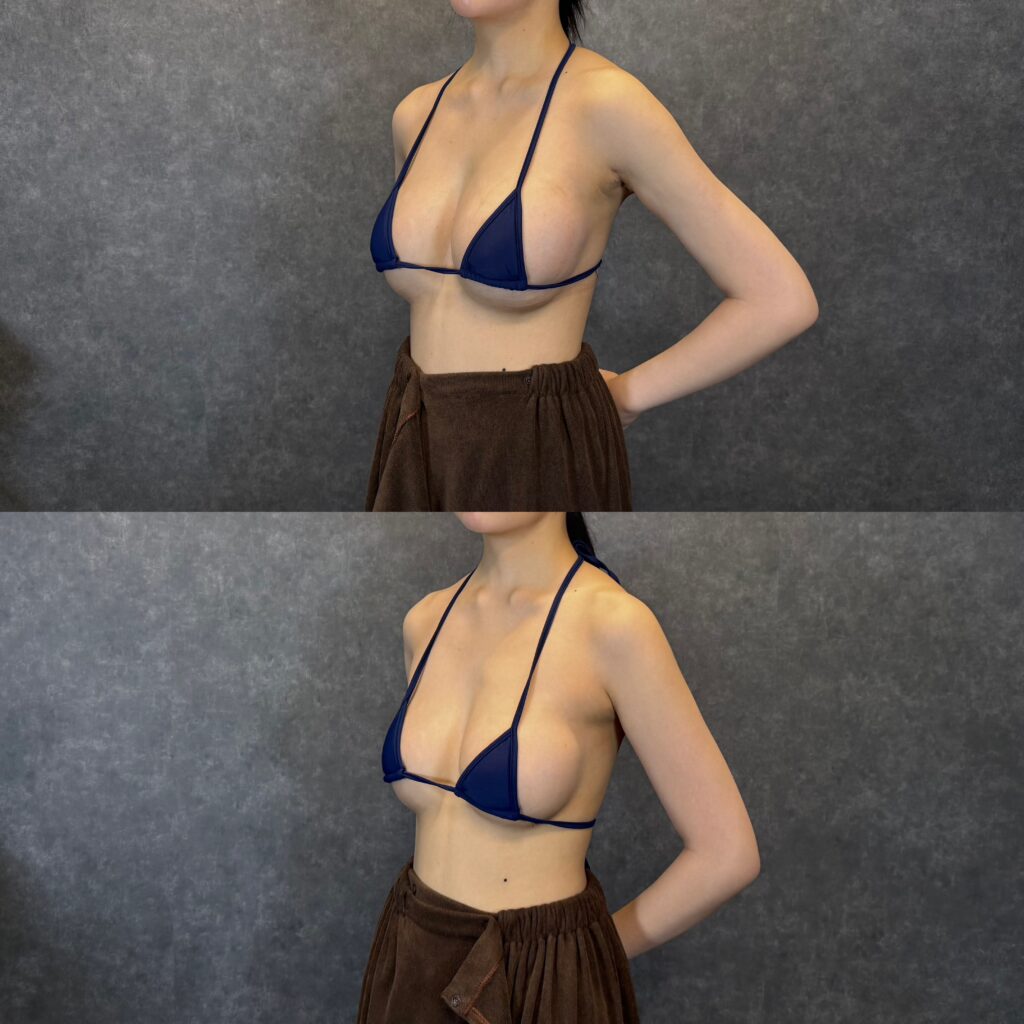
Although the injected volume was not excessive, fat retention was very good, and breast roundness and volume were well maintained.
In this case, we also performed arm liposuction and accessory breast liposuction at the same time.
By improving the heaviness around the arms, armpits, accessory breast area, and outer breast, the appearance of the breast itself can also change.
Rather than simply increasing breast size, we designed a smoother and more refined upper-body line from the arms to the armpits, accessory breast area, and breast.
Benefits of combining accessory breast liposuction
In fat transfer breast augmentation, not only breast volume but also the surrounding contour is important.
If accessory breast tissue or axillary fat remains, the line from the outer breast to the upper arm can look heavy.
By combining accessory breast liposuction, we can aim to:
● Make the armpit area look cleaner
● Improve the outer breast line
● Create a smoother transition to the upper arm
● Make the upper body look more delicate
● Make the breast roundness appear more refined
At AVAN TOKYO, we do not design fat transfer breast augmentation by looking only at the breasts.
We consider the balance of the arms, armpits, accessory breast area, décolletage, waist, and overall upper-body silhouette.
Characteristics of patients who may retain fat well
In fat transfer breast augmentation, some patients tend to retain fat more easily, while others absorb more fat.
Patients who may have better fat retention often have:
● A certain amount of original breast volume
● Stretchable skin
● Good blood flow
● No smoking habit
● No rapid dieting after surgery
● Good nutritional status
● Adequate sleep
● Injection volume that matches breast capacity
However, even when these conditions are present, high fat retention is not guaranteed.
Because fat retention varies between individuals, it is important to understand both the benefits and limitations before surgery.
What AVAN TOKYO focuses on in fat transfer breast augmentation
At AVAN TOKYO, we focus on the following points.
- Avoiding excessive injection
Injecting fat beyond the breast’s capacity can increase the risk of lumps and fat necrosis.
We determine the appropriate volume based on each patient’s breast condition. - Injecting finely into the appropriate layers
For fat to survive, it must be placed where it can receive blood flow from the surrounding tissue.
We adjust the injection layers, such as the subcutaneous layer, around the mammary gland, and intrapectoral layer, depending on the patient’s condition. - Designing the liposuction areas beautifully
In fat transfer breast augmentation, the donor area design is also important.
By contouring areas such as the arms, accessory breast area, abdomen, waist, and thighs, the overall body impression can change. - Supporting postoperative diet and lifestyle management
Fat retention depends on the postoperative environment.
At AVAN TOKYO, we support patients with postoperative nutrition, smoking cessation, weight management, compression care, and follow-up.
Common concerns after fat transfer breast augmentation
How much fat will remain?
Fat retention varies between individuals.
It depends on the injected volume, body type, blood flow, skin stretchability, nutrition, and postoperative lifestyle.
Can I diet after surgery?
Excessive dieting during the early postoperative period is not recommended.
Fat needs nutrition to survive. Especially during the first 4 to 6 weeks, it is important to avoid extreme dieting and focus on nutrient-rich meals.
When can I start medical weight-loss treatment?
Rapid weight loss immediately after fat transfer breast augmentation is not recommended.
The timing should be decided after consultation with a doctor, depending on the patient’s body type, postoperative course, and goal.
Can lumps form after fat transfer breast augmentation?
Yes. Fat necrosis, calcification, and oil cysts may cause palpable lumps.
To reduce the risk of lumps, it is important to avoid over-injection and to distribute fat finely into appropriate layers.
Summary
Fat transfer breast augmentation can create a natural breast enhancement using the patient’s own fat.
However, it is also a delicate procedure because fat retention and the risk of lumps vary between individuals.
To aim for a good result, the following are important:
● Appropriate fat harvesting
● Careful fat processing
● Fine injection into the correct layers
● Avoiding excessive injection
● Postoperative nutrition
● Smoking cessation
● Avoiding rapid weight loss
● Regular follow-up
In this case, 230cc was injected into the right breast and 190cc into the left breast.
By combining fat transfer breast augmentation with arm liposuction and accessory breast liposuction, we aimed to create both breast roundness and a smoother upper-body line.
Fat transfer breast augmentation is a procedure where both surgical precision and postoperative lifestyle help create the final result.
At AVAN TOKYO, we consider each patient’s body shape, fat volume, breast condition, and lifestyle to pursue a natural and beautiful breast line and upper-body balance.
Case Information
Procedures
Fat transfer breast augmentation
Arm liposuction
Accessory breast liposuction
Injected Volume
Right breast: 230cc
Left breast: 190cc
Design Point
We focused not only on breast roundness, but also on creating a smooth line from the arms, armpits, and accessory breast area to the outer breast.
Risks and Complications
Swelling, bruising, pain, fibrosis, firmness, edema, contour irregularities, pigmentation, scarring, infection, hematoma, seroma, asymmetry, sensory changes, numbness, fat necrosis, palpable lumps, calcification, oil cysts, fat absorption, individual differences in fat retention, insufficient breast volume increase, and possible need for revision surgery.
This article is intended for medical education purposes. Results and recovery vary between individuals.