


How Long Is the Recovery After Hybrid Breast Augmentation?2026.07.12
Why It Takes About 3 Months to Feel Natural
Hybrid Breast Augmentation combines the predictable volume of silicone implants with the natural softness of fat grafting. It offers excellent aesthetic results, but because it involves both implant placement and fat transfer, the recovery process is often longer than patients expect.
Many patients worry during the first month because their breasts may still feel tight, firm, or slightly unnatural. In most cases, however, these changes are part of the normal healing process.
This article explains what to expect during recovery and why patience is essential for achieving the best long-term result.
Why Does Recovery Take Longer?
Hybrid Breast Augmentation combines three procedures:
- Silicone implant placement
- Liposuction
- Fat grafting
As a result, both the breasts and the liposuction donor sites must heal simultaneously.
Inside the breast, several healing processes occur at the same time:
- The implant gradually settles into its ideal position.
- The transferred fat develops a new blood supply and survives.
- Swelling and inflammation decrease.
- The surrounding tissue softens.
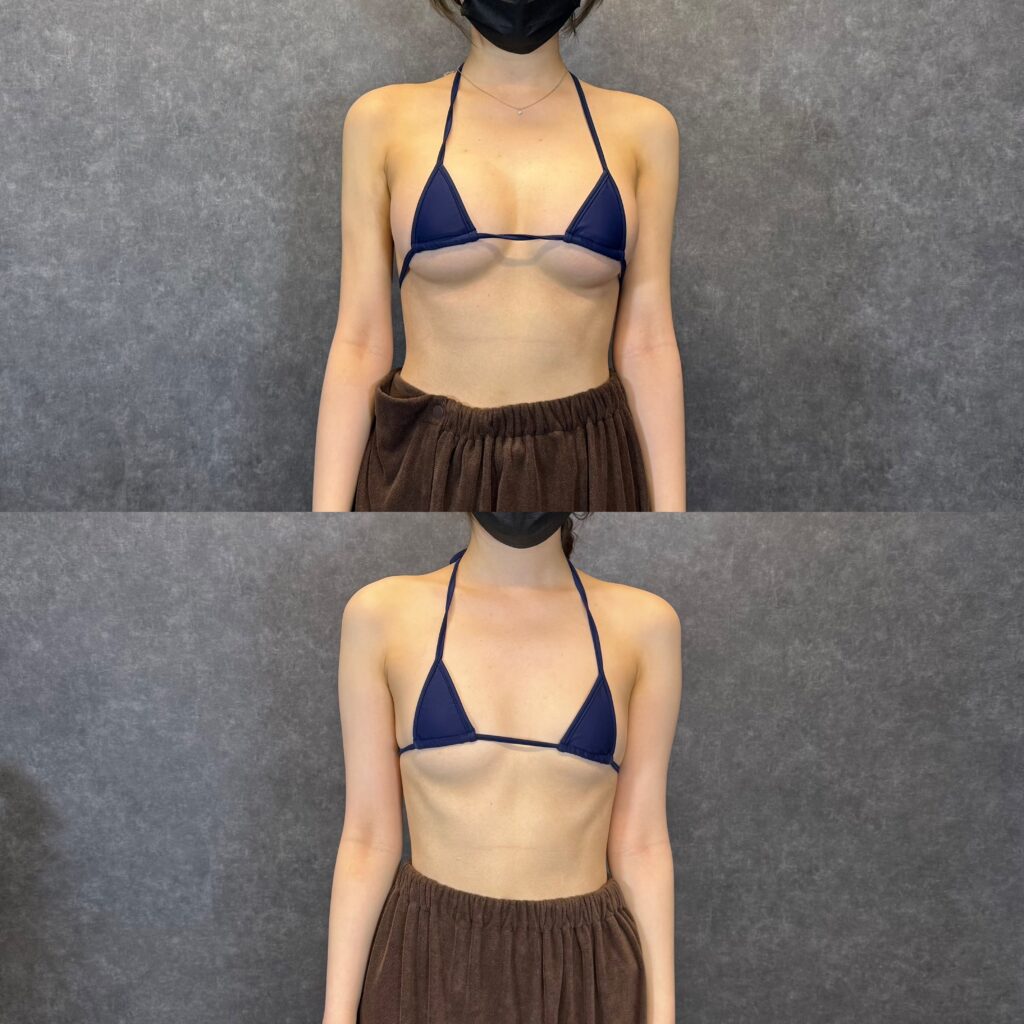
For most patients, the breasts continue to improve over 3–6 months.
What Is Normal at One Month?
Around one month after surgery, patients commonly experience:
- Tightness
- Firmness
- Mild swelling
- A high or “full” appearance
- Slight asymmetry
- An unnatural feeling
These findings are usually temporary.
The implants are still settling, the transferred fat is still stabilizing, and the surrounding tissues continue to heal.
Why Do the Breasts Feel More Natural After Three Months?
Three months is an important milestone because:
The implants settle
The implants gradually move into their final position as the tissues relax.
The fat graft stabilizes
The transferred fat develops a stable blood supply, allowing the surviving fat cells to become established.
The tissues soften
Postoperative swelling and scar tissue gradually improve, resulting in softer, more natural breasts.
For many patients, this is when they begin to truly appreciate their final result.
Recovery Varies Between Individuals
Healing is different for every patient.
Patients with:
- More flexible skin
- Previous pregnancy or breastfeeding
- Naturally larger breasts
may notice a natural appearance sooner.
In the featured case, the patient already felt that her breasts looked natural within approximately one month, with continued improvement by three months.
Lean patients or those with tighter skin may require closer to six months for complete maturation.
Don’t Hesitate to Contact Your Surgeon
Hybrid Breast Augmentation is a major surgical procedure.
It is normal to have questions during recovery.
If you notice persistent concerns or experience significant pain, increasing redness, fever, or unusual swelling, you should contact your surgeon promptly.
Regular follow-up visits are essential to ensure a safe recovery and optimal long-term results.
AVAN TOKYO’s Approach
At AVAN TOKYO, our goal is not simply to enlarge the breasts.
We focus on creating:
- A natural décolletage
- Soft breast contours
- Smooth transitions between the implant and surrounding tissue
- Balanced proportions between the breasts, arms, waist, and upper body
- Beautiful, long-lasting results
We also provide regular postoperative follow-up to support patients throughout the healing process.
Who Is a Good Candidate?
Hybrid Breast Augmentation may be ideal for patients who:
- Want natural-looking breast enhancement
- Desire both volume and softness
- Want simultaneous body contouring with liposuction
- Prefer a balanced upper-body silhouette
- Are willing to allow adequate time for healing
Summary
Recovery after Hybrid Breast Augmentation requires patience.
Although tightness and firmness are common during the first month, many patients begin to notice a more natural appearance around three months, as the implants settle and the transferred fat stabilizes.
At AVAN TOKYO, we focus on comprehensive body contouring—not only enhancing the breasts, but also creating harmony throughout the entire upper body.
Risks and complications: Swelling, bruising, pain, fibrosis, infection, hematoma, seroma, fat necrosis, palpable lumps, fat absorption, capsular contracture, implant displacement, asymmetry, skin tethering, scarring, sensory changes, and the possible need for revision surgery.
This article is intended for medical education purposes. Individual results and recovery vary.