


Does Condensed Rich Fat (CRF) Breast Augmentation Improve Fat Survival? Why Fat Quality Matters2026.07.18
Introduction
“Does Condensed Rich Fat (CRF) breast augmentation provide better fat survival than conventional fat grafting?”
This is one of the most common questions we receive from patients considering fat transfer breast augmentation.
Online, you may find conflicting information. Some sources claim that CRF offers better fat retention, while others suggest there is little difference.
At present, there is no definitive scientific evidence proving that CRF consistently results in higher fat survival than conventional fat grafting.
However, based on our clinical experience, we have often observed that patients treated with CRF appear to maintain breast volume well over time.
This observation reflects our clinical experience rather than a guaranteed outcome, and individual results may vary.
In this article, we explain what CRF is, why fat quality matters, and how AVAN TOKYO approaches fat transfer breast augmentation.
What Is Condensed Rich Fat (CRF)?
CRF is a fat-processing technique that uses centrifugation to remove:
- Blood
- Tumescent fluid
- Excess water
- Damaged fat cells
- Oil and other impurities
The goal is to obtain a cleaner, higher-quality fat graft with a greater proportion of viable fat cells.
CRF is not designed to inject more fat, but rather to inject better-quality fat.
Does CRF Really Improve Fat Survival?
Currently, there is no strong scientific evidence proving that CRF always produces higher fat survival rates.
However, removing unnecessary fluids and damaged tissue may create a more favorable environment for grafted fat.
In our daily practice, we have frequently observed excellent volume retention in patients treated with CRF.
Nevertheless, fat survival depends on many factors—not CRF alone.
Fat Survival Depends on More Than Processing
Successful fat grafting depends on multiple factors, including:
- Gentle fat harvesting
- Fat cell quality
- Processing technique
- Injection technique
- Injection layer
- Blood supply
- Individual healing capacity
Rather than relying on one technique, long-term results are achieved by combining high-quality fat with meticulous surgical technique.
Our Approach at AVAN TOKYO
At AVAN TOKYO, harvested fat is carefully processed using centrifugation to maximize graft quality.
In this featured case, the fat was processed at 800 rpm, allowing us to separate healthy fat cells while removing unnecessary components.
More importantly, we focus not only on processing but also on preserving fat cell viability throughout harvesting, purification, and grafting.
Case Presentation
This patient is a 24-year-old woman who underwent:
- Circumferential upper arm liposuction
- Inner and anterior thigh liposuction
- Condensed Rich Fat (CRF) Breast Augmentation
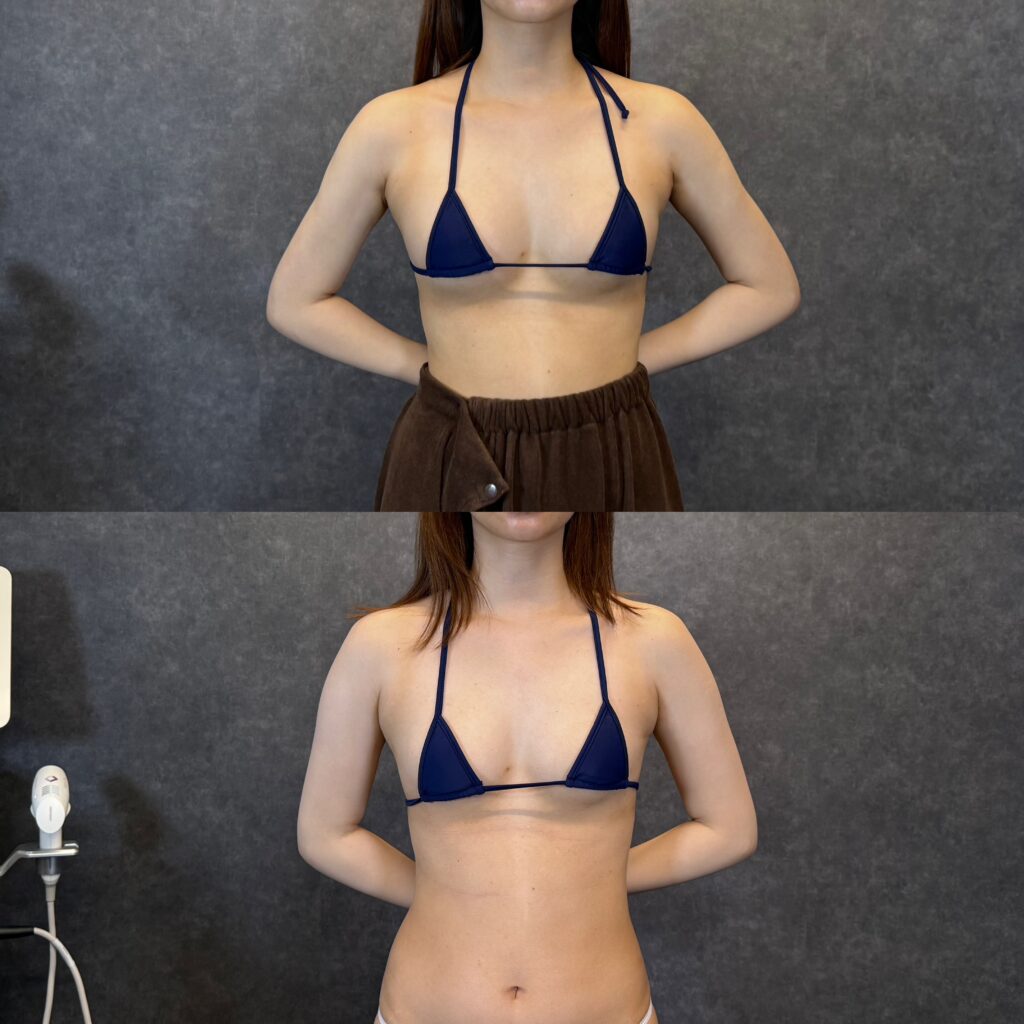
A total of:
- 450 mL of fat was harvested from the upper arms.
- 800 mL was harvested from the thighs.
After centrifugation, 220 mL was injected into the right breast and 200 mL into the left breast.
Although the graft volume was intentionally conservative, fat survival has been excellent, and recovery at one month has been very favorable.
We Don’t Believe “CRF Is Always Better”
At AVAN TOKYO, we do not believe that simply using CRF guarantees superior outcomes.
The final result depends on:
- Fat quality
- Harvesting technique
- Fat processing
- Anatomical injection planning
- Layered micro-fat grafting
Ultimately, successful fat transfer is determined by where the fat is placed, how much is injected into each layer, and why each layer is chosen.
Our Philosophy
Our goal is not simply to increase breast size.
Instead, we carefully design:
- Upper pole fullness
- Cleavage
- Breast symmetry
- Softness
- Long-term fat retention
- Overall body proportions
When appropriate, we may recommend CRF or Hybrid Breast Augmentation to achieve the most natural and balanced result.
Conclusion
CRF is a valuable technique for preparing purified fat before breast augmentation.
Although current evidence does not prove that CRF always produces superior fat survival, our clinical experience suggests that carefully processed, high-quality fat often performs very well.
At AVAN TOKYO, we believe beautiful fat transfer breast augmentation depends not only on the quality of the fat itself, but also on thoughtful surgical planning and anatomy-based injection techniques.
Risks and Potential Complications
Swelling, bruising, pain, infection, fat necrosis, palpable lumps, oil cysts, calcification, asymmetry, partial fat absorption, contour changes, altered sensation, and scarring may occur. Fat survival varies among individuals depending on anatomy, tissue quality, injection volume, and healing response.
Medical Disclaimer
This article is intended for medical education and patient education. Treatment recommendations are individualized following consultation and clinical evaluation.