


Does Fat from the Upper Arms Have Poor Survival in Fat Transfer Breast Augmentation?2026.07.30
The Truth Behind the Myth That “Arm Liposuction Followed by Fat Grafting Is a Waste of Money”
“You shouldn’t use fat from the upper arms for breast augmentation.”
“Only fat from the thighs survives well.”
“Using fat harvested from the arms for breast augmentation is a waste of money.”
These are common claims seen on social media and online forums.
But are they actually true?
The short answer is no.
While the donor site is one factor to consider, the long-term survival of transferred fat depends on far more than where the fat is harvested.
At AVAN TOKYO, the upper arms are actually the most common donor site for patients undergoing fat transfer breast augmentation. With meticulous surgical technique and careful fat handling, we have achieved natural breast volume and stable long-term results in many patients.
In this article, we explain the science behind fat graft survival and why surgical technique matters more than many people realize.
Case Overview
Patient
22-year-old female
Procedures
• Circumferential upper arm liposuction
• Accessory breast liposuction
• Upper and lower back (scapular area) liposuction
• Arm thread lift
• Autologous fat transfer breast augmentation
Surgical Details
• Purified fat harvested: approximately 1,000 mL
• Fat processing: centrifugation at 600 rpm
• Fat injected: 260 mL (right breast), 250 mL (left breast)
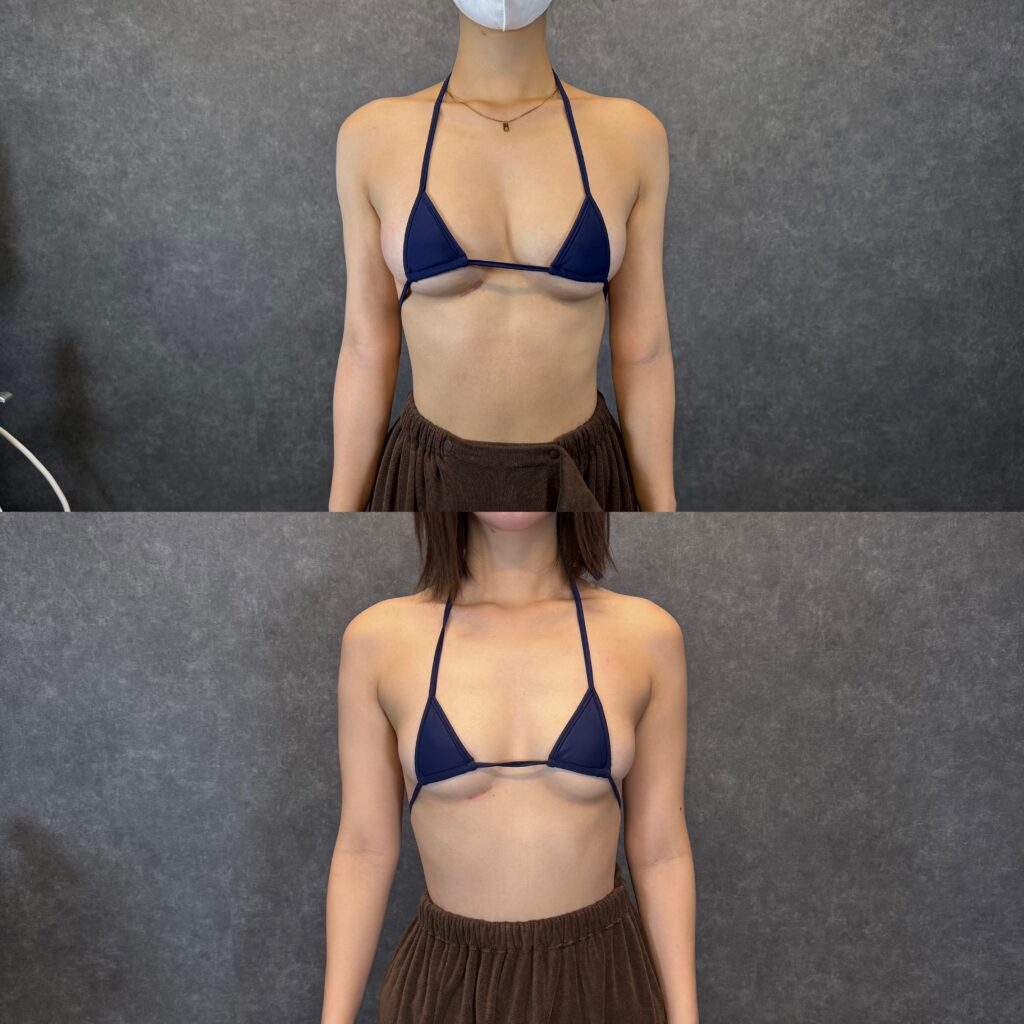
Follow-up
• 6 months after surgery
At six months, the breasts maintained a natural shape, softness, and volume.
At the same time, the upper arms showed a slimmer, smoother contour, demonstrating one of the major advantages of fat transfer breast augmentation: improving two areas of the body with a single procedure.
Is Fat from the Upper Arms Really Less Suitable?
One reason this misconception exists is because scientific studies have reported that adipose-derived stem cell (ADSC) concentrations may be higher in fat harvested from the thighs or abdomen than from the upper arms.
However, this does not mean that fat from the upper arms cannot achieve excellent clinical results.
Fat graft survival depends on many different factors, including:
• The amount of trauma during fat harvesting
• The quality of fat processing
• Injection technique
• Injection volume
• Injection plane
• Blood supply within the recipient breast tissue
• Postoperative care
• Individual patient biology
Simply choosing a donor site with a higher stem cell concentration does not guarantee better fat survival.
The way the fat is harvested, processed, and transplanted is often just as important.
Three Principles We Believe Are Essential for Fat Graft Survival
1. Using High-Quality Purified Fat
Harvested fat is never injected immediately without preparation.
At AVAN TOKYO, we carefully process the harvested fat using optimized centrifugation protocols to remove excess fluid, blood, and damaged tissue while preserving healthy fat cells for transplantation.
Although patients never see this step, it plays an important role in achieving consistent results.
2. Prioritizing Fat Survival Over Injection Volume
More fat does not always produce a better result.
After transplantation, each fat cell depends on oxygen and nutrients supplied by the surrounding tissues until a new blood supply develops.
If excessive amounts of fat are injected into one area, cells in the center may not receive sufficient nutrition, increasing the risk of fat resorption or fat necrosis.
Instead of simply maximizing volume, we distribute carefully planned amounts of fat through multiple anatomical layers.
In many patients, approximately 200–250 mL per breast, strategically injected, can provide beautiful and durable results.
3. Minimizing the Time Between Harvesting and Injection
Fat cells and adipose-derived stem cells gradually lose viability once removed from the body.
For this reason, we minimize the time between fat harvesting, processing, and reinjection whenever possible.
Reducing unnecessary delays helps preserve cellular viability and may contribute to improved graft survival.
Upper Arm Liposuction Offers More Than Just Donor Fat
For many patients, the upper arms are selected not only because they provide donor fat, but also because they improve overall body proportions.
By performing circumferential arm liposuction together with liposuction of the accessory breast and upper back, we can refine:
• The shoulder-to-arm transition
• Bulging around the underarm
• Accessory breast fullness
• Overall upper-body contour
The harvested fat is then used to enhance the breasts.
This allows us to improve both the donor area and the recipient area during a single operation.
At AVAN TOKYO, we view fat transfer breast augmentation as a comprehensive body contouring procedure rather than simply a breast enlargement operation.
Looking Toward the Future of Regenerative Medicine
To further improve fat graft survival, AVAN TOKYO is also preparing to introduce cultured adipose-derived stem cell therapy as part of our regenerative medicine program.
While regenerative medicine continues to evolve and further clinical evidence is still being accumulated, advances in stem cell technology may provide additional opportunities to optimize fat graft survival in carefully selected patients.
As always, we are committed to introducing new technologies responsibly and based on scientific evidence.
Surgeon’s Perspective
Statements such as
“Fat from the upper arms never survives.”
or
“Only thigh fat works.”
are oversimplifications.
Successful fat transfer breast augmentation depends on an entire surgical process:
• Choosing an appropriate donor site
• Gentle fat harvesting
• Careful fat processing
• Precise multilayer injection
• Individualized surgical planning
• Proper postoperative management
At AVAN TOKYO, every fat transfer breast augmentation is customized according to each patient’s anatomy, body proportions, and aesthetic goals.
Our objective is not simply to create larger breasts.
Our goal is to achieve natural, balanced, and long-lasting results that continue to look beautiful six months, one year, and many years after surgery.
This case is published with the patient’s informed consent.
Fat graft survival and surgical outcomes vary among individuals.
This article is intended for patient education and should not replace an individualized consultation with a qualified plastic surgeon.