


How Asians Accumulate Subcutaneous Fat — What Makes It Different from Westerners?2026.05.04
Have you ever wondered why people of similar height and weight can look so completely different in body shape?
Many people notice that even at the same BMI, Asians and Westerners often carry very different silhouettes.
This difference is not simply a matter of “build” or “genetics” in a vague sense — it is a scientifically documented divergence in how subcutaneous fat is distributed across racial groups.
Understanding these biological differences is the essential first step toward addressing body shape concerns at their root.
Why the Same BMI Can Mean Very Different Bodies
BMI (Body Mass Index), calculated as weight (kg) divided by the square of height (m), is the most widely used global standard for assessing obesity.
However, BMI has a critical blind spot: fat distribution patterns differ significantly between racial groups.
Research consistently shows that Asians tend to have a body fat percentage 3–5% higher than Westerners at the same BMI value.
This means that even someone who appears to have a “normal” build may be carrying significantly more body fat internally — a phenomenon often described as “hidden obesity.”
This racial difference is officially recognized by the WHO, which sets the obesity threshold for Asia-Pacific populations at BMI 23 rather than the standard BMI 25.
Asians Tend Toward “Localized” Fat Accumulation
Compared to Westerners, Asians show distinctive patterns in subcutaneous fat distribution.
While Westerners tend to distribute subcutaneous fat relatively evenly across the body, Asians more commonly accumulate fat in concentrated pockets at specific sites — a pattern known as “localized fat accumulation.”
The areas most prone to fat accumulation include:
・Upper arms (the back of the arm / tricep area)
・Abdomen (especially the lower belly and around the navel)
・Thighs (inner and front)
・Hips and waist
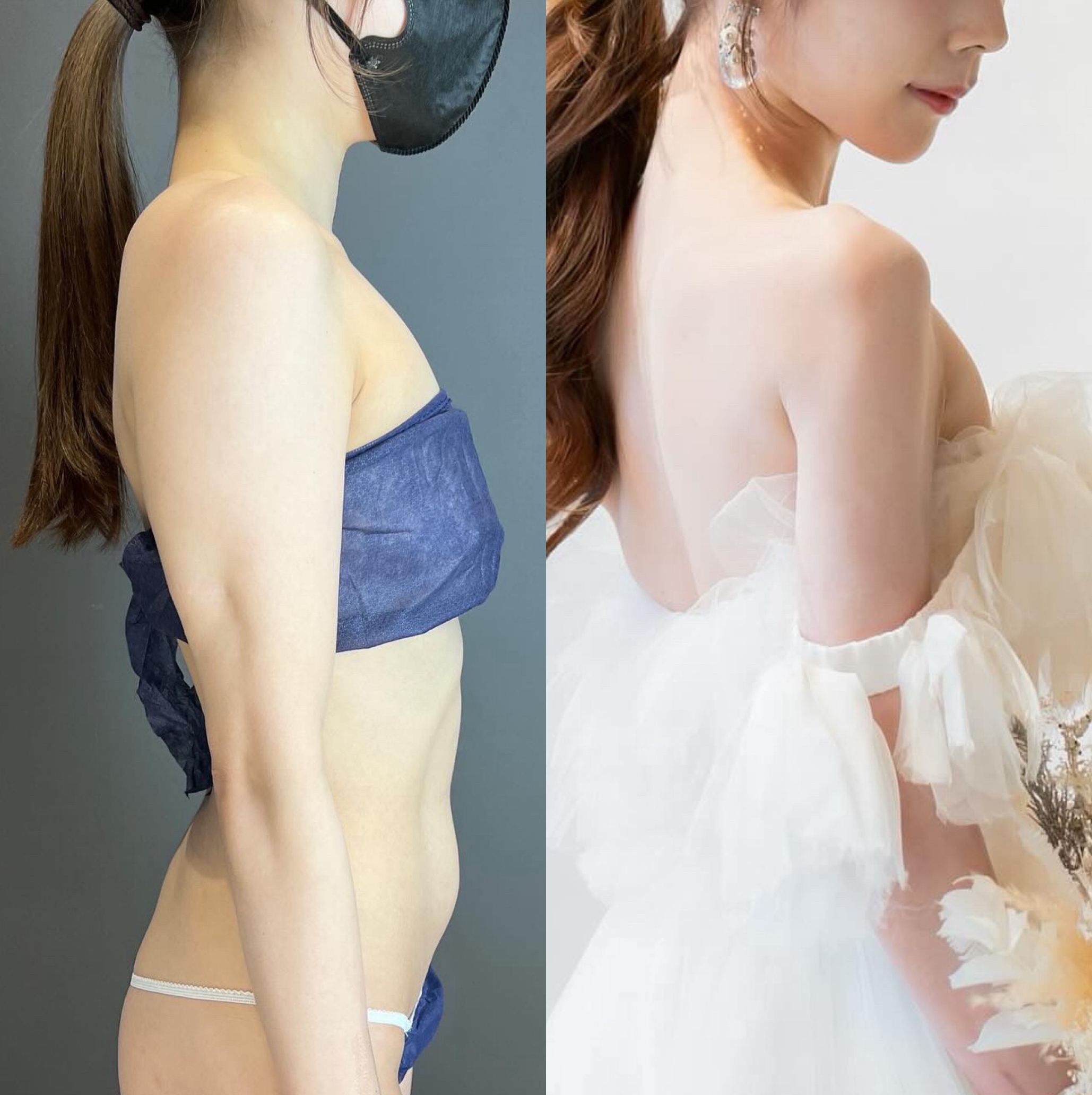
“I’m slim overall, but this one area just won’t change” — this is a uniquely common concern among Asians, and the localized fat distribution pattern is the underlying reason.
Even when overall body weight falls within a healthy range, concentrated fat deposits in specific areas can significantly affect how one’s silhouette appears.
Why Do Asians Accumulate Fat in Specific Areas?
This difference involves a complex interplay of genetic and hormonal factors.
The Role of Estrogen in Subcutaneous Fat
Estrogen, the primary female sex hormone, plays a key role in directing subcutaneous fat to accumulate in specific areas of the body.
It has a particularly strong fat-directing effect toward the abdomen, hips, and inner thighs — and Asian women tend to experience this effect more prominently.
Fluctuations in estrogen levels due to the menstrual cycle and age are reflected in the body as these characteristic localized fat accumulation patterns.
Insulin Sensitivity and Fat Metabolism
Asians tend to have lower insulin sensitivity compared to Westerners, making them more prone to insulin resistance.
Insulin resistance promotes increased fat uptake into fat cells, particularly accelerating fat accumulation in the abdominal area.
This is the biological explanation for why a protruding lower belly or rounded abdomen is more commonly seen in Asians.
Localized Subcutaneous Fat Is Resistant to Diet and Exercise
The localized subcutaneous fat characteristic of Asians tends to be the last to respond, even as overall body fat decreases through diet and exercise.
This is the phenomenon known as “stubborn fat,” caused by an imbalance between alpha receptors (which promote fat storage) and beta receptors (which promote fat breakdown) in fat cells — a ratio that varies significantly by location on the body.
Areas such as the upper arms, lower abdomen, and inner thighs are alpha-receptor dominant, making them highly resistant to conventional weight-loss methods.
Failure to slim a specific area despite overall weight loss is not a willpower problem.
It is a physiological phenomenon rooted in body type and biological structure.
Understanding this fact is the key to choosing an approach that genuinely addresses body shape concerns.
Liposuction Designed for Asian Body Types
For the localized subcutaneous fat patterns characteristic of Asian bodies, liposuction offers a highly effective approach.
The fundamental advantage of liposuction is its ability to physically remove the fat cells in targeted areas that are resistant to change through diet or exercise alone.
At AVAN TOKYO, our surgeons have deep expertise in Asian-specific fat distribution patterns and fascial lines.
Treatment is designed from three angles — front, side, and back — creating a three-dimensional sculpt that goes beyond simply reducing volume to create proportions that beautifully complement Asian skeletal structure.
Because our approach begins with a thorough understanding of body type at a biological level, we are able to offer genuine, lasting solutions to the body shape concerns that diet alone simply cannot resolve.
📍AVAN TOKYO Ginza Liposuction Clinic
AVAN TOKYO GINZA LIPOSUCTION CLINIC
English / 中文 / Tiếng Việt Available
For reservations and consultations:
DM / LINE / Website / Phone