


Why a Waistline Can’t Be Sculpted by Flank Suction Alone | A Doctor Explains the Composite Design of Waist Liposuction and the Lower Back2026.07.17
When patients tell us “I want a slimmer waist,” most immediately picture the fat on the flanks (the sides of the abdomen). But to truly sculpt a beautiful curve with waist liposuction, treating the flanks alone is not enough. Unless the flanks, the lower back, and the area above the iliac crest are designed as one continuous curved surface, the result will not satisfy from the front, from the side, or from behind. In this column, Dr. Moriwaki explains why the waist must be treated as a “surface” rather than a “point,” along with the anatomical basis and the composite design approach used at AVAN TOKYO.
Key Points of This Article
– Waist liposuction requires a composite design connecting the flanks, the lower back, and the area above the iliac crest — not the flanks alone.
– The “lumbar dimple” seen from behind is created by treating the fat over the lower back and just above the iliac crest.
– The flanks and back share a continuous fascia, so uneven suction volumes are what create step-off deformities.
– The pelvis and rib cage cannot be moved, so a “subtractive” design that follows the underlying skeleton is essential.
– Splitting suction volume between the superficial and deep layers is what prevents post-contracture irregularities.
A Waist Is a 360-Degree Volume, Not a 2D Silhouette
Judging the waist only from a two-dimensional photograph puts all the emphasis on the front-view distance between the ribs and the pelvis. But the body is a three-dimensional cylinder: the concavity seen from the side, the lumbar dimple from behind, and the S-curve at a 45-degree angle all contribute to the perceived waistline. Narrowing only the flanks often leaves the boundary between the back and the lower back blurred from behind, or leaves residual volume at the lumbosacral transition (where the lower back meets the pelvis) when viewed from the side. A waist is a body line that only holds up when it works from every angle around the torso.
The Anatomical Reason Waist Liposuction Fails When Only the Flanks Are Treated
The subcutaneous fat over the flanks is seamlessly continuous with both the abdomen (the front of the rectus abdominis and external oblique) and the lower back (lateral to the latissimus dorsi and erector spinae). The two zones are connected by a large fascial sheet called the thoracolumbar fascia, and the fat layer runs along its fibers from front to back. So if only the flanks are suctioned, the adjacent lower back fat looks relatively swollen, and a step-off tends to appear at the border. To finish waist liposuction as a genuine curve, one must understand this fascial continuity and smoothly connect the abdominal side, the flanks, and the back at the same depth and same density.
Suctioning the Lower Back Is What Creates the Rear-View Curve
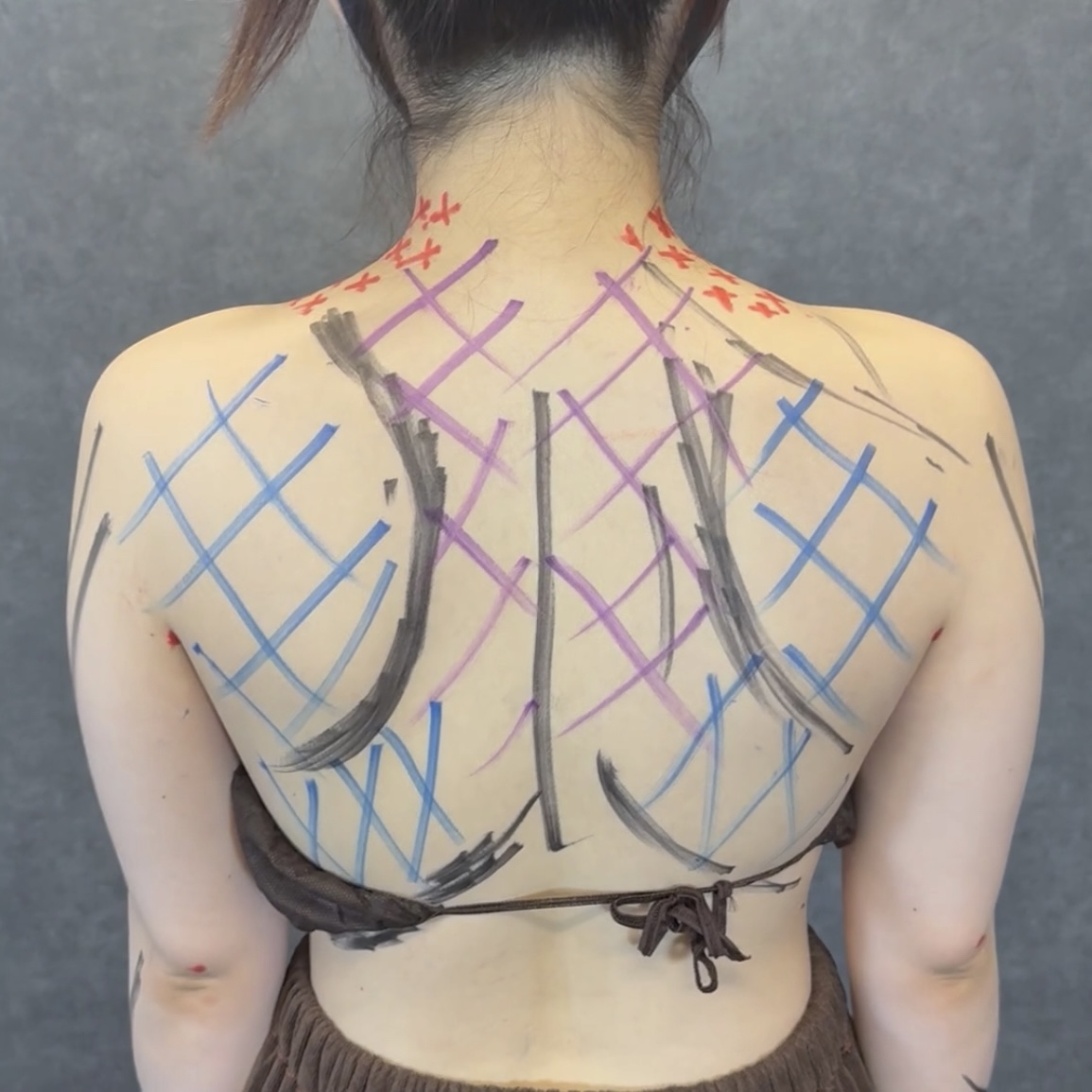
What most influences the impression from behind is the “lumbar dimple” just above the iliac crest and the “dimples of Venus” (the lumbosacral depressions) on either side. Both become clearer when the superficial fat over the lower back is carefully controlled. On the other hand, over-suctioning the deep layer makes the lumbar musculature too prominent and gives a masculine impression, so the balance of depth and volume decides the final look. To “finish the rear view too,” the lower back must be evaluated as a separate unit, with fat tapered smoothly toward the bony line above the iliac crest.
The Pelvis and Ribs Set the Design Ceiling
The upper limit of the waist is set by the lower margin of ribs 10–12, and the lower limit is set by the iliac crest. Patients with a short distance between these bones (a “short-torso” build) have a limited vertical range to sculpt, and overzealous suction can create a “crammed” look where the ribs and iliac appear to press together. Patients with a longer torso, on the other hand, have more freedom to move the position of the narrowest point up or down and can tailor the design to their lifestyle and preferred silhouette. Rather than “taking the maximum possible,” stacking subtractive decisions that follow the skeleton is the shortest path to a good result. For safety standards in aesthetic surgery, please also refer to the Japan Society of Aesthetic Surgery.
The True Cause of “Step-Offs” Seen in Waist Liposuction
Step-offs arise less from “not enough tissue removed” and more from “different volumes removed between adjacent zones.” For example, aggressive suction on the flanks and conservative suction on the back will leave a ridge-like step-off along the border. Slim patients in particular, whose subcutaneous fat is already thin, tend to see even a small volume difference amplified into a visible step, so the superficial layer must be treated with extreme caution while the deep layer is kept continuous. At AVAN TOKYO we combine energy devices with small-caliber cannulas, giving each layer a distinct role — the superficial layer “smooths the surface” while the deep layer “reduces the volume” — as we perform waist liposuction.
For more on postoperative course and site-specific design principles, please see our liposuction column archive here.
Frequently Asked Questions
Q. Can waist liposuction alone give me an ideal curve?
The depth of a waist is determined by more than fat: the distance between the ribs and the pelvis, the curvature of the spine, and posture all play a role. Narrowing the width at the “narrowest point” is possible, but a skeletal ceiling remains. During consultation we evaluate the underlying skeleton and explain the line that is realistically achievable.
Q. Can I have only the flanks treated?
Medically it is possible, but because a step-off tends to form at the border with the lower back, we recommend a composite design that treats the flanks, the lower back, and the area above the iliac crest as a single unit rather than the flanks alone. Correcting a step-off is harder than the primary procedure, so creating a continuous surface at the first surgery is the best strategy.
Q. How long is the downtime?
Swelling and bruising typically last around 2 weeks, contracture-related firmness continues for 1–3 months, and the final result appears at 3–6 months. Including the lower back extends downtime somewhat, but the fact that the rear view is also refined means most patients find it worthwhile.
Q. Do I get more scars when the back is included in the design?
Access sites are just millimeter-sized punctate incisions, and on the lower back they are placed where underwear will cover them. Scars fade over several months and typically settle as inconspicuous punctate marks. Individual variation exists; when residual pigmentation is prolonged, laser and topical vitamin C are options.
Q. Can I have this if I’ve had abdominal liposuction before?
Yes, but the state of scar tissue and the amount of residual subcutaneous fat need to be assessed. We generally require at least six months since the prior operation and confirmation that contracture has settled, and then proceed cautiously with a revision-oriented approach.
──────────────
[Medical Supervision] Shin Moriwaki, MD (Supervising Physician)
Member, Japan Society of Aesthetic Surgery (JSAS) / Member, American Academy of Aesthetic Medicine
ECFMG Certificate
──────────────
📍AVAN TOKYO GINZA LIPOSUCTION CLINIC
English / 中文 / Tiếng Việt available
Appointments and consultations are accepted via
DM / LINE / Website / Phone.