


How Cover Fat Grafting Changes Over Time | Why Implant Contour Reappears — Explained by a Doctor2026.07.15
Cover fat grafting is the technique used to soften the outline of a silicone breast implant, giving the décolletage a natural, gently sloped appearance immediately after surgery. However, cover fat grafting evolves over the years, and several years later some patients notice that the implant edge starts to show through again. In this article, Dr. Moriwaki of AVAN TOKYO Ginza Liposuction Clinic explains why, from the perspectives of histology, blood supply, and skin aging.
Key Takeaways
・Cover fat grafting layers autologous fat above the silicone implant to blend its outline naturally.
・A portion of the grafted fat is gradually resorbed or atrophies, and the border with the capsule may become visible.
・Weight loss, aging, hormonal changes, smoking, and chronic compression are the main drivers of volume loss.
・When the outline reappears, options include additional fat grafting, redesign of the tissue layers, or converting to hybrid breast augmentation.
・Cover fat grafting is not a permanent, unchanging structure — it requires long-term maintenance.
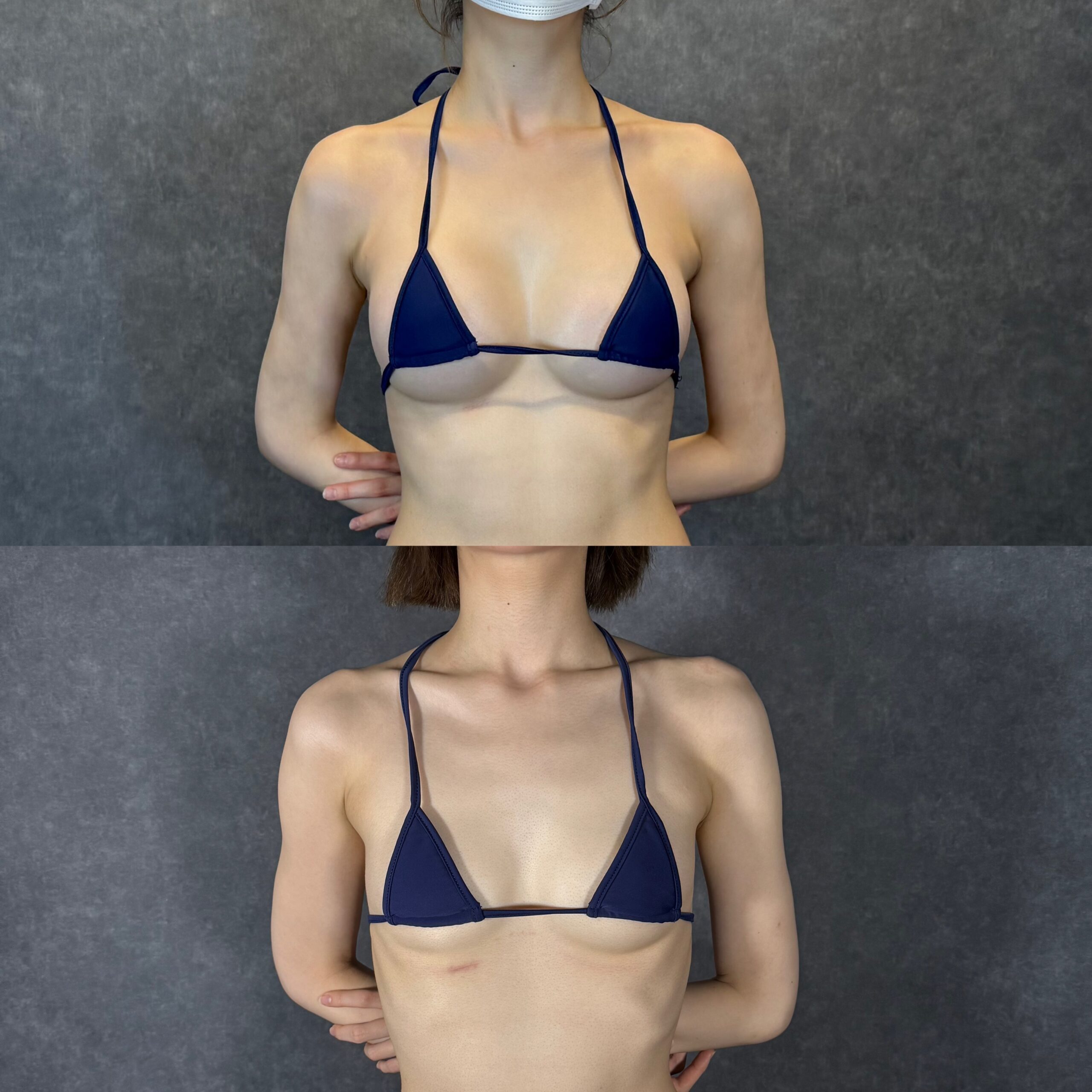
What Is Cover Fat Grafting? Layer Design to Hide the Implant Edge
In slim patients or those with a thin subcutaneous layer, silicone implants can create a visible edge and a “baseball breast” appearance. Cover fat grafting places autologous fat above the implant — either between skin and pectoralis or in the superficial subcutis — to build a smooth gradient. Layered injections along the upper décolletage, lateral breast, and cleavage visually erase the boundary between implant and native tissue, producing a softer, more natural silhouette. For slim patients or those with a flat décolletage, this step often defines the aesthetic result.
The Three Phases of Long-Term Change
1. Take (0–6 months)
Right after grafting, capillary networks rebuild and “circulatory re-establishment” occurs between grafted fat and host tissue. Cells that do not receive oxygen and nutrition are resorbed; the surviving volume is largely fixed by month 6. Take rates are typically reported at 50–70%, and slim patients — whose recipient tissue offers less vascular supply — often sit slightly lower.
2. Stable Phase (6 months – 3 years)
Surviving adipocytes maintain their size and form a stable layer over the capsule. The contour looks most natural, and the aesthetic result is at its best. This is the period when the benefits of cover fat grafting are most visible.
3. Atrophic Phase (after 3 years)
Age-related fat loss, hormonal shifts, weight loss, and chronic compression (e.g., tight underwire bras) accumulate, and adipocyte size begins to shrink. As a result, the implant outline gradually shows through again.
Why the Implant Contour Reappears | Three Mechanisms
Mechanism 1: Reduction in adipocyte size
Adipocytes maintain volume by cell size, not cell number. When total body fat decreases, grafted adipocytes shrink alongside, and the capsule’s irregularities become visible. Rapid weight loss makes this especially prominent.
Mechanism 2: Capsular tension change
A thin capsule naturally forms around the implant. Over time, microscopic hardening and contraction can make the outline more distinct. This is a mild capsular contraction — often Baker grade I–II — and usually does not require treatment.
Mechanism 3: Skin laxity and dermal thinning
Dermal collagen and elastin fibers decrease with age. As the skin thins, the irregularities of the underlying fat layer show through more readily, and the outline becomes visually more apparent. Sun exposure, smoking, and poor nutrition accelerate this process.
How to Make Cover Fat Grafting Last
1. Avoid rapid weight loss: postoperative weight drops of more than 5 kg significantly increase the risk of atrophy.
2. Adequate protein intake: healthy surrounding tissue is essential for adipocyte survival; roughly 1.2 g per kg body weight per day is recommended.
3. Strict smoking cessation: nicotine constricts peripheral vessels and impairs nutrient supply. At least one year of abstinence after surgery is ideal.
4. Avoid chronic compression: prolonged wear of underwire bras places continuous pressure on the fat layer, which may accelerate atrophy.
5. Regular follow-up: schedule medical checks at 3, 5, and 10 years to detect changes in the capsule and contour early.
Options When the Contour Becomes Visible Again
If, after several years, you feel that the implant edge is showing, the following options are available.
・Additional fat grafting: harvest fat from the thighs or abdomen and add small, layered volumes to the atrophic areas. Downtime is light and the procedure is relatively short.
・Layer redesign: reassess the boundary between capsule and subcutaneous tissue, and rebuild the fat layer in a deeper plane for better long-term contour protection.
・Conversion to hybrid breast augmentation: remove the implant, treat the capsule, and simultaneously perform large-volume fat grafting and implant exchange for a comprehensive reconstruction.
For international safety standards in aesthetic surgery, please also refer to the Japan Society of Aesthetic Surgery. More related articles are available on our liposuction column list.
Frequently Asked Questions
Q. How long does cover fat grafting last?
Individual variation is significant, but surviving adipocytes essentially remain for life. However, because their size changes with total body fat and hormones, most patients notice visible changes around the 5- to 10-year mark. Regular follow-up is recommended.
Q. Can I have additional cover fat grafting alone?
Yes. A stand-alone fat grafting procedure without implant exchange is possible. The volume and layer are designed based on the degree and location of atrophy. Downtime is relatively short, minimizing the burden on daily life.
Q. As a slim patient, will cover fat grafting be less effective for me?
Slim patients have limited donor fat, so the effect of a single session tends to be modest. However, planning multiple staged sessions allows even slim patients to achieve satisfactory contour improvement.
Q. Isn’t there a high risk of nodules or calcification?
Cover fat grafting is performed in small, layered doses, so the risk of nodules and calcifications — which typically arise from bulk injection — is relatively low. The risk is not zero, so procedure by an experienced surgeon is essential.
Q. If the contour becomes visible over time, will I always need revision surgery?
Not necessarily. Mild changes can often be observed or managed with adjunctive treatments such as hyaluronic acid. If you notice concerning changes, please consult your surgeon first to discuss the best timing together.
──────────────
Supervising Physician: Shin Moriwaki, M.D.
Member, Japan Society of Aesthetic Surgery (JSAS) / Member, American Academy of Aesthetic Medicine
ECFMG Certificate
──────────────
📍AVAN TOKYO GINZA LIPOSUCTION CLINIC
English / 中文 / Tiếng Việt supported
Reservations and consultations available via
DM / LINE / Website / Phone.