


How Hybrid Breast Augmentation Creates Cleavage in Rib Flare Patients — A Physician Explains the Design Strategy2026.07.05
Some patients feel that even after breast augmentation, cleavage never quite looks the way they wanted or the breasts sit too far apart. One important reason lies in the shape of the rib cage. In particular, patients with prominent lower ribs — a body type known as “rib flare” — often cannot close the central gap with silicone implants alone, and hybrid breast augmentation becomes a highly effective option. In this article, Dr. Shin Moriwaki of AVAN TOKYO GINZA LIPOSUCTION CLINIC explains, from an anatomical standpoint, how rib flare relates to cleavage formation and why hybrid breast augmentation is often the key.
Key Points of This Article
・Rib flare is an anatomical feature where the lower ribs (8th–10th) protrude anteriorly and outward
・Prominent rib flare makes the anterior chest convex, so the breasts sit apart and cleavage is harder to create
・Silicone implants alone cannot physically fill the bony gap over the sternum
・Hybrid breast augmentation layers fat over the sternum and medial décolleté so implants can be complemented to form natural cleavage
・Preoperative rib-cage shape and posture assessment strongly determine outcomes in rib flare cases
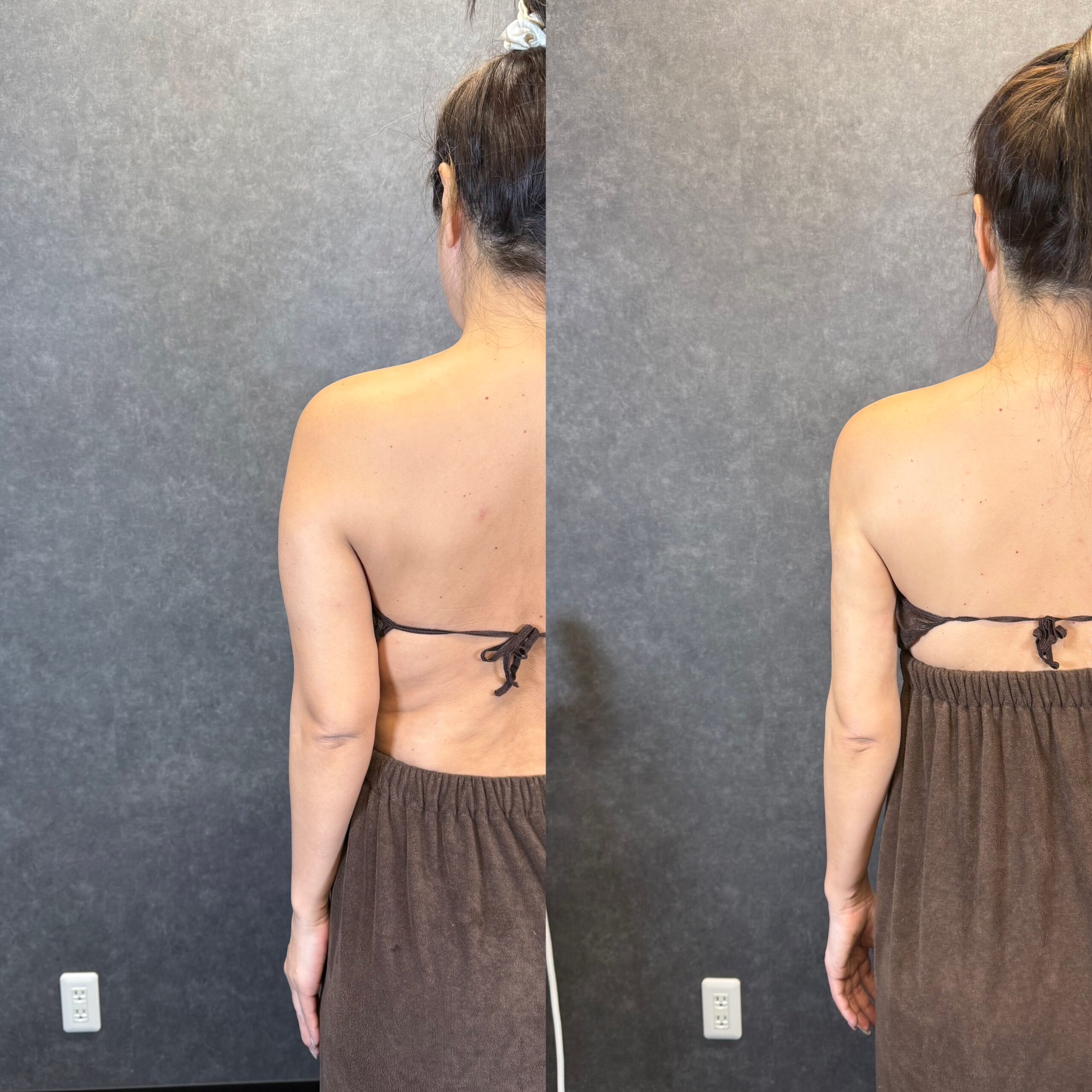
What Is Rib Flare (Anterior Rib Cage Protrusion)?
Rib flare is an anatomical feature in which the lower ribs — especially the 8th to 10th — protrude anteriorly and outward. Some patients have this as a constitutional skeletal trait, while in others it becomes prominent after prolonged lumbar hyperlordosis (swayback), a chronically expanded chest posture, or a shallow chest-based breathing pattern.
Clinically, we assess how far the lower rib margin rises above the horizontal plane in the supine position, and palpate for the protrusion of the xiphoid process and lower ribs in standing. When patients consult us for breast augmentation, we always inspect this rib-cage shape before drafting a surgical plan.
Why Rib Flare Makes Cleavage Difficult
Normally, the sternum sits slightly recessed at the center of the chest, and this central valley is what allows the two breasts to draw toward the middle and form what we call cleavage. In patients with prominent rib flare, however, the costal cartilages on either side of the sternum project anteriorly, so the entire anterior chest becomes a convex, dome-like shape.
In that setting, the chest wall that supports the breasts is a “roof” that opens outward, and the physical tendency for the breasts to converge medially is weakened. As a result, no matter how much breast volume is added, the two breasts do not meet at midline, and cleavage looks distant — a distinctive proportion of this body type.
The Central Gap That Silicone Implants Alone Cannot Fill
In a rib flare case treated with silicone implants alone, the implant is placed in a submuscular or subglandular pocket, but the implant itself cannot physically fill the bony gap over the sternum. Forcing the implants too close to midline raises the risk of a serious complication called symmastia, where both pockets merge across the sternum.
As a result, when clinicians try to build cleavage with implants alone in rib flare patients, an impression of “the chest still looks split down the middle” often remains post-op, and patient satisfaction lags behind.
The Central-Zone Design That Only Hybrid Breast Augmentation Can Deliver
This is where hybrid breast augmentation becomes effective. It is a combined procedure in which silicone implants create the base volume and fat grafting is layered on top for coverage and fine adjustment. For rib flare cases, the following design is effective.
First, we choose a naturally sized round or anatomical implant and place it under the pectoralis major without forcing it toward the midline — an implant pocket that stays within a safe zone is essential. Next, fat is grafted in small, multi-layered aliquots over the sternum and medial décolleté, between the superficial fascia and dermis. This softens the convex contour created by rib flare, generates natural shadows and a subtle indentation both visually and to touch, and yields a genuine cleavage line.
This layered grafting is not a simple volume addition — it is a form of sculpting that controls light and shadow across the central chest.
Posture Assessment and Skeletal Typing
Rib flare is not merely a skeletal trait — it is closely tied to postural habits. Swayback, a forward-leaning posture, and chronic thoracic-dominant breathing are common backgrounds, and all of these influence how the breasts look after surgery. In our preoperative consultation, we examine rib-cage shape and postural habits in three positions: standing, seated, and supine.
Depending on the severity of rib flare, combining postoperative posture correction and breathing training can preserve the aesthetic result of hybrid breast augmentation for longer. For information on safety standards and indications in aesthetic surgery, please also refer to the Japan Society of Aesthetic Surgery.
How to Judge Candidacy for Hybrid Breast Augmentation
Not every patient with rib flare will follow the same design. If the pinch test shows less than 1 cm of subcutaneous fat over the medial décolleté and the patient is very slim with little available donor fat, we first need to assess the volume in donor sites such as the upper arm, abdomen, thigh, or flank. Smokers, patients with severe anemia, or poorly controlled diabetes require careful judgment, as fat graft take is reduced.
Conversely, patients with a standard body type, mild-to-moderate rib flare, and sufficient donor fat are strong candidates for a natural, three-dimensional breast line through hybrid breast augmentation.
Frequently Asked Questions
Q. Can I check for rib flare on my own?
Lying on your back, you can get a rough impression by seeing how much the lower rib margins on either side of the epigastrium rise toward the ceiling. Accurate assessment, however, requires a clinical exam and imaging.
Q. If I have rib flare, should I avoid silicone implants alone?
Not necessarily. Mild rib flare can still produce a good result with implants alone. But when strong cleavage is desired, or when rib flare is moderate or more severe, hybrid breast augmentation is worth considering.
Q. Where is the fat harvested from?
We choose the most suitable donor site based on the patient’s body type — upper arms, abdomen, thighs, or flanks. A major advantage is that body contour is refined at the same time as the breasts.
Q. Is downtime longer in rib flare cases?
It is not significantly different from a standard case. However, to maximize fat graft take, we ask patients to avoid strong compression on the chest for one month after surgery and to attend carefully to posture and nutrition.
Q. Is there a surgery that directly corrects rib flare?
Rib remodeling surgery is an option, but its risks and indications are limited. Most patients achieve a highly satisfactory result through the visual shadow design of hybrid breast augmentation alone.
For more articles on liposuction and breast augmentation, please see our liposuction column index.
──────────────
Medical Supervisor: Shin Moriwaki, MD
Member, Japan Society of Aesthetic Surgery (JSAS)
Member, American Academy of Aesthetic Medicine
ECFMG Certificate
──────────────
📍AVAN TOKYO GINZA LIPOSUCTION CLINIC
English / 中文 / Tiếng Việt available
Reservations and consultations:
DM / LINE / Website / Phone