


Is Laser Liposuction (SmartLipo Type) Really Effective for Sagging Skin? The Limits of Thermal Coagulation and Skin Retraction Explained by a Doctor2026.07.12
“With laser liposuction, sagging skin will tighten at the same time” — patients concerned about loose skin often become interested when they hear this kind of explanation. In fact, laser liposuction represented by SmartLipo and SmartLipo Triplex is a technique whose concept is to melt fat with laser heat while transmitting energy to the deep dermis to trigger collagen re-contraction. However, there are many misconceptions about “how far laser liposuction can actually treat sagging,” and this is an area where the gap between expectation and reality easily emerges. In this column, Dr. Moriwaki of AVAN TOKYO explains the thermal coagulation mechanism and the limits of skin retraction achieved by laser liposuction, comparing it with other energy devices (VASER, Aqualyx-type, PAL).
Key Points of This Article
・Laser liposuction (SmartLipo type) is a technique that destroys fat cell membranes with laser heat while simultaneously targeting collagen contraction in the deep dermis.
・The skin tightening effect is most reliable in “mild to moderate sagging,” but it cannot replace excisional lift surgery for severe skin laxity.
・Because the method relies on thermal coagulation, excessive heat delivery increases the risk of complications such as burns, contour irregularities, and strong contracture.
・For large-volume, wide-area removal, VASER / Aqualyx-type / PAL are often more suitable, while laser liposuction shows its true value in “small-area cases with concurrent mild sagging.”
・When skin excess is prominent, combining excisional lift or radiofrequency tightening (BodyFX, Morpheus8) becomes the realistic solution.
What Is Laser Liposuction (SmartLipo Type)?
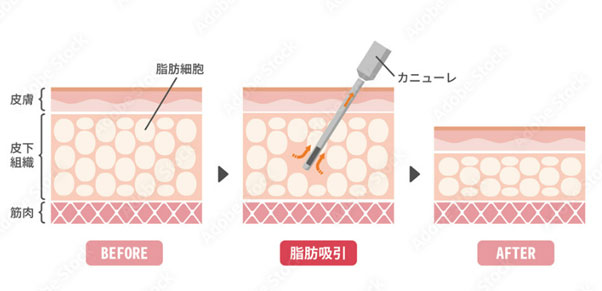
Laser liposuction is a technique that inserts a thin laser fiber (Nd:YAG type at wavelengths such as 1064nm, 1320nm, or 1440nm) subcutaneously, applies heat selectively to fat cells to liquefy the fat, and then aspirates it through a fine cannula. Representative devices include SmartLipo (Cynosure) and SmartLipo Triplex, and some clinics in Japan have introduced them.
Compared to conventional “mechanical aspiration,” the biggest selling point of laser liposuction is “skin tightening by heat.” The 1440nm wavelength is strongly absorbed by water, so heat is efficiently transferred to collagen fibers, and the reticular collagen in the deep dermis denatures and contracts, working toward postoperative skin tightening. This phenomenon is called the “thermal tightening effect.”
Mechanism of Thermal Coagulation and Skin Retraction — How Much Can We Expect?
Collagen fibers undergo instant contraction as their triple helix structure unwinds at around 60–65°C, and fibroblasts subsequently produce new type I and III collagen during wound healing. This is the scientific basis for the “tightening” effect of laser liposuction.
However, because this contraction is proportional to the amount of heat reaching the deep dermis, it works well in younger patients with thick, elastic skin, while the effect plateaus in patients over their late 40s with thinner dermis and reduced elastic fibers. Reported literature also shows that the skin surface area reduction from laser liposuction averages only about 10–17% at 6 months postoperatively — meaning it does not truly substitute for an excisional lift.
Ideal and Non-Ideal Cases for Laser Liposuction
Ideal cases
・Small areas such as upper arms, knees, or submental region with concurrent “mild to moderate skin sagging”
・Patients in their 30s to early 40s who still have sufficient skin elasticity
・Cases where excisional lift is excessive, but standard liposuction alone leaves concerns about tightening
Non-ideal cases
・Wide-area liposuction (whole abdomen, whole circumference of thighs) where aspiration exceeds 2,000mL
・Cases with clearly severe skin excess where excisional lift is indicated
・Highly fibrotic areas (male abdomen, history of repeated weight fluctuation)
For cases requiring rapid treatment of large areas, laser liposuction incurs additional time cost for heat delivery and, on the contrary, increases burn risk. In such cases, VASER, Aqualyx-type, and PAL — which selectively fragment fat with mechanical vibration — are more rational choices because they can remove large volumes uniformly and safely.
Complication Risks — Pitfalls Unique to a Heat-Dependent Technique
Complications specific to laser liposuction include:
・Skin burns (second-degree burns from heat leakage to the superficial layer)
・Excessive fibrosis and strong contracture (by-products of thermal coagulation)
・Contour irregularities (combination of uneven fat lysis and over-aspiration)
・Prolonged pigmentation (post-inflammatory hyperpigmentation after thermal damage)
Especially in Japanese and other Asian patients with thin skin, if the surgeon does not strictly control laser output and treatment time, heat can accumulate in the dermis, and the result — intended to tighten — can actually leave irregular contours or strong contracture. For safety standards in aesthetic surgery, please also refer to the Japan Society of Aesthetic Surgery (JSAS) when choosing a facility and surgeon.
AVAN TOKYO’s Approach — “Do Not Rely Only on the Aspiration Device for Tightening”
At AVAN TOKYO, we do not recommend laser liposuction alone as “sagging skin treatment.” The reason is that the thermal contraction effect of the laser is limited, and it is difficult to control patient expectations.
Instead, we recommend the following combined design strategies:
・Mild sagging: liposuction + Morpheus8 Burst radiofrequency tightening
・Moderate sagging: liposuction + InMode BodyFX (bipolar RF targeting deep dermis and subcutaneous tissue)
・Severe sagging: excisional lift (brachioplasty, mastopexy, etc.)
Rather than relying on laser liposuction, which “heats up to the dermis during aspiration,” we believe that separating roles — “aspiration with aspiration technique, tightening with a dedicated device” — allows us to minimize burn risk while maximizing the tightening effect.
Summary
Laser liposuction (SmartLipo type) is a rational option for small-area cases with concurrent mild to moderate sagging, but the skin retraction effect tops out at around 10–17% and cannot substitute for excisional lift surgery. For wide-area liposuction, VASER, Aqualyx-type, and PAL are the first-line choices, and for cases with severe sagging, combining a dedicated tightening device or excisional lift is the realistic solution. Before choosing laser liposuction just because “you are worried about sagging,” please consult an experienced surgeon about the optimal combination based on your skin elasticity, fat volume, and lifestyle.
Related liposuction columns are available at our liposuction column list.
Frequently Asked Questions
Q. Can laser liposuction alone completely correct sagging?
Only for mild to moderate sagging with preserved skin elasticity can we expect partial tightening. Since skin surface reduction is only about 10–17% on average, when clear skin excess is present, combining excisional lift or radiofrequency tightening becomes the realistic option.
Q. Which is better, SmartLipo or VASER liposuction?
It is not about superiority but about indication. Laser liposuction offers certain benefits when small-area work is combined with mild sagging, but for cases requiring wide-area and large-volume removal, VASER can process the fat more uniformly and safely, and the quality of contracture is also easier to control.
Q. Is the burn risk of laser liposuction high?
It depends heavily on the surgeon’s skill. If the fiber travel distance, output, and treatment time are not properly managed, thermal accumulation in the dermis can cause superficial burns or contour irregularities. Especially in the thin skin of Asian patients, strict parameter management by an experienced surgeon is essential.
Q. How does the downtime differ from conventional liposuction?
Initial swelling and bruising are similar, but because the tissue reaction from heat is stronger, the “firmness” during the contraction phase tends to last a little longer. In most cases, the tissue gradually softens over 3–6 months, but there is individual variation, so please continue postoperative follow-up.
Q. Is general anesthesia required?
For small areas, tumescent anesthesia combined with intravenous sedation is often sufficient, and general anesthesia is not always required. However, for multi-area procedures done simultaneously, or for patients with strong anxiety about pain, general anesthesia may be chosen from the standpoint of safety and comfort. The indication is decided carefully during preoperative consultation.
──────────────
Supervising Physician: Shin Moriwaki, MD
Member of the Japan Society of Aesthetic Surgery (JSAS) / Member of the American Academy of Aesthetic Medicine
ECFMG Certificate
──────────────
📍AVAN TOKYO GINZA LIPOSUCTION CLINIC
English / 中文 / Tiếng Việt available
Reservations and consultations are accepted via
DM / LINE / Website / Phone.