


Upper Arm Liposuction: Why Your Shoulders Look Narrower After Sculpting the Arms2026.06.01
“I want slimmer upper arms” is one of the most common requests at our clinic. Yet when we listen carefully to our patients, the underlying concern is often not the absolute thickness of the arm itself, but rather the visual impression that “my shoulders look broad and my upper body looks bulky when viewed from the front.” In short, a properly designed upper arm liposuction can create a remarkable phenomenon: the shoulders themselves are not narrower in measurement, yet they look distinctly slimmer and more delicate. This article explains why, from the perspectives of fascial lines, fat distribution, and three-dimensional design.
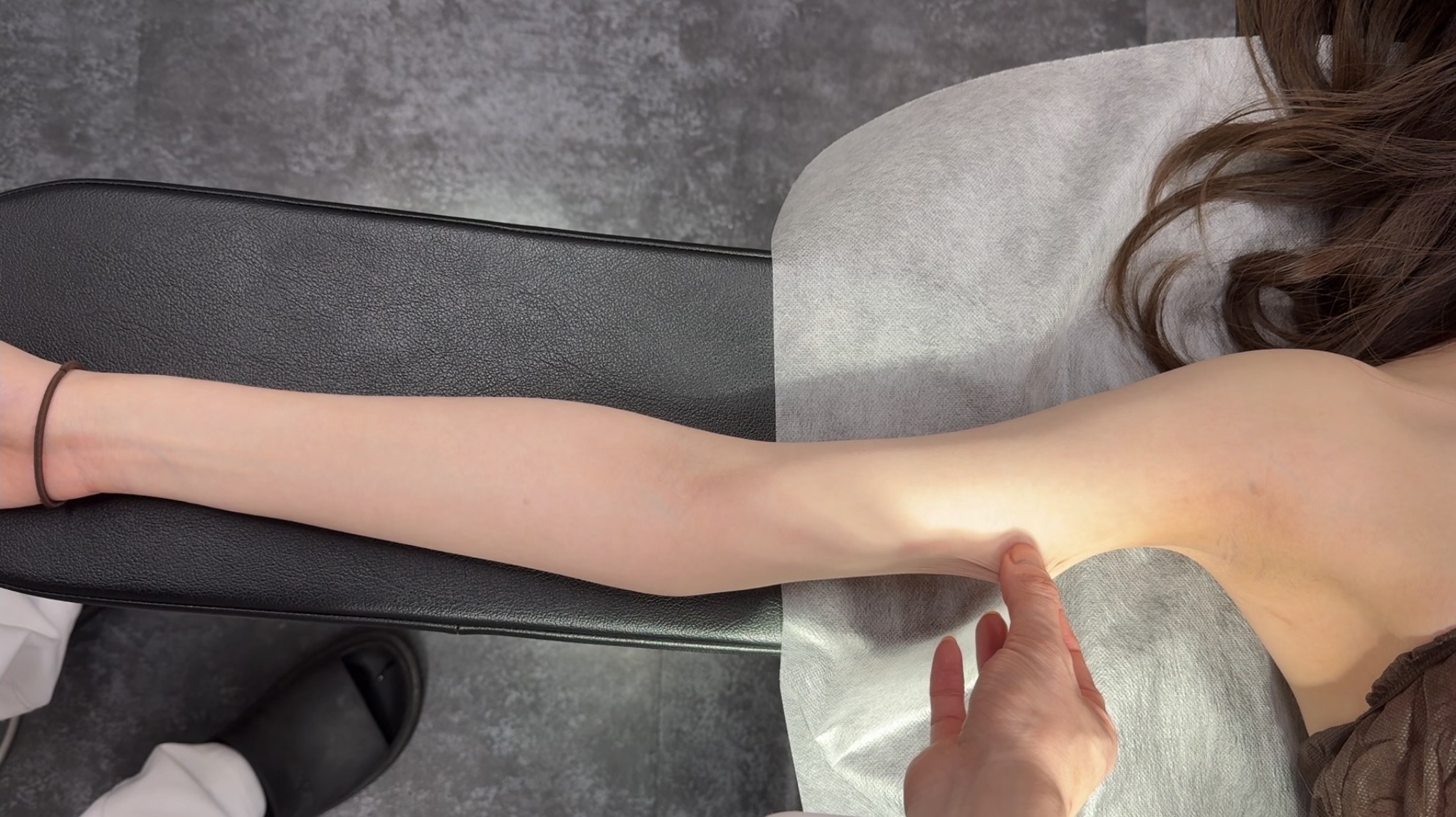
Why Upper Arm Liposuction Makes the Shoulders Look Narrower
A common misunderstanding is that the shoulder width is a fixed value determined by the skeleton (the positional relationship between the clavicle, scapula, and humeral head), and liposuction cannot move the bones themselves. However, the “visual shoulder width” is dramatically influenced by the continuous silhouette running from the shoulder down through the upper arm — specifically, whether the bulge of the lateral deltoid and the outer volume of the upper arm form one thick, unbroken line.
When the arm from shoulder to elbow forms a near-cylindrical shape, the shoulders appear wide. Conversely, when a subtle “indentation” of shadow appears just below the acromion, the projection of the shoulder visually shrinks. This is the essence of upper arm liposuction performed with true three-dimensional design.
Shadow Matters More Than Size
The human eye is more sensitive to the contrast of light and shadow than to the outline itself. When a shadow appears just below the shoulder, the brain automatically interprets it as “the arm becomes narrower here,” making the shoulder line appear smaller and the upper arm look slimmer. Even a difference of just a few millimeters in volume can dramatically change visual impression.
The Impact on Your Back View
Not only the front view, but also the “flow from the back to the upper arm” when viewed from behind, is critical. If the fat around the bra line and below the scapula is connected to the outer volume of the upper arm, the entire back view looks bulky. By carefully designing not only the outer arm but also the posterior and axillary regions, a delicate back view can be achieved at the same time.
Reading the Upper Arm Through Fascial Lines
Fat on the upper arm is not simply “evenly distributed around the circumference.” Along the three muscles — the deltoid, biceps brachii, and triceps brachii — and the fascial lines that surround them, fat accumulation follows distinct patterns.
A particularly common pattern in Asian women is thick fat accumulation over the lateral head of the triceps, which causes the boundary with the deltoid to disappear. Where a subtle shadow (the deltoid line) should naturally exist between the deltoid and the upper arm, fat piles up instead, making the shoulder and elbow look connected as one straight line — and the shoulders appear broader as a result.
Fascial Adhesions and the “Bat-Wing” Sag
Due to aging or postural habits, the fascia of the posterior upper arm can adhere to the subcutaneous fat layer, producing the classic downward-sagging “bat-wing” appearance. These adhesions cannot always be fully corrected by suction alone — appropriate release and surface treatment are essential. An experienced surgeon performing upper arm liposuction will evaluate the presence of such adhesions preoperatively and reflect that in the design.
Three-Dimensional Design — Sculpting Volume, Not Flat Surfaces
Conventional liposuction often relied on a two-dimensional approach: “evenly suctioning the outside of the arm.” But this approach never lifts the shoulder line. We approach the upper arm as a three-dimensional structure of four planes — anterior, lateral, posterior, and medial — plus the regions just below the acromion and above the elbow, and we vary the amount suctioned at each.
The Critical “Indentation” Below the Acromion
The single most important point in highlighting the shoulder line is intentionally leaving a shadow just below the acromion, at the boundary between the deltoid and the upper arm. Deliberately suctioning more aggressively in this zone makes the shoulder appear as an independent rounded shape, and the entire upper arm looks one step slimmer. If this zone is left untouched, the impression of “broad shoulders” remains, no matter how thin the rest of the arm becomes.
The Inner Arm and Above the Elbow Create the Delicate Look
Fat on the inner arm (medial to the biceps brachii) and just above the elbow directly determines how slim the arms look in sleeveless clothing. By carefully refining these areas, when the arms hang naturally at the sides, the gap (the so-called “triangle between the arm and the waist”) becomes clearly visible, making the entire upper body look delicate.
The Risks of Over-Suction — and What Fat Must Remain
The single most important risk to avoid in upper arm liposuction is over-suctioning to the point of destroying the deltoid line. Trying to extract every bit of fat causes direct adhesion between the skin and fascia, producing unnatural depressions and steps. Furthermore, compromised subcutaneous circulation can cause hyperpigmentation and prolonged contracture.
Safety standards in cosmetic surgery are repeatedly emphasized by the Japan Society of Aesthetic Surgery (JSAS), where it is widely recognized that the essence of the procedure is not “the pursuit of thinness” but “the design of beautiful lines.”
Contracture Is a Step Toward Beauty
During the contracture phase (one to three months postoperatively), the skin temporarily becomes firm, with possible bumpiness and tightness. This is a normal healing process in which the skin adapts to its new volume, and with appropriate massage and time, the final result settles into a smoother and more refined line.
AVAN TOKYO’s Approach to Upper Arm Liposuction
At our clinic, we emphasize three core principles in upper arm liposuction. First, during the preoperative design stage, we comprehensively evaluate the skeleton, muscle volume, fat distribution, and skin thickness to create a three-dimensional design optimized for each individual patient. Second, we perform refined suction, adding an ultrasound device when needed, minimizing damage to the skin and bleeding. Third, we never compromise on the treatment of the area just below the acromion and the inner arm, with the highest priority placed on creating the delicate silhouette where “the shoulders look narrower.”
The upper arm has thinner skin than many other body regions and requires delicate handling. For this reason, both design skill and technique greatly influence the result. Please also visit our related liposuction column list for more articles on other body regions and risks.
Conclusion: Upper Arm Liposuction Transforms the Entire Upper Body Through Design
If your true concern is not “my arms are thick” but rather “my upper body looks bulky” or “I don’t look good in sleeveless tops,” this is not a skeletal problem — it is a concern that can likely be dramatically improved through the design of upper arm liposuction. Rather than simply making the arms thinner, sculpting the shoulder, axillary, posterior, and medial surfaces in three dimensions creates a silhouette where the shoulders look narrower and the upper body appears delicate and light. We invite you to consult with our specialists.
──────────────
Medical Supervisor: Shin Moriwaki, MD
Member, Japan Society of Aesthetic Surgery (JSAS)
Member, American Academy of Aesthetic Medicine
ECFMG Certificate
──────────────
📍AVAN TOKYO Ginza Liposuction Clinic
AVAN TOKYO GINZA LIPOSUCTION CLINIC
English / 中文 / Tiếng Việt available
Reservations and consultations are accepted via
DM / LINE / Website / Phone.