


Why Your Front Thighs Bulge: The Real Causes Lie in Fat Position and Fascial Adhesions2026.05.20
“My weight is normal, but only my front thighs stick out.” “When I wear skinny pants, only the front of my thighs looks dramatically prominent.” These concerns about “front thigh bulging” are among the most common we hear from women.
Even with squats, cardio, and strict dieting, this issue is notoriously difficult to improve, and many people give up, assuming it must be due to “overdeveloped muscles.”
In reality, however, the main cause of front thigh bulging is not the muscle itself.
The true culprits are the “position where fat accumulates” and the “fascial adhesions” beneath it. The three-dimensional protrusion you see is created when these two factors combine.
Understanding the cause correctly is the first step toward reclaiming a beautiful thigh line.
Why Do Front Thighs Bulge?
The bulging appearance of front thighs is not caused by a single factor but by several anatomical elements layered on top of each other.
The “tightness” you see on the surface is actually the result of structures deep within the tissue rising up.
How “Fat Position” Shapes the Front Thigh Contour
Subcutaneous fat on the front thigh is distributed with particularly strong patterns compared to the rest of the thigh.
Fat that sits above the knee and covers the quadriceps tends to shift toward the front of the body, influenced by pelvic anterior tilt and standing posture habits.
People with anterior pelvic tilt caused by long hours of desk work or wearing high heels are especially prone to developing thicker fat layers on the front of their thighs.
Additionally, Asian women tend to accumulate subcutaneous fat in deeper layers rather than surface layers compared to Western women. When this deep fat layer sits on top of the quadriceps, it creates the impression that the front thigh is pushed outward in three dimensions.
Even for slim individuals, simply having this “front-biased deep fat” causes the front thigh to appear bulging.
This is not a question of muscle mass—it is a question of where and at what depth the fat is located.
How “Fascial Adhesions” Create Protrusion
The other critical factor is fascial adhesion.
Fascia is the thin, membrane-like tissue that wraps around muscles and fat layers. Normally, it slides smoothly to support joint movement and the fluidity of fat tissue.
However, when fascial movement becomes restricted due to prolonged sitting, postural imbalance, or lack of exercise, the fascia can begin to “adhere” to itself or to nearby fat layers.
In areas where adhesion occurs, fat becomes fixed in place and cannot flow freely.
As a result, clusters of fat and tissue remain trapped in specific spots on the front thigh, fixing the bulging appearance on the surface.
Massage and exercise alone are often ineffective because the problem lies not only in the subcutaneous fat but also in the fascial layer beneath it.
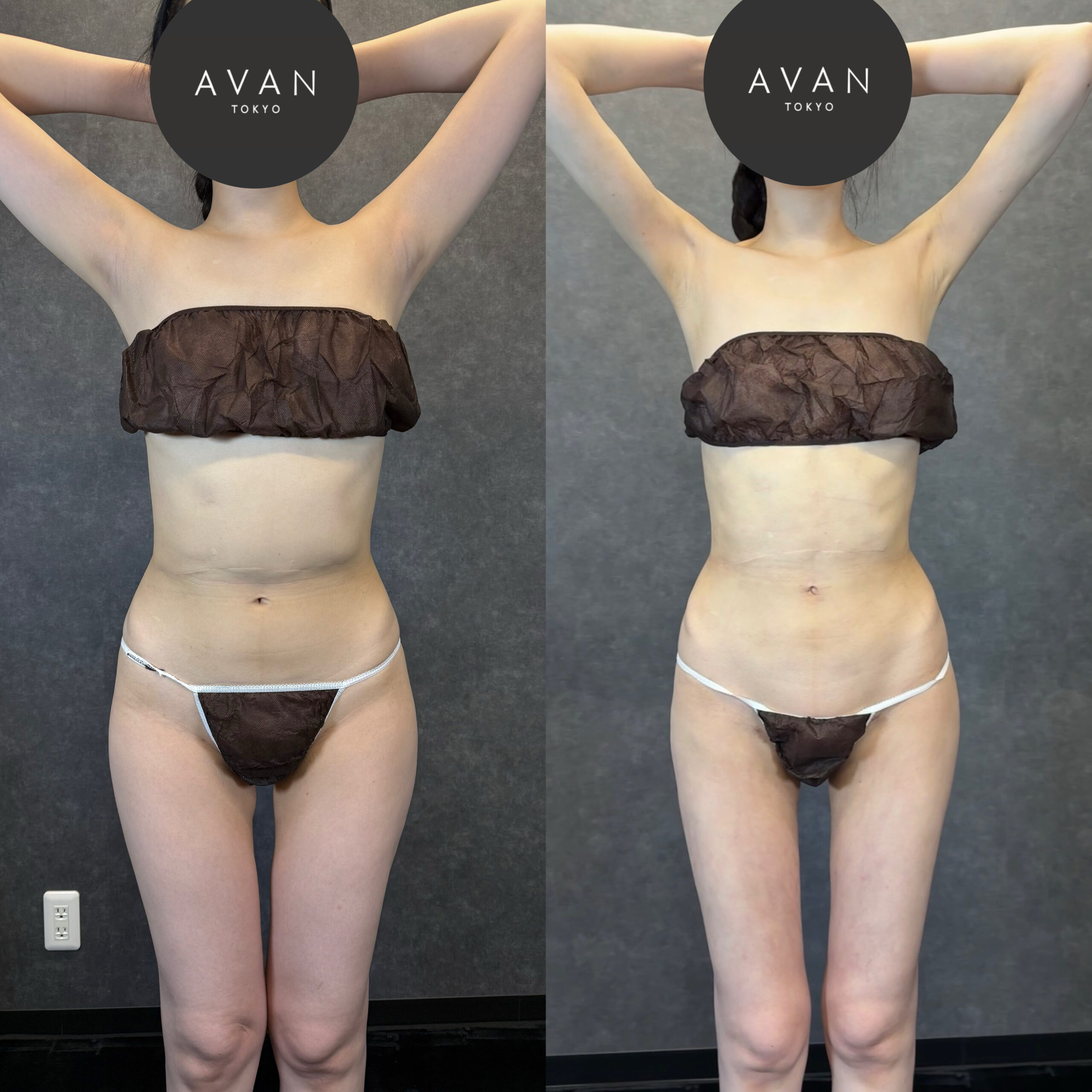
Essential Approaches to Resolving Front Thigh Bulging
To solve front thigh bulging at its root, simply reducing surface fat is not enough.
It is necessary to address both problems—“position” and “adhesion”—simultaneously.
Redesigning Fat “Position” Through Liposuction
Liposuction is not just a procedure for reducing fat volume.
When addressing front thigh bulging in particular, the most crucial element is the depth design—knowing which layer the fat should be removed from.
Suctioning only the shallow layer carries a risk of surface irregularities and does not resolve the underlying protrusion.
At AVAN TOKYO, we focus primarily on the deep fat layer, resetting the imbalanced fat distribution that covers the quadriceps. This allows us to redesign the three-dimensional volume of the front thigh itself.
By gradually adjusting thickness from above the knee, across the front thigh, and toward the inguinal area, we create a naturally straight and elongated front thigh line.
The essence of resolving front thigh bulging lies not in “removing” fat but in “repositioning” it.
Simultaneously Addressing Fascial Adhesions
In skilled liposuction practice, the cannula (thin suction tube) is operated with careful awareness of the boundary between fascia and fat layers.
By carefully passing the cannula through areas of adhesion, we can achieve both fat removal and a release effect that restores fascial mobility.
This is a fundamentally different procedure from “simple fat removal”—it is a three-dimensional, functional treatment.
Once adhesions are released, fat re-accumulation becomes less likely, supporting long-term silhouette maintenance.
Front thigh bulging that resisted dieting and exercise can finally be addressed from its structural foundation through a medical approach.
Conclusion
Front thigh bulging is not caused by muscles or weight.
It is a three-dimensional structural problem created when two anatomical factors—“the position where fat accumulates” and “fascial adhesions”—combine.
That is precisely why diet and exercise alone struggle to resolve it, and why a medical approach that redesigns the structure proves effective.
Liposuction is not merely a procedure to remove fat—it is a technique that creates beautiful silhouettes by “adjusting position.”
By addressing deep fat and releasing fascial adhesions simultaneously, you can achieve a naturally straight, elongated front thigh line.
If you have struggled for years with front thigh bulging, we encourage you to receive an anatomical consultation from a specialist.
It can be the first step toward structurally reclaiming the beautiful thigh line that your body was always meant to have.
📍AVAN TOKYO GINZA LIPOSUCTION CLINIC
English / 中文 / Tiếng Việt available
For reservations and consultations,
please contact us via DM / LINE / Website / Phone.