


When Should You Have Liposuction or Breast Augmentation If You Plan to Get Pregnant? | A Doctor Explains Timing and Future Body Changes2026.07.16
“I plan to get married and have children soon — is it still safe for me to have liposuction or breast augmentation?” This is one of the most common questions in consultations at AVAN TOKYO. The short answer is that liposuction and breast augmentation are possible for women who plan to become pregnant — but whether you have surgery before pregnancy or wait until after delivery significantly affects how long your results last and your risk of needing revision. In this article, supervising physician Dr. Shin Moriwaki explains, from a medical perspective, how pregnancy and delivery change subcutaneous tissue and the mammary glands, how fat cell number and distribution work physiologically, and how to decide when to schedule liposuction.
Key Points of This Article
– For women planning pregnancy, liposuction should ideally be performed during a period of stable weight, and pregnancy should be avoided for at least 3–6 months after surgery
– Because liposuction reduces the number of fat cells, treated areas remain relatively resistant to weight gain during pregnancy, while untreated areas may gain fat as compensation
– Both fat-graft breast augmentation and silicone implant augmentation allow breastfeeding, but the choice of technique should consider stress on the mammary ducts and post-pregnancy skin stretch
– Body changes after pregnancy vary greatly between individuals, so waiting “until the postpartum body has settled” is also a perfectly valid choice
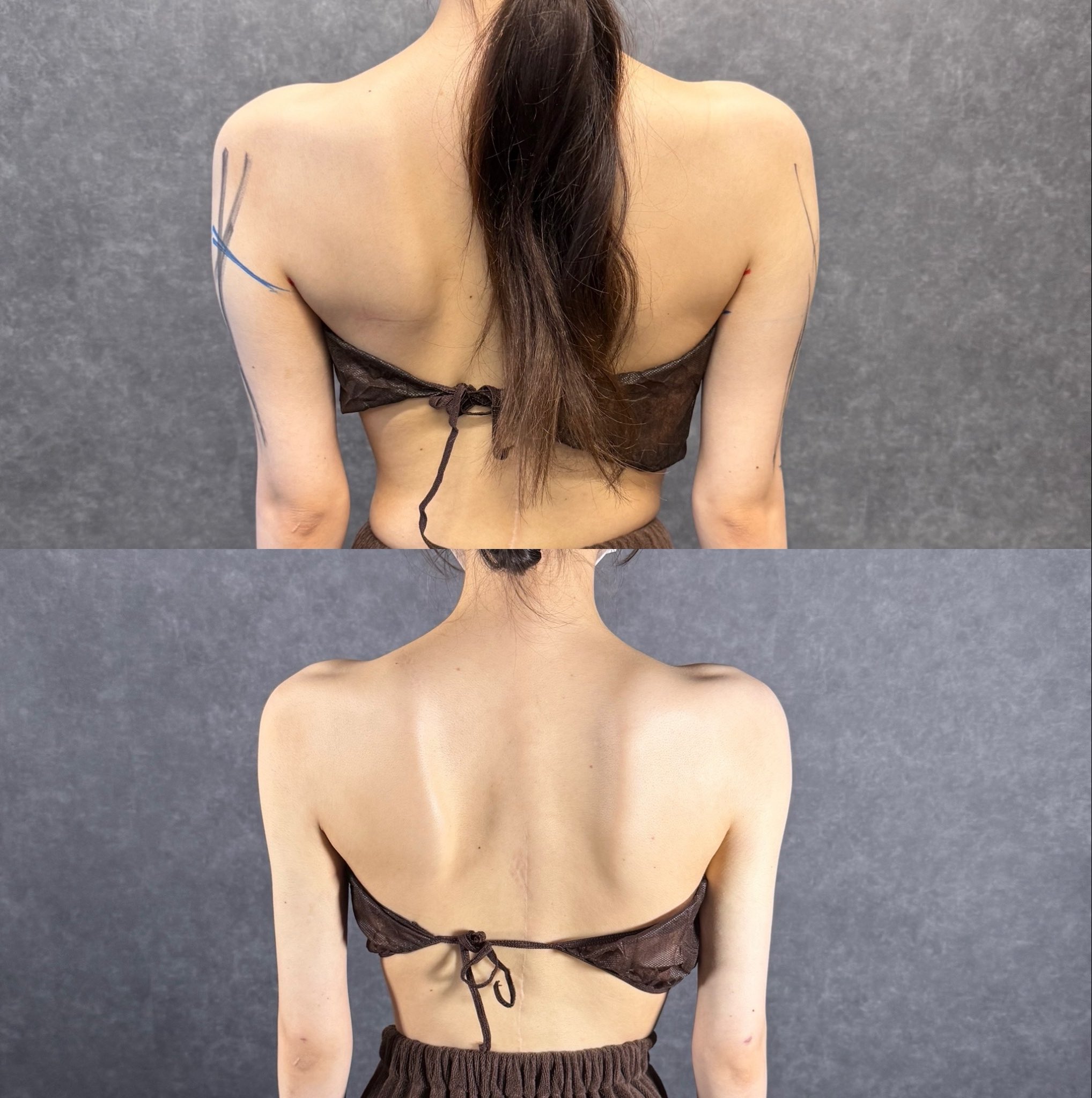
Pregnancy and Liposuction: Why Timing Matters
Liposuction reduces the actual number of fat cells. In adulthood, fat cell number is essentially fixed and weight gain occurs mainly through enlargement of individual cells (fat hypertrophy). Therefore, areas that have undergone liposuction are relatively resistant to weight gain during pregnancy because the number of cells is lower, while untreated areas — such as the back, lower abdomen, or upper arms — tend to accumulate fat as compensation.
Cases Where Pre-Pregnancy Liposuction Makes Sense
If you want to shape areas that typically become more noticeable with pregnancy weight gain — the upper arms, thighs, or waistline — undergoing liposuction beforehand can be a rational choice for maintaining a shape less prone to weight gain. However, tissue contraction and healing continue for at least 3–6 months postoperatively, so pregnancy should be avoided during this period.
Cases Where Post-Pregnancy Liposuction Makes Sense
On the other hand, the shift in subcutaneous fat distribution and abdominal wall stretching (including rectus diastasis) that follow pregnancy vary greatly between individuals and are difficult to predict in advance. For many women, better results come from treating “the postpartum shape that will not return” after delivery. Abdomen and waist areas in particular tend to benefit from waiting until the postpartum body has stabilized.
Considerations for Pregnancy After Liposuction
The timing of pregnancy after surgery should be considered from the following medical perspectives.
1. Maturation of Contracture and Fibrosis
After liposuction, subcutaneous tissue goes through inflammation, lymphatic drainage, contraction, and fibrosis, stabilizing over roughly six months. During pregnancy, circulating blood volume rises and subcutaneous water content increases, so becoming pregnant before contracture has fully settled risks fixing any residual unevenness or asymmetry.
2. Anesthetic Clearance
Lidocaine used in tumescent anesthesia is typically metabolized within a few days, but it can linger somewhat in fatty tissue. Because of concerns about fetal exposure, pregnancy within 1–2 months of surgery is not recommended.
3. Recovery from Anemia
Large-volume liposuction causes a temporary drop in hemoglobin. Because iron demand rises further during pregnancy, it is important to plan pregnancy only after postoperative anemia has fully resolved.
Breast Augmentation, Future Pregnancy, and Breastfeeding
The most common question from women considering augmentation before pregnancy is about breastfeeding. Here is how the techniques differ.
Fat-Graft Augmentation and Breastfeeding
Fat-graft augmentation injects fat outside the glandular tissue (superficial subcutaneous and pre-pectoral planes), so it does not directly damage the ducts or parenchyma. Impact on breastfeeding function is therefore minimal. However, part of the grafted fat may calcify, and you must always disclose your fat grafting history at future mammography screenings.
Silicone Implants and Breastfeeding
Silicone implants are placed under the pectoralis muscle or under the gland, so ducts are not directly divided. Breastfeeding is possible, though prolonged compression of glandular tissue could theoretically influence milk secretion. For safety standards in aesthetic surgery, please also refer to the Japan Society of Aesthetic Surgery.
Ptosis Risk from Pregnancy and Breastfeeding
A more important issue is skin stretching from the swelling and shrinking of breasts during pregnancy and lactation. Pregnancy and breastfeeding after augmentation can cause the skin to stretch and the breasts to sag, sometimes requiring revision or implant exchange. If you plan two or more pregnancies, considering augmentation after your last delivery is also a reasonable choice.
Dr. Moriwaki’s Practical Framework for Timing
The following is a general framework we use when advising patients. Optimal timing varies per individual, and a face-to-face consultation is essential.
– Pregnancy planned more than 2 years away → both liposuction and augmentation can be safely performed now
– Pregnancy planned within 1 year → liposuction is possible, but contraception is required for 6 months postop. Augmentation is more reasonable after delivery
– Currently breastfeeding → wait at least 6 months after weaning for hormones to normalize
– No specific pregnancy plans but possible in future → current preferences may take priority
In every case, comprehensive planning — including pre-existing conditions, medications, obstetric history, appropriate treatment area, graft volume, and weight management — is essential. For related topics, see our column archive on liposuction and breast augmentation here.
Frequently Asked Questions
Q. How many months after liposuction is it safe to get pregnant?
We recommend waiting at least 3 months and preferably 6 months or more. Waiting until tissue contracture and fibrosis have stabilized and anemia and residual anesthetic have fully resolved is safer for both mother and fetus.
Q. Do treated areas really stay slim during pregnancy?
Because fat cell number itself has been reduced in the treated area, it is relatively resistant to weight gain. However, whole-body fat distribution shifts during pregnancy, so untreated areas such as the back, lower abdomen, and upper arms may accumulate more fat.
Q. Is breastfeeding truly unaffected after fat-graft augmentation?
Because fat is injected outside the mammary gland, direct impact on breastfeeding function is minimal. However, always disclose your fat grafting history at future mammography. If calcifications appear, differentiation between graft-related and pathological findings is required.
Q. Should I have liposuction before my first pregnancy to avoid post-baby body changes?
It is not a straightforward yes or no. Body changes during pregnancy vary greatly and are hard to predict. Treating areas that already concern you and will likely worsen makes sense before pregnancy, but waiting until postpartum to reassess is equally valid.
Q. Is it safe to give birth and breastfeed with silicone implants in place?
Medically, yes. However, the swelling and shrinking of breasts during pregnancy and lactation can stretch the skin and shift the postoperative result toward ptosis. We discuss revision options in advance so you know what to expect.
──────────────
[Medical Supervision] Shin Moriwaki, MD (Supervising Physician)
Member, Japan Society of Aesthetic Surgery (JSAS) / Member, American Academy of Aesthetic Medicine
ECFMG Certificate
──────────────
📍AVAN TOKYO GINZA LIPOSUCTION CLINIC
English / 中文 / Tiếng Việt available
Appointments and consultations are accepted via
DM / LINE / Website / Phone.