


Why Muscular Body Liposuction Is So Difficult: The Science of Subfascial Fat and Surgical Design Explained by a Doctor2026.07.07
We frequently receive consultations from patients who continue strength training or naturally have a muscular build, asking whether muscular body liposuction is even indicated for them. Contrary to popular belief, a muscular body type actually falls into the highest-difficulty category for this procedure. The reason lies in the thin layer of fat sitting above the fascia, which structurally limits the surgical design options available. In this article, we explain in a physician’s voice the anatomical reasons muscular patients need to understand before surgery, along with the design principles that maximize the final result.
Key Takeaways
・Muscular body types have a thin subcutaneous fat layer, so muscular body liposuction is structurally limited in the volume it can address
・Handling the sparse fat above the fascia “uniformly across a plane” requires high-precision technique
・Rather than “making it thinner,” the true determinant of the result is a design that respects the underlying muscle contour
・The post-op contracture phase overlaps with what feels like “muscle tightness,” so evaluating the outcome takes roughly six months
・Since muscle mass itself cannot be reduced, combination with treatments such as Botox should be considered when appropriate
The Anatomical Reasons Muscular Body Liposuction Is Difficult
In a muscular patient’s body, the distance from the underside of the dermis down to the fascia is often only a few millimeters. Standard suction design treats fat in three layers—superficial, intermediate, and deep—but in a muscular patient there is frequently almost no fat corresponding to the “deep layer.” Because the working space for the cannula is so narrow, the surgeon must accurately identify the layer within an extremely tight anatomical corridor.
Additionally, fat distribution tends to be uneven along the muscle contour. On the arm, thickness differs at the lateral edge of the triceps; on the thigh, the inner and outer aspects of the quadriceps carry different amounts of fat. Suctioning this asymmetry without adjustment can leave muscle lines starkly visible after surgery, producing a “bulky” appearance. Ironically, pushing too hard to make the area thinner can end up emphasizing the skeleton and musculature—a classic failure pattern in muscular patients.
Understanding the Difference Between Superficial and Deep Fat
Subcutaneous fat is histologically divided into a “superficial fat” layer near the dermis and a “deep fat” layer against the fascia. Deep fat has sparsely arranged adipocytes and higher fluidity, making it comparatively easy to suction. Superficial fat, on the other hand, is densely traversed by fibrous septa; forcing suction there damages the subdermal vascular network and dramatically raises the risk of contour irregularities, pigmentation, and even skin necrosis.
Because the deep layer itself is thin in muscular patients, the surgeon inevitably must venture into the superficial layer more often. What matters here is the skill of “shaving thinly and uniformly across the surface” while preserving fiber orientation and blood flow. Cannula diameter, suction speed, and layer identification are the three variables that most heavily depend on the operator’s judgment. A less experienced surgeon will fail to reach the intended layer with precision and will tend to leave irregularities behind.
Design Philosophy Required for Muscular Patients
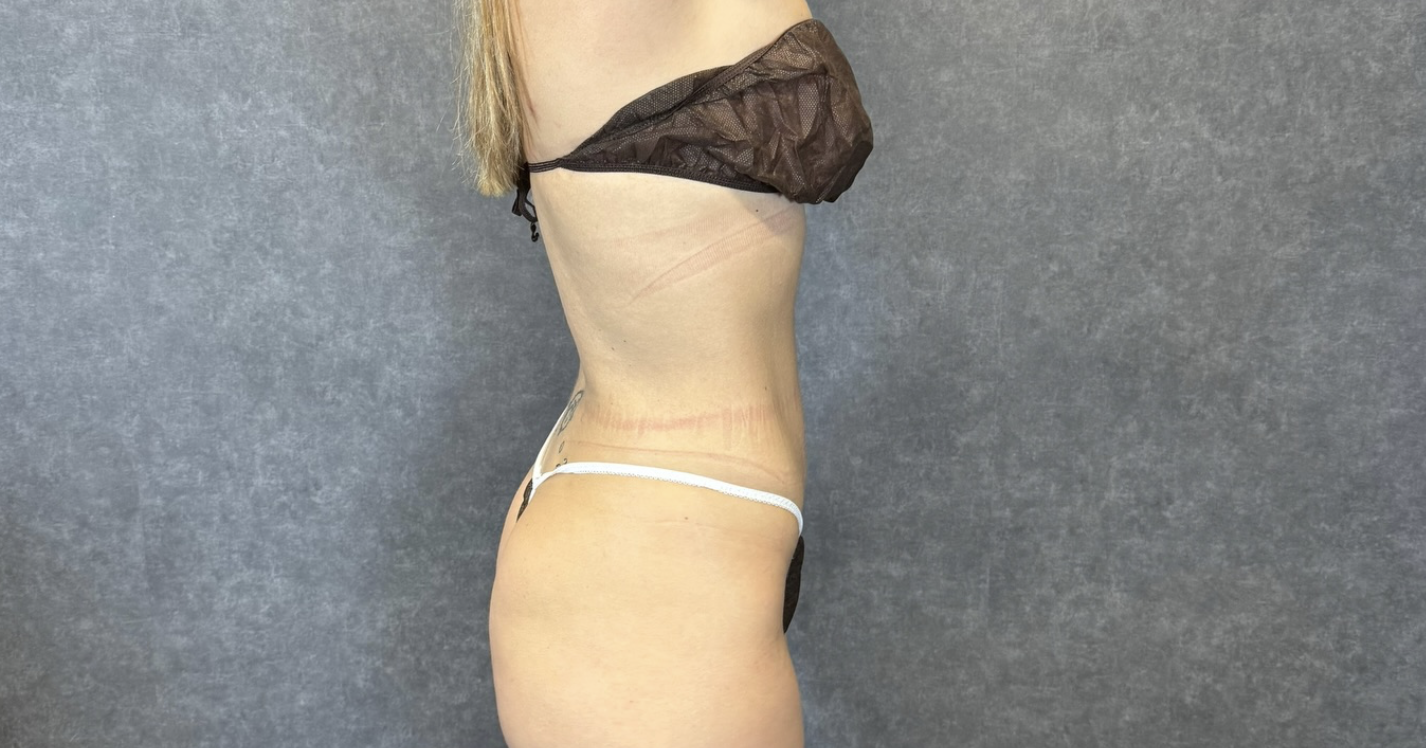
The single most important perspective in muscular body liposuction is: “How do we make the muscle line work for us?” Simply thinning every fat depot uniformly is not the goal. The design must preserve feminine softness and anatomical continuity while subtracting only what needs to be subtracted.
For the arm, controlling the volume so that the lateral edge of the triceps is not overemphasized is crucial. On the thigh, we must avoid enhancing the bulge of the quadriceps and calculate inner-thigh versus outer-thigh volumes separately. In the abdomen, suctioning until the rectus abdominis contour surfaces would erase the feminine curve, so we sometimes deliberately leave a thin superficial fat layer to preserve the line. The elegance of the design lies not in “how much to subtract” but in “what to leave.”
For safety standards and surgical validity in cosmetic surgery, information from the Japan Society of Aesthetic Surgery is also worth consulting.
Post-Op Evaluation and What Liposuction Alone Cannot Change
What’s uniquely challenging in muscular patients is evaluating the recovery timeline. Swelling and contracture make the tissue feel firm for a prolonged period, and during that window the area looks as if “the muscle is tight.” Between months one and three, fibrosis and lymphatic stasis occur simultaneously, so the true result should not be judged until at least six months post-op.
Also, this surgery reduces the “number of fat cells” and does not directly diminish muscle mass. When muscle tension or bulk is the concern, a separate approach such as Botox injection—which acts directly on muscle—must be combined. Relative line correction through fat grafting to other areas can also be effective in muscular patients. Rather than expecting fat reduction alone to solve everything, a holistic, combination-based body-design perspective is essential. For related topics, please also see our liposuction column archive here.
Frequently Asked Questions
Q. Is it safe to continue strength training while undergoing surgery?
Continuing training preoperatively is fine, but please avoid intense weight training for at least 4–6 weeks postoperatively. Loading the tissue during the strong inflammation and swelling phase can worsen contracture and prolong bruising. Return to training is done gradually while monitoring recovery.
Q. Can I have surgery specifically to make my muscles thinner?
No. This procedure only removes subcutaneous fat and cannot physically reduce muscle mass. If muscle bulk is the concern, another method that acts directly on the muscle—such as Botox—is required.
Q. Can a muscular person actually get thinner with this surgery?
In areas where the absolute amount of fat is low, there is a structural limit to how much thinner you can become. During consultation we perform a pinch test (measuring subcutaneous fat thickness by hand) to align expectations and confirm the true indication with the patient.
Q. Is the downtime longer for muscular patients?
Because the surgeon works meticulously in a thin layer, intraoperative tissue trauma tends to be relatively mild. However, the contracture phase overlaps with what feels like “muscle tightness,” so many patients perceive the psychological downtime as long. Please plan for a long-term perspective of around six months.
Q. Which suction devices are suited to muscular patients?
VASER, which efficiently loosens fibrous septa, and thin-cannula superficial approaches are effective. That said, more than the device itself, the operator’s design judgment—”which layer, and how”—is what determines the outcome.
──────────────
【Supervised by】Shin Moriwaki, MD (Supervising Physician)
Member of the Japan Society of Aesthetic Surgery (JSAS) / American Academy of Aesthetic Medicine
ECFMG Certificate
──────────────
📍AVAN TOKYO Ginza Liposuction Clinic
AVAN TOKYO GINZA LIPOSUCTION CLINIC
English / 中文 / Tiếng Việt supported
For consultations and reservations,
please contact us via DM / LINE / Website / Phone.