


Pure Fat vs. Condensed Fat: A Doctor’s Complete Guide to Fat Grafting Breast Augmentation Techniques2026.06.05
In recent years, fat grafting breast augmentation has been chosen by many women for its natural appearance and soft, lifelike feel. There are two main techniques in fat grafting breast augmentation: “pure fat grafting” and “condensed (concentrated) fat grafting.” These two methods differ medically in graft survival rate, downtime, suitability based on body type, and the volume of augmentation possible in a single session. In this article, the supervising physician at AVAN TOKYO Ginza Liposuction Clinic explains the differences between pure fat and condensed fat, along with which technique best suits various patient profiles, based on anatomical and histological evidence.
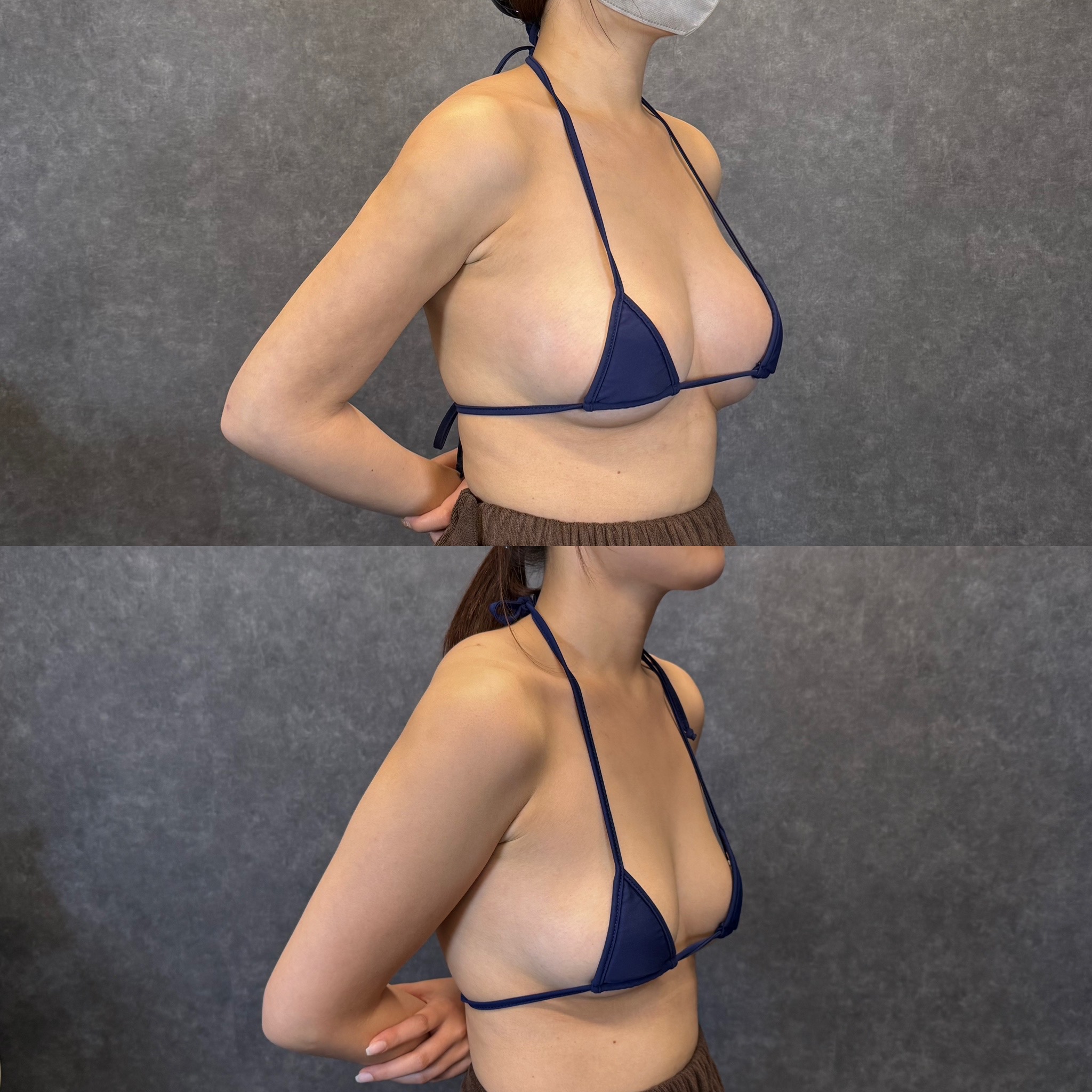
What Is Fat Grafting Breast Augmentation? The Basic Mechanism
Fat grafting breast augmentation is a procedure in which subcutaneous fat harvested from the patient’s own thighs, abdomen, or lower back is injected into the breast to enlarge and shape it. Unlike implant-based augmentation using silicone, this method uses the patient’s own tissue, so the risks of allergic or foreign-body reactions are extremely low. The texture is soft and natural, and the feel even resembles real mammary tissue — a major advantage of this approach.
However, not all injected fat remains in the breast permanently. Immediately after injection, fat cells are in an ischemic state and only achieve “graft take” after undergoing the process of revascularization — receiving nutrients and oxygen from surrounding tissue. The technique used to harvest and process the fat — that is, the form in which the fat is injected — is critical to maximizing this take rate. This is precisely where pure fat and condensed fat differ most.
How Injected Fat Establishes Graft Take
Injected fat draws in blood vessels from surrounding tissue over about two weeks and stabilizes after roughly three months. The final breast shape is established around six months post-operation and is then maintained long-term. To maximize the take rate, it is medically important to minimize damage to fat cells and inject them in a distributed manner into layers with good blood supply.
What Is Pure Fat Grafting? Features and Medical Advantages
Pure fat grafting is a technique in which the harvested fat is processed minimally — through centrifugation or filtration — and injected in a nearly natural state. This method places little physical stress on fat cells, making it one of the least burdensome to the tissue and one of the mainstream approaches in modern autologous breast augmentation.
Advantages of Pure Fat Grafting
Its greatest benefit is that, because fat cells experience minimal stress, they tend to graft well and maintain a stable shape over the long term. Furthermore, because the fat is not strongly compressed or concentrated as in condensed grafting, the risks of lumps, fat necrosis, and calcification are also relatively lower. The flexibility to inject in a layered, distributed pattern throughout the breast makes it well suited to creating natural fullness and cleavage.
Disadvantages of Pure Fat Grafting
Because pure fat undergoes less processing, it contains a certain amount of impurities — saline, damaged fat cells, blood components — and therefore the actual “live fat volume” per injection is lower than condensed fat. As a result, patients seeking dramatic size increases may require multiple sessions of the same procedure.
What Is Condensed (Concentrated) Fat Grafting? Features and Medical Advantages
Condensed fat grafting is a technique in which impurities and necrotic fat cells are removed as much as possible to inject a higher concentration of viable fat cells. It is often chosen by patients seeking maximum size increase in a single procedure or by slim patients with limited harvestable fat.
Advantages of Condensed Fat Grafting
Its main appeal is the significant breast enlargement achievable in a single session, made possible by injecting high-concentration viable fat. Because impurities are reduced, post-operative swelling and bruising can be relatively mild, offering certain downtime advantages. It is an option that meets the needs of slim patients who say, “I have limited harvestable fat but want a clear size increase.”
Disadvantages of Condensed Fat Grafting
On the other hand, because the concentration process applies physical stress to fat cells, depending on the processing method, the take rate may be lower than with pure fat. Furthermore, the higher concentration tends to increase the local volume injected, so controlling the risks of lumps, calcification, and fat necrosis requires highly skilled technique and meticulous injection-route design.
Pure Fat vs. Condensed Fat: Which to Choose for Fat Grafting Breast Augmentation
Choosing between pure fat and condensed fat is not a binary of “which is better.” The optimal choice differs depending on the patient’s body type, desired size, lifestyle, and medical history. At AVAN TOKYO, we conduct body-type analysis and assessment of subcutaneous fat volume during the initial consultation and then design the technique on a fully custom basis.
Choosing Based on Body Type and Desired Size
When sufficient harvestable fat is available and the priorities are natural feel and long-term stability, pure fat grafting is the first choice. On the other hand, for slim patients with limited harvestable fat who still want a meaningful size increase in a single session, condensed fat grafting is suitable. For patients seeking a natural one-cup increase, pure fat grafting can often deliver adequate results.
Choosing Based on Downtime and Safety
Downtime itself does not differ greatly between the two techniques, but the lower impurity content of condensed fat sometimes results in lighter immediate post-operative swelling. However, individual variation is large and depends heavily on the surgeon’s technique and injection design. From the perspective of long-term lump prevention, pure fat grafting — which avoids large-volume injection into a single site and instead distributes injections across layers and directions — tends to allow for higher safety.
The AVAN TOKYO Philosophy of Fat Grafting Breast Augmentation
We regard this procedure not merely as an injection technique but as “three-dimensional breast contouring using autologous tissue.” Beyond simply how much fat to inject, we design depth, layer, distribution pattern, and cannula trajectory meticulously to match each patient’s chest wall morphology and mammary tissue, achieving a beautiful, natural breast contour that remains stable long-term.
Referring also to the guidelines of the Japan Society of Aesthetic Surgery on safety standards and ethics in aesthetic surgery, AVAN TOKYO provides this procedure grounded in the latest medical evidence.
For more on related procedures, please see our liposuction and breast augmentation related column list here.
──────────────
Supervising Physician: Shin Moriwaki (Director)
Member, Japan Society of Aesthetic Surgery (JSAS) / Member, American Academy of Aesthetic Medicine
ECFMG Certificate
──────────────
📍AVAN TOKYO GINZA LIPOSUCTION CLINIC
English / 中文 / Tiếng Việt available
Reservations and consultations welcome via
DM / LINE / Website / Phone.