


Why Does Asymmetry Occur After Liposuction? A Physician Explains the 3 Underlying Causes: Preexisting Asymmetry, Adhesion, and Healing Differences2026.07.04
After liposuction, many patients stand in front of the mirror worrying, “Could the two sides be shaped differently?” In reality, liposuction asymmetry is often temporarily emphasized during the healing process and does not necessarily indicate a surgical failure. Three factors typically intertwine behind it: (1) preexisting anatomical asymmetry in skeleton and fat distribution, (2) uneven adhesion and contraction during healing, and (3) side-to-side differences in wound-healing speed. In this column, Dr. Shin Moriwaki of AVAN TOKYO GINZA LIPOSUCTION CLINIC explains the medical mechanisms behind liposuction asymmetry and how to judge when revision surgery should be considered.
Key Points of This Article
・Liposuction asymmetry is mainly caused by three factors: preexisting anatomical asymmetry, differences in adhesion and contraction, and side-to-side differences in healing speed
・During the contraction phase from 2 weeks to 3 months post-op, asymmetry may be temporarily exaggerated
・Final assessment of the outcome should generally be made 6 months or more after surgery, and revision decisions should follow that timeline
・Preoperative design precision and postoperative compression management are the two biggest factors that minimize liposuction asymmetry
・If you notice any concerning changes, do not self-diagnose—always consult your operating surgeon
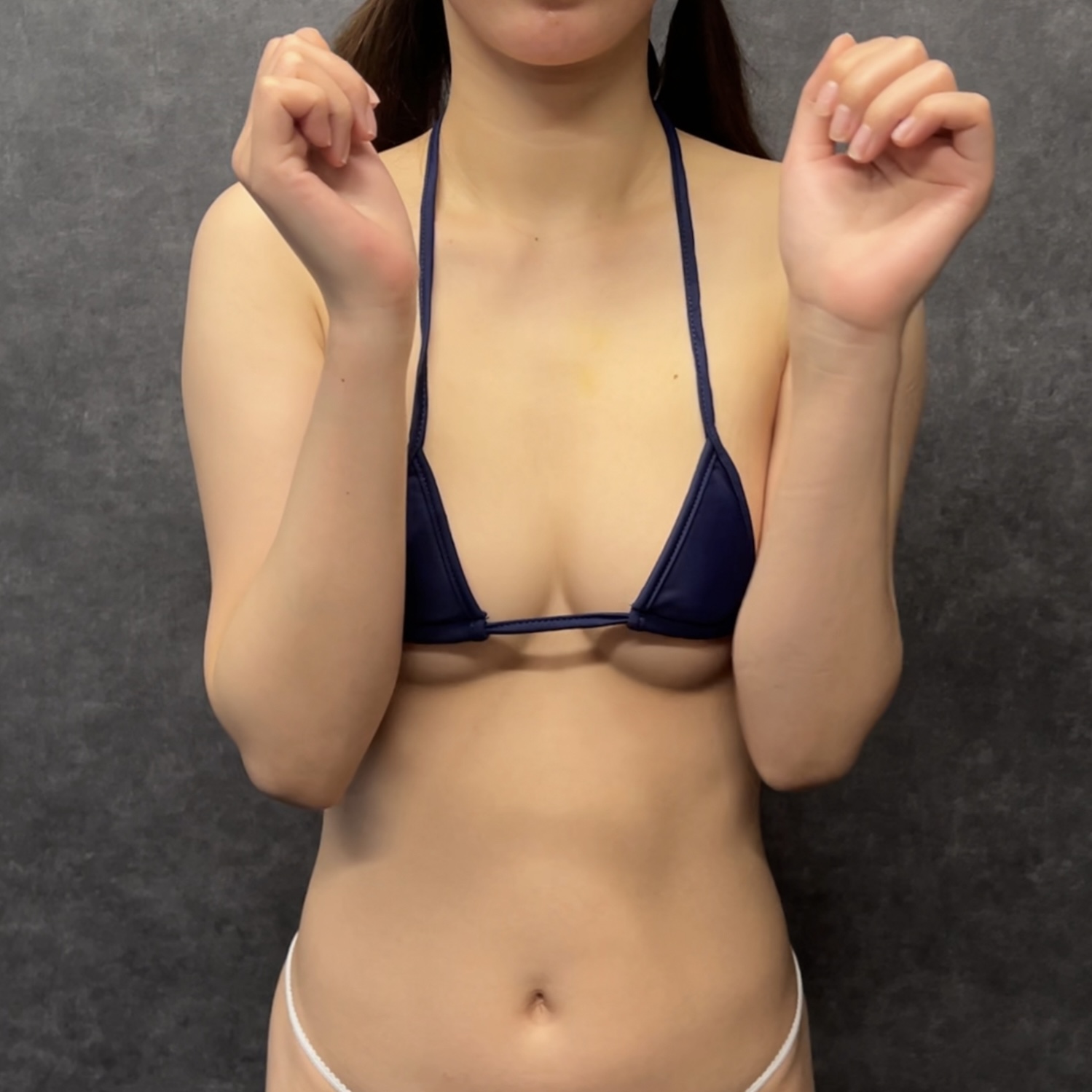
The Human Body Is Never Perfectly Symmetrical
Medically, the human body always exhibits some degree of asymmetry. Pelvic height, rib flare, breast size, and fat distribution vary from side to side in virtually everyone. In particular, the dominant-side arm and shoulder normally show differences in muscle mass and subcutaneous fat thickness. This is a physiological, not pathological, asymmetry.
Therefore, before evaluating post-liposuction asymmetry, it is important to recognize how often “the asymmetry was actually present before surgery.” Taking preoperative photos from multiple angles and observing your body carefully in a mirror often reveals that the asymmetry did not appear after surgery—it was already there.
Cause 1: Preexisting Anatomical Asymmetry
The most overlooked cause of liposuction asymmetry is preexisting side-to-side difference. In the upper arms, the dominant side often has more developed muscle and subcutaneous fat that projects outward. In the abdomen, organ position (liver on the right, stomach and spleen on the left) and lumbar scoliosis create subtle differences in the location of the waistline. In the thighs, pelvic tilt and femoral torsion shift the outer contour from side to side.
Liposuction is not a procedure that removes an identical volume from both sides. It is a procedure that judges the appropriate volume for each side individually and designs the removal so the final result appears symmetric. If the anatomical assessment during the preoperative consultation is superficial, the risk of postoperative asymmetry increases. Observing the skeleton, muscle, and fat layer in standing, sitting, and supine positions—and fine-tuning the suction volume for each side—is essential.
Cause 2: Side-to-Side Differences in Adhesion and Contraction
Between 2 weeks and 3 months after liposuction, the subcutaneous tissue undergoes rapid fibrosis and contraction (re-adhesion of the skin to deeper structures). During this contraction phase, the skin may feel lumpy, hard, or partially tethered. These changes are not pathological; they are the physiological process by which excess skin tightens and reshapes.
The challenge is that the direction and progression of contraction are never exactly the same on both sides. Daily habits (dominant arm use, sleeping posture, sitting position, weight-bearing on one leg), the fit of compression garments, and lymphatic flow all differ side-to-side, producing uneven adhesion patterns. As a result, asymmetry may appear temporarily exaggerated at 1 to 3 months post-op. In most cases, contraction settles and both sides blend by around 6 months.
Cause 3: Side-to-Side Differences in Healing Speed
Bleeding volume, bruise absorption speed, and swelling resolution vary side-to-side based on both constitution and anatomical region. In particular, the side closer to lymph nodes (the upper arm nearer the axilla, the inner thigh nearer the groin) drains faster, while the opposite side tends to lag.
This difference in healing speed appears at 1 month post-op as “one side is still swollen or firm.” Many patients interpret this as newly developed asymmetry, but in most cases it is simply a time lag in healing—not a difference in the final result. Watching the recovery patiently leads to a more accurate evaluation.
When Should Liposuction Asymmetry Be Evaluated?
The final outcome of liposuction asymmetry should generally be evaluated 6 months or more after surgery. This is when contraction has fully settled and scar tissue has matured. Judging revision earlier risks mistaking the temporary shape of the contraction phase for the “final result” and can trigger unnecessary additional surgery.
Even when revision is considered, operating before the scar tissue has softened raises the risk of secondary problems, such as contour irregularity from additional suction or reduced fat-graft survival. The indication and timing of revision must be discussed thoroughly with the operating surgeon.
Three Perspectives That Minimize Liposuction Asymmetry
(1) Precision in preoperative design: observe the body from multiple angles in standing, sitting, and supine positions, and adjust suction volumes side-to-side after identifying skeletal, muscular, and fat asymmetries.
(2) Postoperative compression management: fit compression garments evenly on both sides so one side does not loosen. Uneven pressure produces uneven contraction.
(3) Awareness of daily habits: always sleeping on one side, standing on one leg, or leaning on one elbow can exaggerate contraction asymmetry.
These are all points the patient can actively work on, and they directly affect the final result. Please also see our liposuction column index. For safety standards in aesthetic surgery, refer to the guidelines of the Japan Society of Aesthetic Surgery.
Frequently Asked Questions
Q. How long does liposuction asymmetry last?
The contraction phase peaks between 2 weeks and 3 months post-op and then gradually settles. Final shape assessment should be made 6 months or more after surgery. Most patients find that by 6 months, asymmetry has blended to a level that no longer stands out.
Q. If the asymmetry looks clearly large, should I have a revision right away?
Within the first 3 months, asymmetry may be a temporary contraction-phase phenomenon, so immediate revision is not recommended. Consult your operating surgeon first, follow the recovery closely, and evaluate comprehensively once scar tissue has matured at 6 months or later.
Q. Can massage or self-care improve asymmetry?
Contraction-related asymmetry can be improved with proper contraction-phase massage and correctly fitted compression garments. However, preexisting anatomical asymmetry is difficult to change without physical intervention such as additional suction or fat grafting. Follow the self-care instructions from your operating surgeon.
Q. Can liposuction asymmetry be prevented?
Preoperative design precision and postoperative compression management are the most important factors. In particular, if compression garments loosen on one side, the pressure differs between sides and contraction progresses unevenly. Check daily in a mirror that the garment fits evenly on both sides.
Q. Can liposuction asymmetry be reduced to absolute zero?
Medically, perfect symmetry is not achievable. However, careful preoperative design and postoperative management can bring the result to a level where asymmetry is no longer noticeable in daily life. A realistic goal is not “perfect symmetry” but “balanced, natural symmetry.”
──────────────
Medical Supervisor: Shin Moriwaki, MD
Member, Japan Society of Aesthetic Surgery (JSAS)
Member, American Academy of Aesthetic Medicine
ECFMG Certificate
──────────────
📍AVAN TOKYO GINZA LIPOSUCTION CLINIC
English / 中文 / Tiếng Việt available
Reservations and consultations:
DM / LINE / Website / Phone