


Why Fat Grafting Lumps Happen | Doctor Explains How Over-Injection Is the Real Cause2026.06.18
One of the most common concerns among patients considering fat grafting breast augmentation is the risk of fat grafting lumps. With proper technique and an appropriate injection volume, this complication can be kept extremely rare — but once it occurs, it may leave hardness, pain, or visible irregularities that persist for many months or even years. Supervised by AVAN TOKYO Ginza Liposuction Clinic, this article explains the true mechanism of how lumps form, and the medical fact that “over-injection is the single greatest cause.”
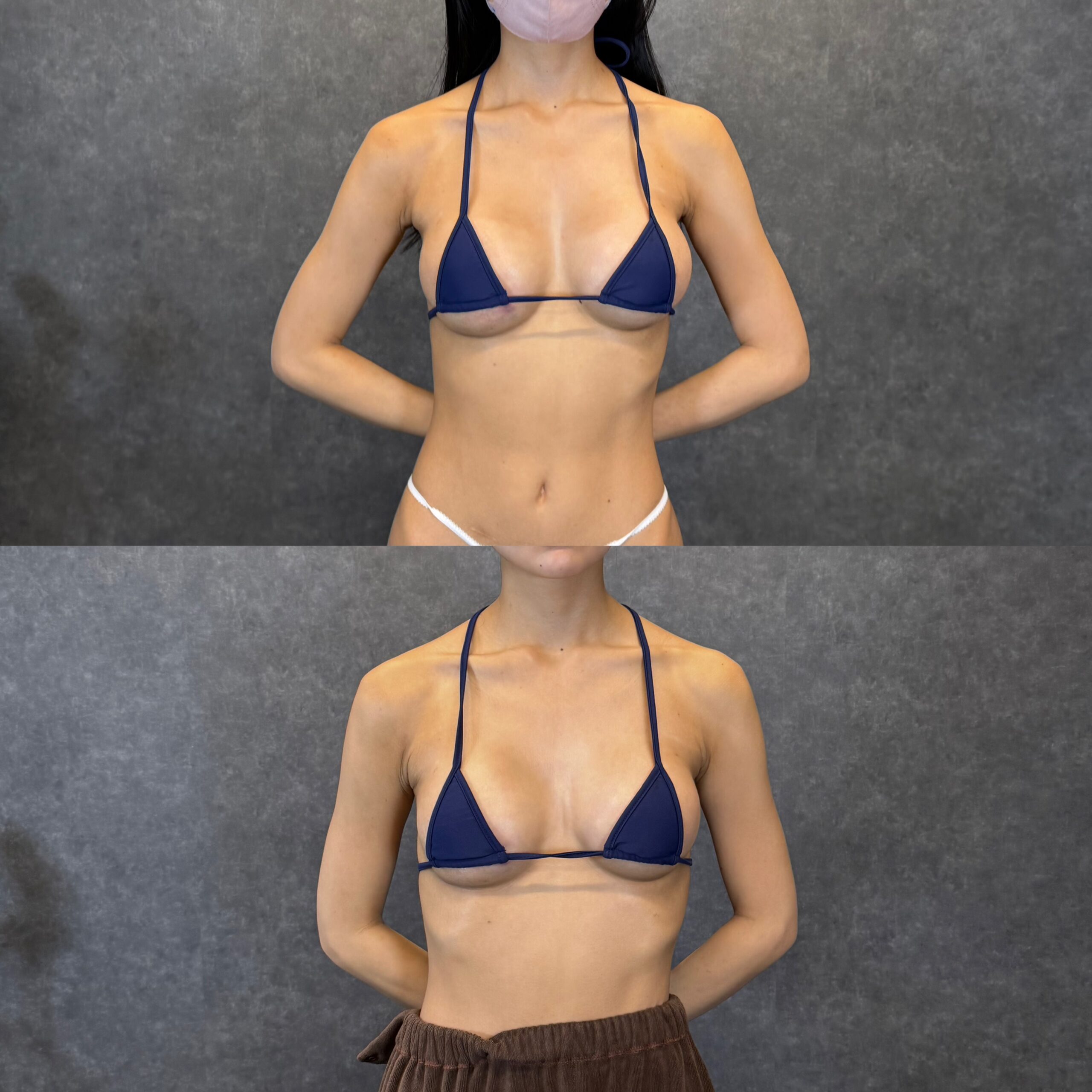
What Are Fat Grafting Lumps? Knowing Their True Identity
The term “lump” in fat grafting is actually an umbrella label covering several different conditions. The most common include oil cysts (necrotic fat cells that have liquefied), fibrotic scar tissue, and calcified nodules. All of these originate from soft fat that fails to engraft and becomes isolated from the surrounding tissue.
A frequent misconception is that “lumps mean infection or cancer.” In reality, the vast majority of fat grafting lumps are benign and are pathologically completely different from breast cancer. However, the firmness and distortion patients can feel through the skin create significant emotional stress and substantially reduce post-operative satisfaction.
A Lump Is the Result of Fat Being Isolated
Transplanted fat cells survive only when they receive oxygen and nutrients from surrounding tissue. Conversely, fat injected as a large mass cannot deliver oxygen to its center and necroses from the inside out. The liquefied necrotic fat encapsulated in a thin membrane is exactly what an oil cyst is.
Why “Over-Injection” Is the Sole Root Cause of Fat Grafting Lumps
Here is the central point. AVAN TOKYO consistently emphasizes that the biggest factor producing lumps is not the surgeon’s individual skill — it is the volume injected in a single session.
Fat Cells Need to Stay Within 2mm of a Blood Supply
Immediately after injection, fat cells rely on the diffusion of oxygen and nutrients from surrounding capillaries to survive. However, the maximum distance oxygen can effectively diffuse is approximately 2mm. Any fat deposit thicker than this will necrose at its core. In other words, when too much fat is placed along a single injection track, the center inevitably dies — and the oil cysts we recognize as fat grafting lumps appear.
The Principle of Not Trying to Enlarge Too Much in One Surgery
The desire to “go big in a single procedure” is psychologically understandable. But injecting beyond what a single breast can physiologically accept guarantees a sharp rise in lump risk. The mammary gland, pectoral muscle, and subcutaneous layer each have a hard biological ceiling on how much fat they can engraft at once. Ignoring this ceiling has been the underlying cause of countless lump cases in the past.
The “Micro-Droplet Injection” Technique That Prevents Fat Grafting Lumps
The global gold standard for fat grafting injection is the micro-droplet technique. Fat is placed in volumes of 0.1cc or less and dispersed in 360 degrees across every available tissue layer.
“Mist,” Not “Lines”
Skilled surgeons withdraw the cannula slowly, depositing extremely thin layers of fat. Subcutaneous, sub-mammary, supra-pectoral, intra-pectoral — by distributing fat evenly across multiple planes, every injected fat cell stays within 2mm of host tissue. With this approach, oxygen diffuses to every cell and there is physically no fat mass left to necrose.
“Quality of Dispersion” Matters More Than Total Volume
Even when the same 300cc is injected, a surgeon who lays down fat in thick lines and one who mists it across layers produce dramatically different lump rates. The key to preventing fat grafting lumps lies not in total volume but in the quality of dispersion. This is why experienced surgeons spend enormous time refining cannula motion, withdrawal speed, and micro-pressure control.
A Multi-Session Strategy Is Often the Fastest Route
At AVAN TOKYO, for slim patients or those seeking a major size increase, we propose a planned 2–3 session strategy rather than forcing everything into a single procedure. This is not about adding cost or time — it is the medically optimal path to a beautiful result while completely avoiding lumps. Reducing the volume injected per session dramatically improves engraftment, and the final cumulative size is often greater than what a single overloaded session could ever produce.
For information on aesthetic surgery safety standards and complication management, refer to the Japan Society of Aesthetic Surgery (JSAS).
If Fat Grafting Lumps Do Form
Even if a lump is felt, the appropriate response depends on its size, hardness, and whether it is painful. Small oil cysts a few millimeters across may be reabsorbed naturally with observation, while larger ones over 1cm can be treated by ultrasound-guided needle aspiration or, in some cases, surgical removal.
What matters most is consulting a doctor who treats lumps not as a “failure to hide” but as a manageable condition to be properly diagnosed and treated. At the consultation stage, always ask your surgeon how they approach the prevention and treatment of fat grafting lumps.
Read more liposuction and fat grafting columns here
──────────────
Supervised by: Shin Moriwaki, MD
Member, Japan Society of Aesthetic Surgery (JSAS) / American Academy of Aesthetic Medicine
ECFMG Certificate Holder
──────────────
📍AVAN TOKYO GINZA LIPOSUCTION CLINIC
English / 中文 / Tiếng Việt supported
Reservations and consultations available via
DM / LINE / Website / Phone.