


How Injection Depth Changes Breast Shape in Fat Grafting Breast Augmentation | A Doctor Explains the Science of Layered Injection2026.06.15
Why Depth Decides the Result of Fat Grafting Breast Augmentation
The single factor that most determines the outcome of fat grafting breast augmentation is not the volume of fat injected, but the depth at which it is placed. Even when 250 cc is injected, the final shape, softness, take rate, and risk of lumps differ dramatically depending on which layers of the breast receive the fat. At AVAN TOKYO, we treat this procedure not as a simple “volume operation” but as a “three-dimensional design operation organized by layer.” This article explains how injection depth shapes the breast, from both anatomical and risk-management perspectives.
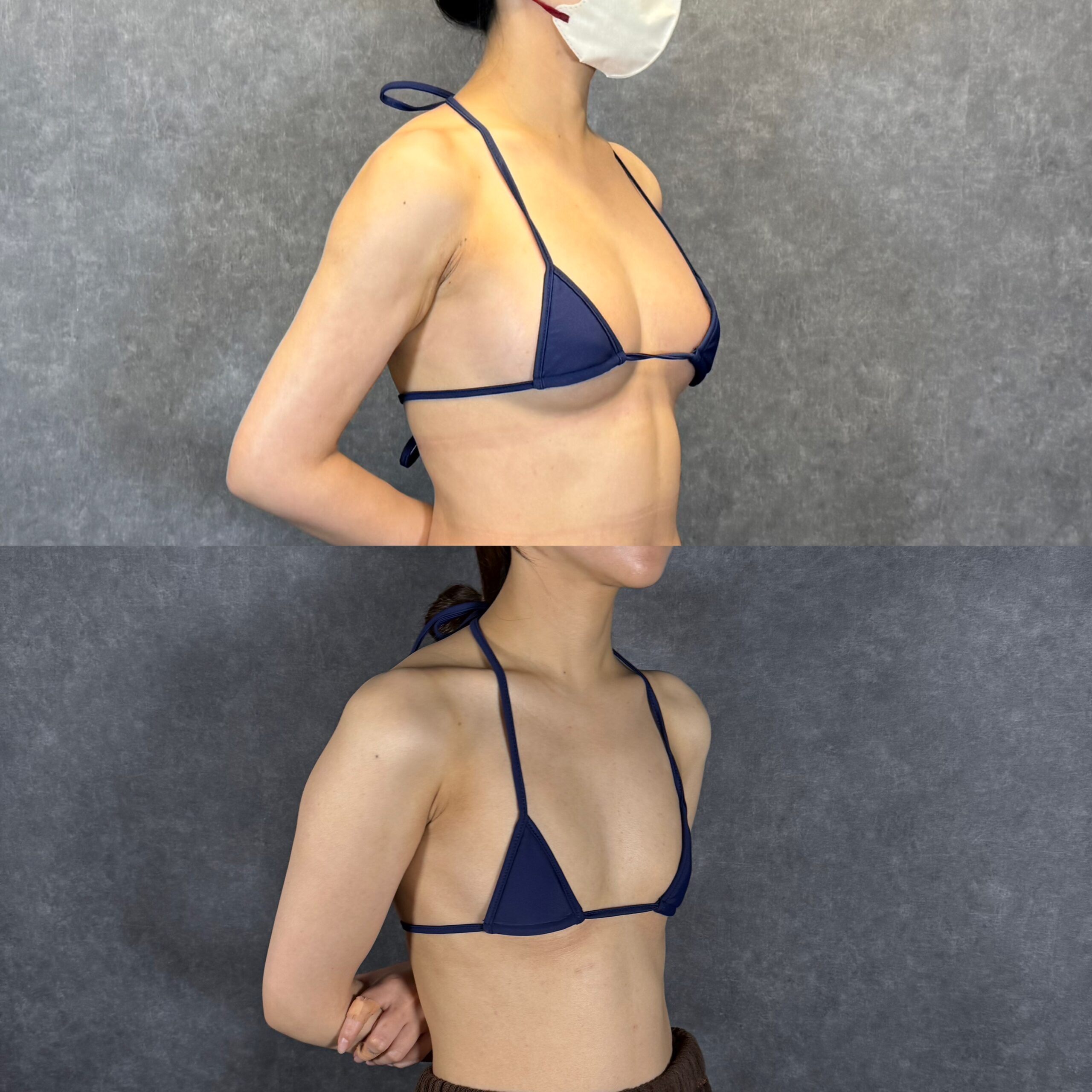
Anatomy of the Breast — The Four Injection Layers Used in Fat Grafting Breast Augmentation
The breast is composed of multiple layers running from the skin down to the pectoralis major. Fat must be placed only after the surgeon has a precise understanding of this layered structure, choosing both the route and the depth accordingly.
1. Subcutaneous Layer (Most Superficial)
A thin fat layer directly beneath the skin. It is essential for fine-tuning the shape, but excessive injection here causes irregularities and palpable lumps.
2. Retro-Mammary Fat Layer (Mid Layer)
The most important layer for overall volume. Rich vascular supply gives high take rates, making this the main workhorse layer of breast augmentation.
3. Pre-Pectoral Layer (Deep)
The layer between the pectoralis major and its fascia. It lifts the foundation of the breast and creates natural roundness and dimension.
4. Intra- and Sub-Pectoral Layer (Deepest)
Used in slim patients with thin skin. It allows the base volume to be increased without over-stretching the skin envelope.
Risks and Signs of Injection That Is Too Shallow
Injection too close to the skin is the leading cause of post-operative problems. The capillary network near the skin is sparse, so injected fat cells receive less oxygen and nutrients. Some fat then undergoes necrosis and becomes oil cysts, producing lumps, calcifications, and palpable nodules. Breasts that feel “hard to the touch” or have a “granular feel” are usually the result of over-injection into the superficial layer.
Superficial injection also lifts the skin strongly, but the outline of fat tends to show through thin skin — a phenomenon called “rippling.”
Risks and Signs of Injection That Is Too Deep
Conversely, excessive injection deep against the pectoralis or near the ribs compresses the ribs and intercostal muscles, prolonging post-operative pain. Large-volume injection into deep layers also carries a risk of pneumothorax (lung injury). Deep layers have good blood supply, but if fat cells are packed too close together they cannot diffuse, and the fat at the center still undergoes necrosis.
“Deeper equals safer” is a misconception — modern breast augmentation follows a different principle.
The AVAN TOKYO Approach: “Multi-Layer Injection by Plane”
Rather than placing large volumes into a single layer, our clinic distributes small amounts thinly across every layer in what we call “multi-layer injection.” The core of this technique is to ensure that every individual fat cell remains within the distance (about 2 mm) from a nearby blood vessel needed to receive oxygen.
In practice:
– Inject 0.1–0.3 cc per pass (single passage of the cannula)
– Cross from superficial to deep layers hundreds of times in multiple directions
– Disperse fat not as a “sheet” but as a “fine mist”
This approach dramatically reduces the risk of lumps while delivering natural roundness and softness.
Décolletage, Cleavage, Lower Pole — Why Depth Differs by Region
The breast is a single organ, but each region — décolletage, cleavage, lower pole, lateral chest — requires a different shape character.
– Décolletage: delicate placement in the superficial-to-mid layer to create natural roundness beneath thin skin
– Cleavage: distributed injection across deep and mid layers to bring the inner breasts together
– Lower pole: solid construction in the deep layer to resist gravitational descent
– Lateral chest: mid-layer focus to create flowing lines
The three-dimensional design ability to decide “where, how much, and at what depth” ultimately determines the beauty of the result.
Common Misconceptions About Depth in Fat Grafting Breast Augmentation
A frequent question is: “Wouldn’t injecting more make the breasts bigger?” In reality, increasing only the volume without correcting the depth design produces the worst outcome — lower take rates and higher lump risk.
For safety standards in aesthetic surgery please refer to the Japan Society of Aesthetic Surgery. The safety of breast augmentation depends heavily on the surgeon’s anatomical understanding and design skill.
Designing a Safe and Beautiful Breast
The true value of this surgery is not “making the breasts bigger” but “creating a breast that feels like a natural extension of the patient’s own body.” Achieving this requires anatomically accurate layer-by-layer injection and a three-dimensional design tailored to each patient’s body type. For slim patients we use the deep layer to build structural volume; for patients with thicker skin we work primarily in the mid layer to deliver natural roundness — the strategy changes for every case.
More detailed commentary is available in our related liposuction and fat grafting column index.
Conclusion — Fat Grafting Breast Augmentation Is About Depth, Not Volume
What determines the result is the design of depth, not the amount injected. The combination of superficial, mid, and deep layers in multi-layer injection is the key to a soft breast without lumps, a natural décolletage line, and a beautiful form that lasts. If you are considering this surgery, we recommend asking your physician not just “how much” but “where” the fat will be placed.
──────────────
[Medical Supervisor] Shin Moriwaki (Supervising Physician)
Member, Japan Society of Aesthetic Surgery (JSAS) / Member, American Academy of Aesthetic Medicine
ECFMG Certificate
──────────────
📍AVAN TOKYO Ginza Liposuction Clinic
AVAN TOKYO GINZA LIPOSUCTION CLINIC
English / 中文 / Tiếng Việt supported
For reservations and consultations
Available via DM / LINE / Website / Phone.