


The True Nature of Firmness After Fat Grafting Breast Augmentation | How Diffuse Fibrosis Differs from Lumps, Explained by a Doctor2026.07.06
Patients who have undergone fat grafting breast augmentation sometimes report a vague sense that their breasts feel uniformly firm or slightly stiff overall. In many cases this is not the well-known lump (oil cyst or fat necrosis nodule), but a different condition called diffuse fibrosis, in which scarring spreads thinly across the entire breast. Because the firmness is felt as a plane rather than a discrete mass, patients often describe it only as heaviness or a subtle change in texture. In this article, Dr. Moriwaki explains the physiological mechanisms of fibrosis after fat grafting breast augmentation, how it differs from lumps, and how it can be prevented.
Key Points of This Article
– Firmness after fat grafting breast augmentation has two distinct forms: focal lumps and diffuse fibrosis
– Fibrosis is scar tissue caused by excessive collagen production in poorly perfused fat, replacing necrotic cells
– Overinjection, injection into layers that are too superficial, smoking, and postoperative compression all promote fibrosis
– On ultrasound, fibrosis appears as diffuse hyperechoic areas, distinguishable from the cystic hypoechoic pattern of lumps
– Choosing the right technique and respecting per-session injection limits is the most essential fibrosis prevention strategy
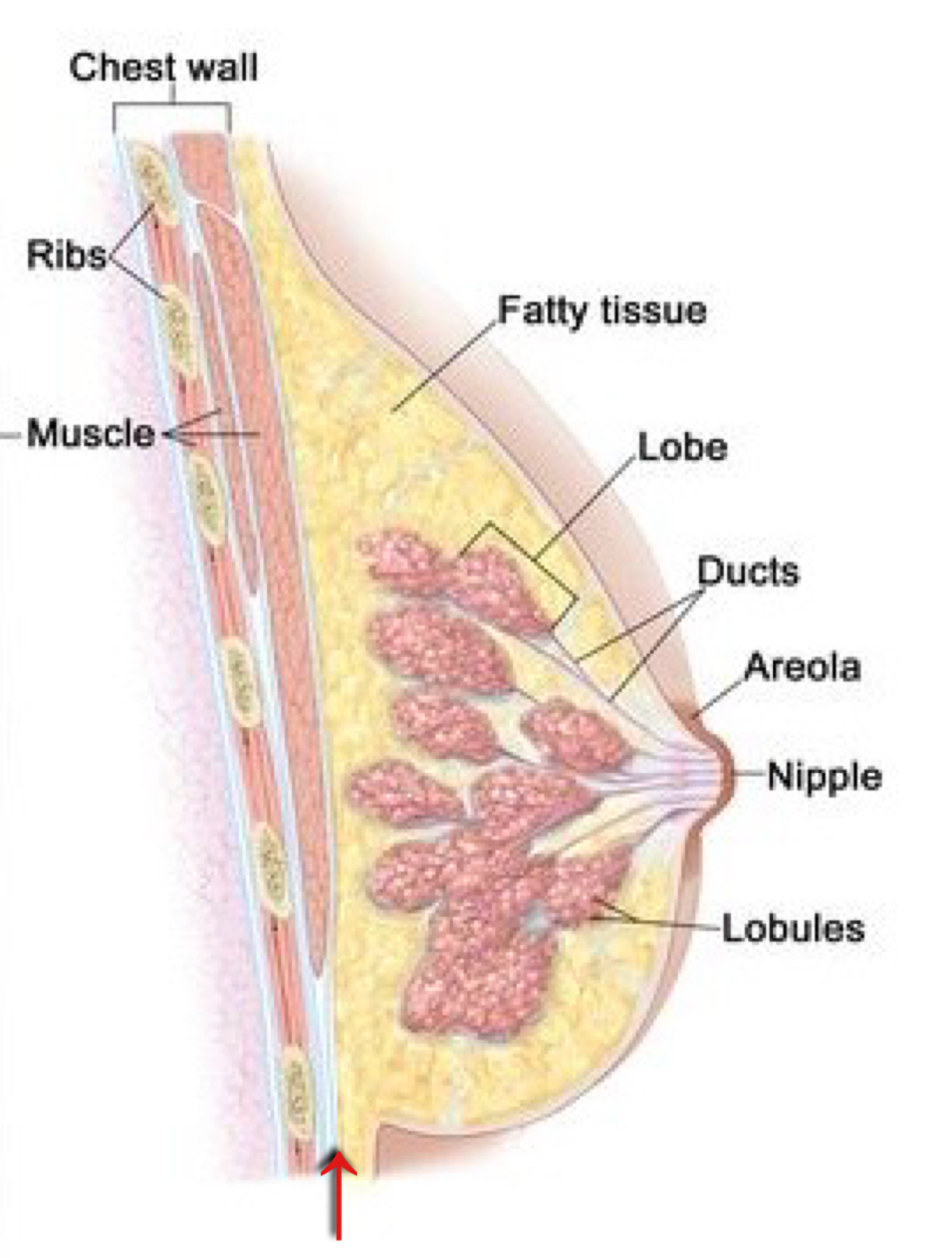
What Is Fibrosis After Fat Grafting Breast Augmentation?
Fibrosis refers to the replacement of native fat and mammary tissue with collagen-based scar tissue. When fat is grafted, cells that do not receive enough oxygen and nutrition undergo necrosis, and fibroblasts move in to fill the gap by producing collagen.
Whereas a lump is a firmness felt at a single point, fibrosis is firmness felt as a broad plane. The elasticity of the entire breast gradually decreases, and the tissue no longer rebounds quickly under gentle pressure. It tends to occur more often in thin patients or when a large volume is injected in a single session.
A Clear Distinction from Lumps
Lumps such as oil cysts or fat necrosis nodules are palpable as clearly defined masses ranging from a few millimeters to several centimeters. On ultrasound, they appear as well-demarcated hypoechoic cystic lesions. Diffuse fibrosis, by contrast, has indistinct borders and spreads as a fine mesh across breast tissue, so it is perceived as an overall firmness rather than a discrete mass.
Why Does Fibrosis Occur After Fat Grafting Breast Augmentation?
1. Fat Necrosis in Low-Perfusion Zones
Grafted fat cells initially survive by diffusion of oxygen from the surrounding tissue. Before neovascularization occurs — roughly the first 48-72 hours — fat cells can only live within a distance of about 1.5-2 mm from a viable blood supply. Cells beyond that range become ischemic, and around the necrotic cells chronic inflammation continues, activating fibroblasts to overproduce collagen.
2. Elevated Tissue Pressure from Overinjection
When too much fat is injected at once, pressure in the recipient layer rises, compressing microvessels and further reducing perfusion. More is not better. Injecting beyond the physiological capacity leads to both fibrosis and oil cysts.
3. Injection into Overly Superficial Layers
The layer just beneath the skin has poor vascularity to begin with, so fat placed there is unlikely to engraft. A large proportion becomes necrotic and fibrotic, and the firmness becomes noticeable at the skin surface.
4. Systemic Factors (Smoking, Anemia, Poor Glycemic Control)
Smoking dramatically reduces fat survival through nicotine-mediated peripheral vasoconstriction. Anemia, diabetes, and peripheral circulatory insufficiency also impair oxygen delivery to the grafted fat and raise the risk of fibrosis. For related articles, please see the liposuction column index here.
Surgical Techniques That Prevent Fibrosis
Layered Injection
Rather than depositing fat in one bolus through a single cannula pass, small amounts should be placed separately into the deep, middle, and superficial layers — each below physiological capacity. This minimizes tissue pressure and maximizes the vascular contact surface.
3D Distribution
Fat must be spread out three-dimensionally so that no dense cluster forms. Concentrated injection at a single point necroses at the center and becomes the seed of fibrosis.
Preserving Graft Quality
Low-pressure harvest, appropriate concentration by centrifugation or sedimentation, and washing to remove free oil all help preserve the viability of injected fat cells. Damaged cells will not engraft and simply become raw material for fibrosis. For safety standards in aesthetic surgery, please also refer to the Japan Society of Aesthetic Surgery.
What to Do If You Feel Fibrosis
Observation Comes First
Firmness in the first 3-6 months often softens naturally as the scar tissue matures. Excessive massage or stimulation may prolong inflammation and worsen fibrosis.
Ultrasound Evaluation
If firmness persists beyond 6 months, ultrasound can objectively assess the extent of diffuse hyperechoic changes. When cystic lumps are also present, each requires a different management approach.
Additional Grafting: Reshape Rather Than Excise
Excising fibrotic tissue causes significant damage to the breast and is rarely performed. Instead, high-quality fat is redistributed in small amounts around the firm areas to restore softness and form.
Frequently Asked Questions
Q. Can I tell fibrosis and lumps apart on my own?
Palpation alone is often insufficient. Lumps tend to feel like discrete masses while fibrosis feels like a general firmness, but the two often coexist, so accurate diagnosis requires ultrasound. Please consult the clinic where your surgery was performed rather than judging on your own.
Q. Can fibrotic tissue return to its original state?
Complete restoration to soft native fat is difficult, but the acute fibrosis of the first 3-6 months does soften as it matures. The best way to minimize long-term fibrosis is to choose the right technique and respect per-session injection limits from the beginning.
Q. Can massage resolve fibrosis?
Excessive massage can prolong inflammation and worsen fibrosis. Please stay within the gentle care recommended by your surgeon.
Q. Why is fat grafting breast augmentation performed in multiple sessions?
Exceeding the physiological capacity in one session sharply increases the risk of fibrosis, lumps, and fat necrosis. Keeping each session within the safe range and dividing treatment across 2-3 sessions maximizes total retention and breast quality.
Q. Does fibrosis affect future mammograms?
Diffuse fibrosis can appear as calcifications or shadows on mammography. Always inform your radiologist of your fat grafting history at breast cancer screenings, and combine ultrasound or MRI when possible.
──────────────
Supervising Physician: Shin Moriwaki, MD
Member, Japan Society of Aesthetic Surgery (JSAS) / Member, American Academy of Aesthetic Medicine
ECFMG Certificate
──────────────
📍AVAN TOKYO GINZA LIPOSUCTION CLINIC
English / 中文 / Tiếng Việt available
Appointments and consultations are accepted via DM / LINE / Website / Phone.