


Why You Must Not Compress Your Breasts After Fat Grafting Breast Augmentation | Actions to Avoid in the Early Engraftment Period2026.07.11
There is a clear medical reason why surgeons repeatedly warn patients not to press or compress the breasts immediately after fat grafting breast augmentation. Whether the transplanted fat cells will survive is decided during the first 2 to 3 weeks after surgery, when they receive oxygen and nutrients from the surrounding tissue. If external pressure is applied during this window, the ongoing process of “vascular re-establishment” between the fat cells and surrounding tissue is physically disrupted, raising the risks of poor take rate and lump formation. In this article, Dr. Moriwaki of AVAN TOKYO explains why compression after fat grafting breast augmentation must be avoided, along with the underlying mechanism and specific behaviors to steer clear of.
Key Points of This Article
・After fat grafting breast augmentation, transplanted fat cells are in the middle of “vascular re-establishment,” rebuilding blood supply from the surrounding tissue over 2 to 3 weeks.
・Strong compression during this period physically crushes tiny new blood vessels, driving parts of the fat toward ischemia and necrosis.
・Beyond a lower take rate, necrotic fat can liquefy and encapsulate, forming lumps or oil cysts.
・For the first month after surgery, avoid sleeping face down, underwire bras, aggressive massage, and chest-focused exercise.
・To protect both a natural shape and the take rate, strict “no-pressure living” is as essential as good surgical technique.
How Do Grafted Fat Cells Survive?
The transplanted fat cells themselves have no blood vessels; they are placed as isolated clusters within the gaps of surrounding tissue. Right after injection, the fat is not yet “engrafted.” It first receives oxygen and nutrients while suspended in tissue fluid seeping in from surrounding tissue (the diffusion nutrition phase). Then capillaries from nearby tissue grow into the graft, rebuilding a network inside. This is “vascular re-establishment,” the essential engraftment mechanism of fat grafting breast augmentation.
This process requires “static, stable contact” between the grafted fat and surrounding tissue. Only when the tissues stay still, allowing microvessels time and scaffolding to grow, does the fat settle in as living cells. Conversely, any factor that physically disrupts this delicate process becomes a direct cause of poor engraftment and lumps.
Three Ways Compression Damages Fat Cells
The risks of compressing the breasts after surgery can be grouped into three. First, the tiny new blood vessels that have just started to grow are crushed, leaving the fat cells beyond them ischemic. Second, repeated shifts in contact between fat cells and the recipient tissue destabilize diffusion nutrition itself. Third, in areas where pressure concentrates, fat cells are packed together, and necrosis progresses from the oxygen-starved core. This necrotic tissue liquefies into an “oil cyst,” while the surrounding tissue fibroses, producing a palpable “lump.”
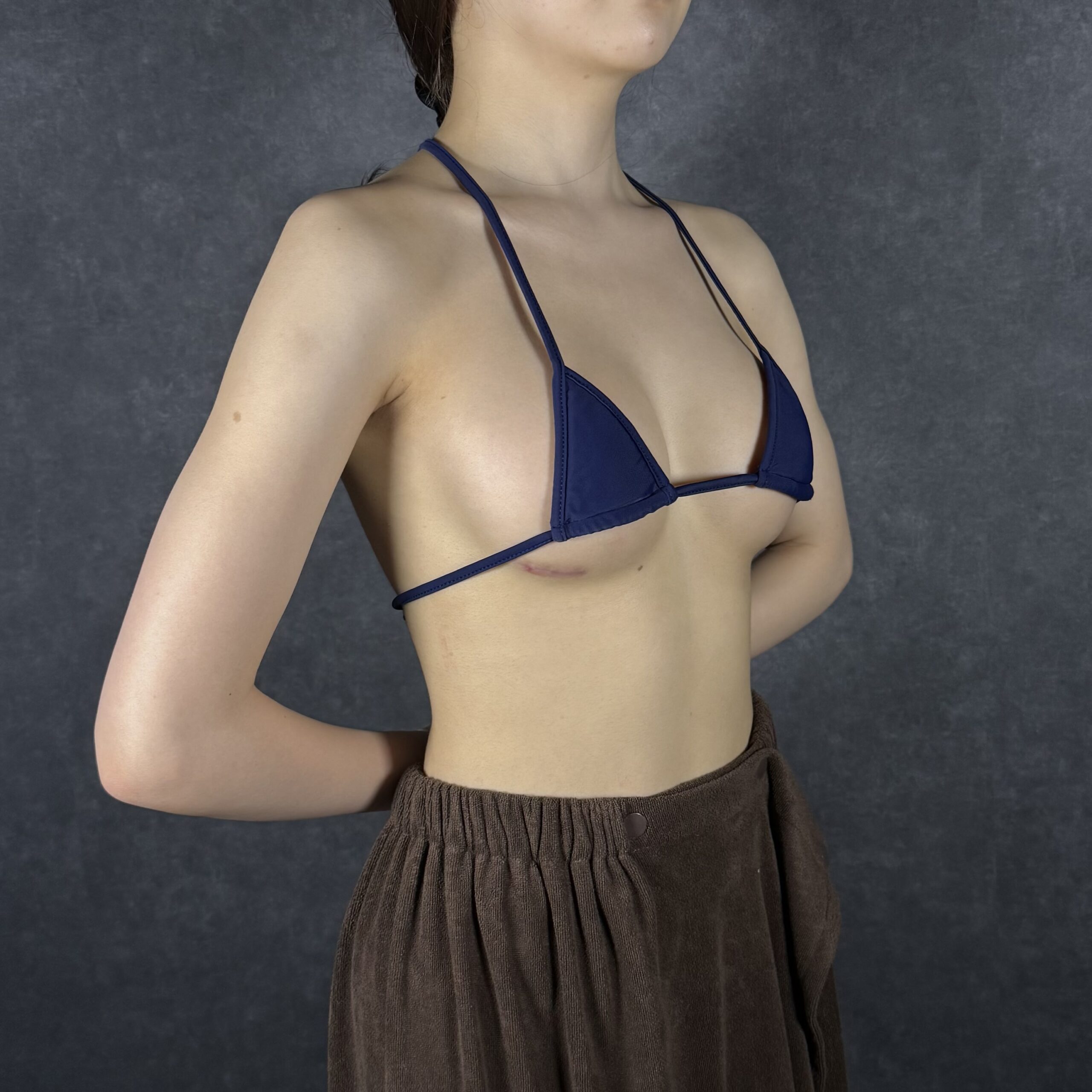
Specific Behaviors to Avoid After Surgery
Even when told to “avoid compression,” many hidden sources of pressure exist in daily life. To protect the take rate of fat grafting breast augmentation, the following actions must be strictly avoided for at least one month. Individual differences aside, these four items share a large impact on the early engraftment period.
Long Hours of Face-Down or Side Sleeping
During sleep, your body weight rests on the chest for long periods. Face-down sleeping in particular sustains high pressure over hours, making it the most damaging position for grafted fat. For the first month after surgery, sleep on your back as a rule. If you tend to roll to the side, use a body pillow to disperse pressure on the chest.
Underwire or Tightly Compressive Bras
Bras designed to “lift and push together” using wires or pads are an extremely poor match for the early postoperative breast. Use the prescribed non-wire bra or a soft bralette, with the sole goal of “keeping the fat still in position.” Bras that pull tightly with hooks can trigger localized rippling or lumps.
Massage, Bodywork, and Self-Directed Care
The notion that “massage is needed to help the fat settle” is a major misconception. For this procedure it is the opposite: early postoperative massage is the worst possible act, one that destroys new blood vessels. Even if contracture care or lymphatic massage becomes necessary later, that is strictly after engraftment stabilizes, and should never be attempted within the first month based on self-judgment.
Intense Exercise and Chest-Focused Training
Movements that strongly contract the pectoralis muscles repeatedly apply pressure and shear force to the grafted fat layer. Bench presses, push-ups, and certain yoga poses should be avoided for at least a month. Running also keeps the breasts bouncing vertically, so restart gradually while stabilizing them with the prescribed sportswear.
A “No-Pressure Lifestyle” Shapes the Result
The outcome of fat grafting breast augmentation is not determined in the operating room alone. Injection technique and fat quality matter, of course, but the patient’s own “one month after surgery” weighs just as much or more on the take rate. Especially for slim patients or those unsatisfied with the take rate of past procedures, tight lifestyle management during this window dramatically changes results. AVAN TOKYO invests carefully in postoperative nutrition and lifestyle guidance precisely because we understand the medical importance of this early engraftment window.
For safety standards and postoperative management principles in cosmetic surgery, please also refer to information from the Japan Society of Aesthetic Surgery. For more detailed articles on breast augmentation and liposuction, please see our liposuction column index.
Frequently Asked Questions
Q. When can I sleep on my stomach after fat grafting breast augmentation?
One month after surgery, once engraftment stabilizes, is the general guideline. Individual variation exists, and caution is needed if swelling or discomfort remains. At our clinic, we check your condition at the one-month follow-up before individually advising when face-down sleeping is safe.
Q. If I wear an underwire bra too early after surgery, could that cause lumps?
Wearing an underwire bra early creates intense local pressure, raising the risk of lump formation and rippling-like depressions. We recommend using the prescribed non-wire garment for at least one month, then transitioning back gradually in stages.
Q. Does breast massage improve the take rate?
Scientifically, the answer is the opposite: early postoperative massage is a high-risk act that destroys new blood vessels and likely lowers the take rate. Massage aimed at “blending in” the fat is not recommended for this procedure. Please think of doctor-directed care and self-directed massage as entirely different things.
Q. How careful do I need to be? Should I avoid seatbelts too?
The key is to avoid “sustained, strong pressure.” A few seconds of contact or ordinary seatbelt use is not a major issue. Strictly avoiding face-down sleeping, tight compressive underwear, and chest-focused exercise is the practical yardstick.
Q. If I compressed my breasts even once, will that area no longer engraft?
One brief contact will not dramatically lower the overall take rate. However, repeated pressure or prolonged compression accumulates as damage. Once you notice it, revise your habits and consult your surgeon at the postoperative check.
──────────────
Supervised by: Dr. Shin Moriwaki (Supervising Surgeon)
Member, Japan Society of Aesthetic Surgery (JSAS) / Member, American Academy of Aesthetic Medicine
ECFMG Certificate
──────────────
📍AVAN TOKYO Ginza Liposuction Clinic
AVAN TOKYO GINZA LIPOSUCTION CLINIC
English / 中文 / Tiếng Việt available
For reservations and consultations,
please contact us via DM / LINE / Website / Phone.