


Abdominal Liposuction Is Not Just About the Waistline — What Is the “Lower Belly Pocket”?2026.05.13
“No matter how hard I diet, only my lower belly sticks out.” “I have a waistline, but from the side, my belly still looks puffy.” Many women face exactly this kind of frustration.
When people think of abdominal liposuction, they tend to focus on creating a defined waist. In reality, however, what most determines the final silhouette is the so-called “lower belly pocket” — a localized mass of fat that sits below the navel.
The lower belly pocket has a uniquely complex anatomical structure and is notoriously resistant to diet and exercise.
Without properly understanding and treating this region, no amount of waistline contouring will eliminate the side-profile bulge. Let us examine, from a medical standpoint, why this pocket is so stubborn and how it should be approached with liposuction.
What Exactly Is the “Lower Belly Pocket”?
The lower belly pocket refers to an independent layer of fat that sits between the navel and the pubic bone. Its properties differ from those of ordinary abdominal fat, and it is strongly influenced by hormonal and skeletal factors.
Anatomical Characteristics of the Lower Belly
Compared to the upper or lateral abdomen, the subcutaneous fat of the lower abdomen contains looser fibrous connective tissue and larger adipocytes. In other words, it is a “storage-type” fat that easily accumulates energy and releases it only with difficulty.
The lower abdomen lies between the lower edge of the rectus abdominis muscle and the upper rim of the pelvis, where fascial tension is structurally weaker. As a result, aging, childbirth, or postural collapse can loosen the fascia and push fat forward into a distinctive pocket-like shape.
The lower belly pocket is therefore not simply fat accumulation — it is a structural phenomenon involving fascia, skeleton, and fat working together.
Why Diet and Exercise Cannot Remove It
The lower belly fat is a subcutaneous fat strongly influenced by estrogen, and unlike visceral fat, it does not burn off quickly through short-term energy expenditure. This is precisely why the lower belly is often the last area to slim down, even as overall body fat decreases.
Furthermore, in women with a posteriorly tilted pelvis, the fascia of the lower abdomen tends to stretch forward, causing the fat to protrude even more prominently. No amount of crunches can correct this structural issue between fascia and subcutaneous fat, which is why the visible bulge stubbornly remains.
Without addressing this underlying structure, removing only the superficial fat will not yield a meaningful improvement.
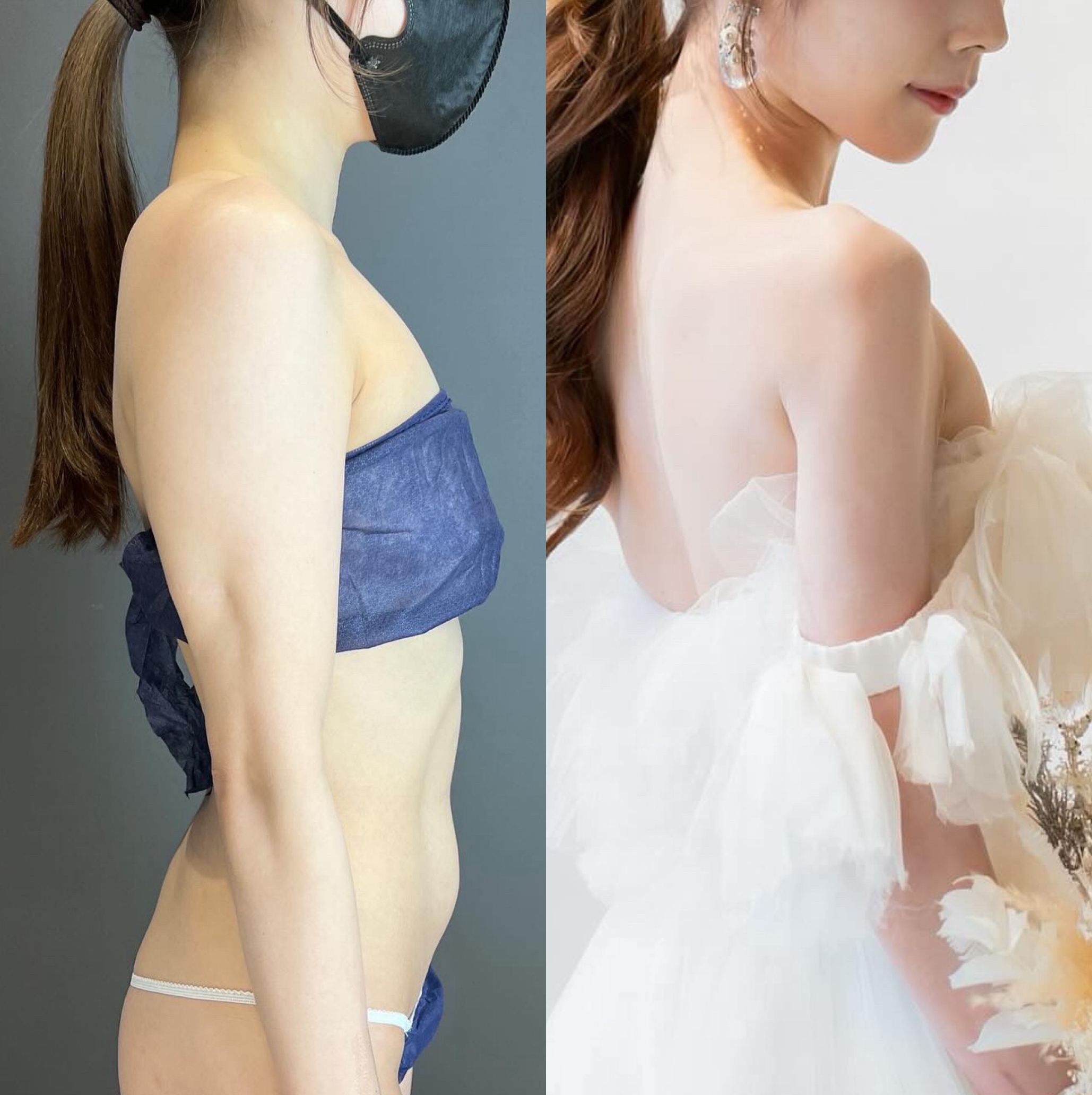
How to Design Lower Belly Liposuction
If abdominal liposuction focuses only on the waistline, the side profile will remain visually unsatisfying. To truly sculpt a beautiful abdomen, the front-view waist curve and the side-view flatness must both be addressed in a three-dimensional design.
Thinking in Layers, Not Surfaces
What matters most in lower belly liposuction is treating both the superficial and deep layers. Suctioning only the superficial layer can leave post-operative unevenness, while addressing only the deep layer leaves the surface thickness — and thus the pocket — intact.
At AVAN TOKYO, we divide the lower abdomen into superficial and deep layers and adjust the amount removed based on the quality and quantity of fat in each. By carefully thinning the deep layer, we flatten the forward protrusion between the pelvis and abdominal wall from the inside, producing a beautifully flat side profile. At the same time, evenly contouring the superficial layer eliminates the visible bulge while preserving smooth, supple skin.
Connecting the Waist and the Lower Belly
A defined waistline is created by three-dimensional liposuction of the lateral abdomen between the lower ribs and the iliac crest. However, if only this area is treated and the lower belly is left untouched, the patient may look slim from the front yet still display a forward bulge from the side — an unbalanced outcome.
The ideal design connects the narrowest part of the waist to the lower belly with a smooth, continuous curve. The entire abdomen, from below the ribs to above the pubic bone, must be approached as a single surface and sculpted three-dimensionally. This concept of “through-suction” is what truly transforms the final result of abdominal liposuction.
At AVAN TOKYO, we evaluate pelvic tilt, fascial tension, and fat distribution from multiple angles before designing a customized abdominal plan for each patient.
Summary
Abdominal liposuction is not just about creating a waistline — it is fundamentally about how the lower belly pocket is handled.
This pocket is a structural phenomenon shaped by fat, fascia, and skeleton working in concert, and it is extraordinarily resistant to diet and exercise.
Achieving a truly beautiful abdomen requires layered, three-dimensional liposuction and a continuous design that connects the waist to the lower belly. The simple notion of “removing belly fat” will never deliver the ideal side-view silhouette.
If you have struggled for years with a stubborn lower belly, we encourage you to consult a specialist who can design liposuction tailored to your unique abdominal structure. Properly treating the lower belly pocket creates a stomach line that is beautiful from every angle — front, side, and beyond.
📍AVAN TOKYO Ginza Liposuction Clinic
AVAN TOKYO GINZA LIPOSUCTION CLINIC
English / 中文 / Tiếng Việt supported
For appointments and consultations,
please contact us via DM / LINE / Website / Phone.