


Why Skin Recovery Differs After Liposuction in Your 40s and 50s | A Doctor Explains Dermal Collagen and Elastic Fibers2026.07.10
Patients in their 40s and 50s considering liposuction almost always ask the same question: “Will my skin retract the way it did when I was younger?” The honest answer is that liposuction after 40 shows a slower skin remodeling pace compared with patients in their 20s, and the pattern of contracture and the final line take longer to settle. That does not mean the skin “won’t retract.” With a surgical plan and postoperative care designed around age-related changes in dermal collagen and elastic fibers, beautiful lines are absolutely achievable in the 40s and 50s. In this article, Dr. Moriwaki explains the anatomy of the dermis, the biology of skin aging, and how design and downtime should be adjusted for mature skin.
Key Points of This Article
・Liposuction after 40 involves slower collagen synthesis and altered cross-linking, so skin remodeling requires a longer timeline than in the 20s.
・Elastic fibers (elastin) barely regenerate over a lifetime and fragment with age, so the skin’s intrinsic ability to “pull back” is physically reduced.
・Superficial over-suctioning is risky at any age, but preserving the sub-dermal fat pad is absolutely essential in patients over 40.
・Extending the compression period and optimizing nutrition and sleep during the contracture phase produces marked line refinement even in mature skin.
・When skin laxity is severe, liposuction alone is not the answer — combining excision or tightening devices should be considered.
Why Liposuction After 40 Shows a Different Skin Response
Skin consists of three layers — epidermis, dermis, and subcutaneous tissue — and postoperative “recovery” is largely governed by the remodeling capacity of the dermis. The dermis is built from collagen fibers that provide strength, elastic fibers (elastin) that provide recoil, and a ground substance of hyaluronic acid supporting both. Age-related change in the balance and quality of these three components is the true reason mature skin takes longer to snap back.
Quantitative and Qualitative Changes in Collagen Fibers
Dermal collagen peaks in the late 20s and then declines by about 1% per year, meaning patients in their 40s already have 10 to 15% less total collagen. Age-related glycation (AGE formation) also cross-links collagen fibers abnormally, robbing them of their suppleness. The result is skin that remains thick but no longer shrinks, prolonging the re-adhesion of skin to underlying tissues after liposuction.
The Elastin Meshwork
The elastic fiber network is largely completed in fetal development and barely regenerates thereafter. UV damage, smoking, and chronic inflammation gradually fragment elastin, so the meshwork is noticeably sparse by the 40s and 50s. Because the skin’s “pull-back and reshape” force depends on this network, mature skin simply has less physical reserve to retract than younger skin does.
The Biological Reason Recovery Feels Slower
Skin remodeling is a sequential wound-healing process centered on fibroblasts, and fibroblast activity itself is influenced by age.
Hormonal Response in Wound Healing
Estrogen is a key hormone promoting collagen synthesis and angiogenesis, and its levels decline gradually from the 40s and steeply after menopause. Given the same surgical insult, fibroblasts in women in their 40s respond more slowly, and the peak of the contracture phase tends to arrive one to two months later than in younger patients. This is not “poor healing” but a longer healing curve — a distinction that matters when deciding whether to consider revision. Patience during this window is critical.
Reduced Blood Flow and Metabolism
Capillary density in the subcutaneous tissue decreases with age, slowing oxygen delivery and metabolite clearance in the skin. Bruising that fades in 2 to 3 weeks in younger patients often takes 4 to 5 weeks after liposuction in the 40s. Warm baths, light aerobic activity, and adequate protein intake can meaningfully support metabolism during this recovery phase.
Adjusting Suction Design for Mature Skin
The most important principle of liposuction after 40 is: “Do not remove the same volume, at the same depth, as you would in a younger patient.” Instead of relying on the skin’s ability to shrink, the surgeon shapes the line by choosing which fat to leave behind.
Absolute Avoidance of Superficial Over-Suctioning
Just beneath the dermis lies a thin layer called the sub-dermal fat pad, which supplies blood to the dermis and preserves skin glide. Aggressively suctioning this layer in patients over 40 dramatically increases the risk of blotchy irregularities, skin tethering, and prolonged hyperpigmentation. In mature-skin cases, we strictly adhere to layered suction and deliberately preserve the superficial plane.
The Concept of Layer-Specific Fat Preservation
Rather than simply “taking less,” we suction the deep layer to define the outline, contour the mid layer to refine volume, and preserve the superficial layer as a skin cushion. This three-layer strategy prevents unnatural sag and step deformities even when skin elasticity is reduced. For aesthetic surgery safety standards and technical benchmarks, the Japan Society of Aesthetic Surgery is also a useful reference.
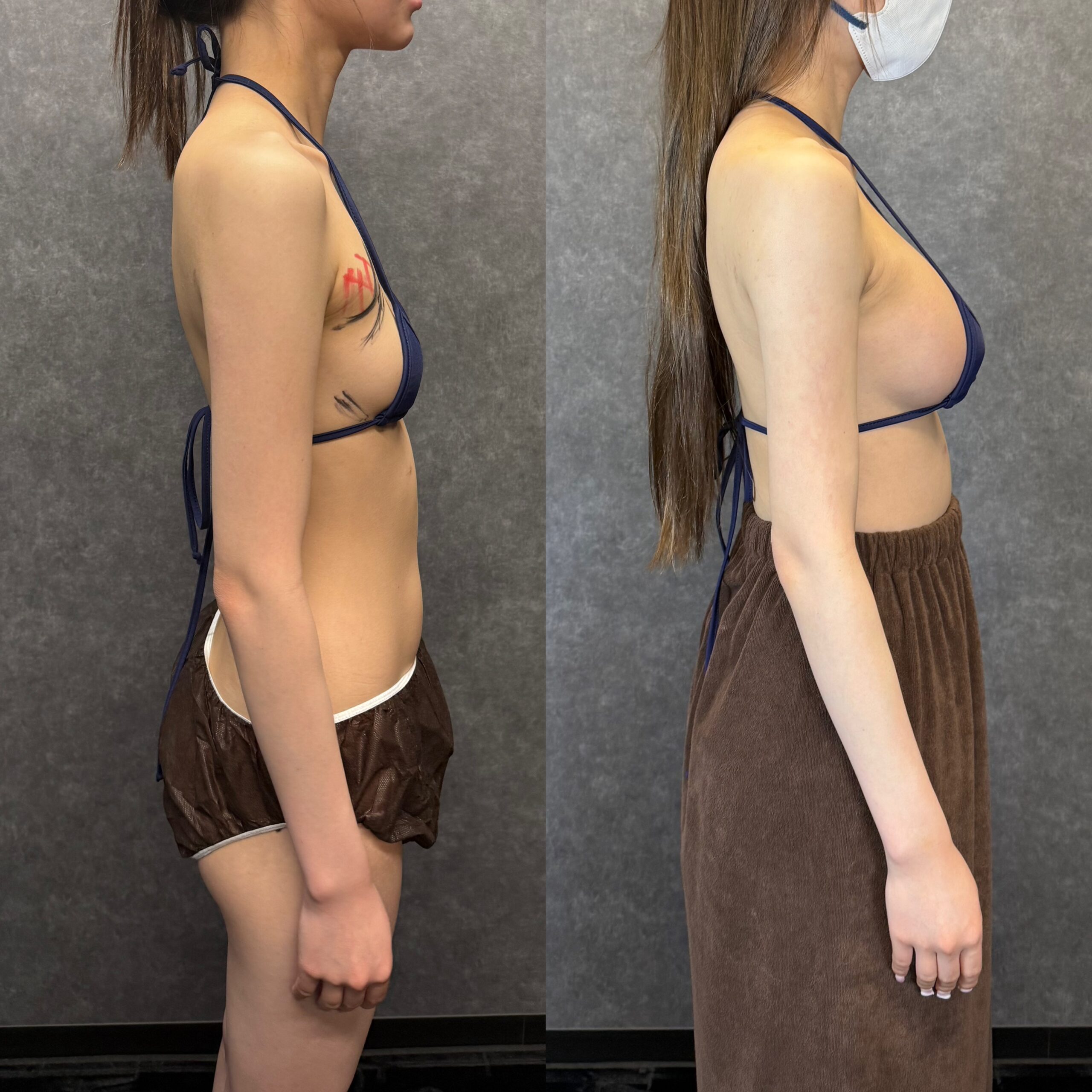
Postoperative Care to Maximize Skin Retraction
In mature skin, the quality of postoperative care translates directly into the final result. The same surgery can produce very different appearances at three months depending on how the recovery period is managed.
Extending the Compression Period
Where 2 to 3 weeks of compression is standard for younger patients, we recommend that patients in their 40s and 50s continue compression garments for 4 to 6 weeks. Compression promotes dead-space closure and skin re-adhesion, preventing prolonged swelling — the most fundamental and important postoperative measure.
Nutrition, Protein, and Sleep
Collagen re-synthesis requires amino acids, iron, vitamin C, and zinc. We recommend protein intake of 1.2 to 1.5 grams per kilogram of body weight, and encourage patients to avoid caffeine and alcohol for two hours before bed to protect the deep-sleep phase during which growth hormone peaks.
For more detailed recovery guidance and case examples by area, please also see our liposuction column index.
Frequently Asked Questions
Q. Can I have liposuction in my 40s?
Age alone is not a reason to give up on liposuction. However, elasticity, medical history, medications, and lifestyle all need to be evaluated. Planning with a layered design tailored to mature skin — rather than replicating a younger-patient design — is what directly determines both safety and satisfaction.
Q. Will the skin still retract in the 50s?
Yes, it will retract, but more slowly and to a more limited extent. When elasticity is clearly reduced, combining liposuction with skin excision or RF/ultrasound-based tightening devices can be a valid, and sometimes necessary, strategy.
Q. What complications should patients in their 40s watch for?
The most typical are blotchy irregularities from superficial over-suctioning, skin tethering, and prolonged pigmentation. These can be substantially prevented by careful management of the suction plane during surgery and by consistent postoperative compression, moisturization, and sun protection.
Q. How long until the final shape appears?
In liposuction after 40, the contracture peak occurs at 1 to 3 months and the final line typically settles at 6 to 9 months — plan for one to two months longer than a younger patient would need.
Q. When can revision surgery be performed if needed?
Scar tissue matures after about six months, and most revision decisions are best made at 9 to 12 months. Attempting revision too early risks stacking tissue damage and worsening the final appearance.
──────────────
【Supervising Physician】Shin Moriwaki / 森脇 進
Member, Japan Society of Aesthetic Surgery (JSAS) / Member, American Academy of Aesthetic Medicine
ECFMG Certificate
──────────────
📍AVAN TOKYO Ginza Liposuction Clinic
AVAN TOKYO GINZA LIPOSUCTION CLINIC
English / 中文 / Tiếng Việt supported
Reservations and consultations available via
DM / LINE / Website / Phone.