


Is Fat From the Arms Suitable for Fat Transfer Breast Augmentation?2026.07.13
Why Arm Liposuction and Breast Augmentation Are an Excellent Combination
Many people believe that fat harvested from the thighs is the best choice for fat transfer breast augmentation, and that fat from the upper arms is of lower quality.
In reality, this is not necessarily true.
At AVAN TOKYO, the upper arms are the most common donor site for patients undergoing fat transfer or Hybrid Breast Augmentation.
Although studies suggest that thigh fat may contain a higher concentration of adipose-derived stem cells, successful fat graft survival depends on many factors—including harvesting technique, fat processing, injection technique, blood supply, and postoperative care—not simply where the fat is harvested.
Why We Frequently Harvest Fat From the Upper Arms
Many of our patients choose:
- Circumferential arm liposuction + Fat Transfer Breast Augmentation
- Circumferential arm liposuction + Hybrid Breast Augmentation
This combination allows us to improve the entire upper body at the same time.
During one procedure, we can:
- Slim the upper arms
- Reduce accessory breast (axillary fat)
- Refine the underarm contour
- Enhance breast volume
The result is a much more balanced and elegant upper-body silhouette.
Creating a Better Body Balance
Beautiful body contouring is not only about adding volume.
It is also about removing volume from the right areas.
If breast volume is increased while the upper arms remain bulky, the overall appearance may simply look heavier.
By slimming the arms and underarm area while enhancing the breasts, the breasts appear more prominent and the entire upper body becomes more proportionate.
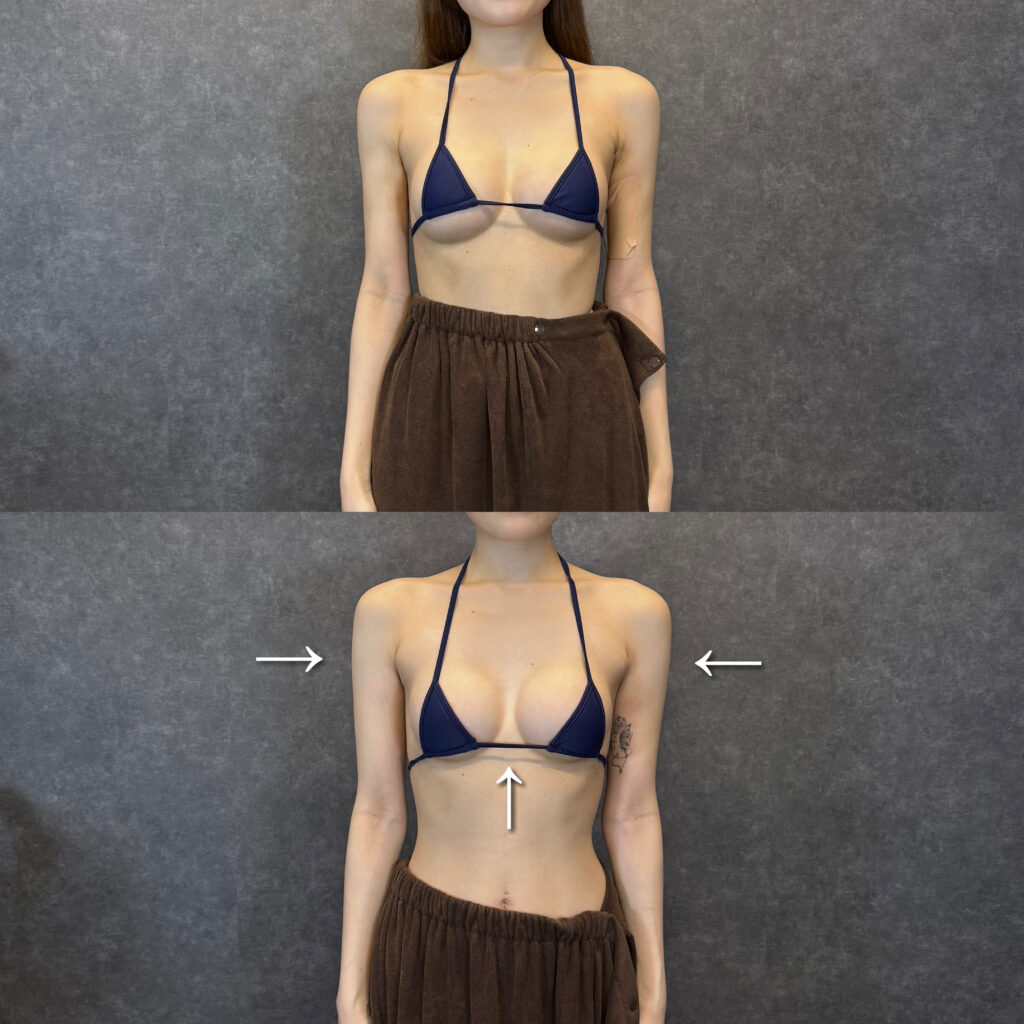
Featured Case
This patient had a BMI below 18 and previously underwent breast augmentation with silicone implants at another clinic.
Because of her lean body type, the implant edges were relatively noticeable.
We performed:
- Circumferential arm liposuction
- Accessory breast liposuction
while preserving approximately 2 mm of the superficial fat layer to maintain smooth arm contours.
The harvested fat was carefully injected into the upper cleavage and décolletage:
- Right breast: 140cc
- Left breast: 120cc
At 3 months after surgery, the transferred fat has demonstrated excellent retention while creating a softer, more natural upper breast contour.
Why Arm Liposuction and Breast Augmentation Work So Well Together
Arm liposuction is more than simply making the arms smaller.
The harvested fat can also be used to:
- Improve the décolletage
- Soften implant edges
- Correct asymmetry
- Enhance upper pole fullness
Rather than simply transferring fat, we reshape the entire upper body.
The AVAN TOKYO Philosophy
At AVAN TOKYO, we do not view arm liposuction as an isolated procedure.
We carefully design:
- Arm contour
- Shoulder transition
- Accessory breast area
- Underarm contour
- Breast contour
- Décolletage
- Overall upper-body balance
Our goal is to create natural, harmonious body proportions rather than simply reducing fat.
Who May Benefit?
This combination may be suitable for patients who:
- Want slimmer arms and fuller breasts simultaneously
- Have a lean body type
- Want to soften visible implant edges
- Desire more upper breast fullness
- Wish to improve accessory breast fullness
- Prefer comprehensive upper-body contouring
Summary
The quality of fat used for breast augmentation is not determined solely by where it is harvested.
Successful fat grafting depends on surgical technique, fat processing, graft placement, blood supply, and postoperative care.
At AVAN TOKYO, arm fat is frequently used with excellent clinical outcomes.
By combining arm liposuction with fat transfer or Hybrid Breast Augmentation, we create a slimmer upper body and a naturally enhanced breast contour at the same time.
Risks and complications: Swelling, bruising, pain, fibrosis, infection, hematoma, seroma, fat necrosis, palpable lumps, calcification, oil cysts, fat absorption, individual variation in fat survival, asymmetry, skin tethering, scarring, pigmentation changes, sensory changes, and possible revision surgery.
This article is intended for medical education purposes. Individual results and recovery vary.