


Bi-Needle Fat Grafting for Breast Augmentation: Four-Layer Even Distribution Explained2026.09.10
In fat grafting breast augmentation, the way harvested fat is distributed influences the final size, softness, and lump-free feel far more than the raw volume injected. At our clinic we use bi-needle fat grafting — placement with multi-port cannulas — to lay down thin, even strands of fat across four distinct planes: subcutaneous, subglandular, intramuscular, and submuscular. Drawing on a case in which fat was harvested from several upper-body sites and roughly 250–260 ml was placed into each breast, this article explains, from the operating surgeon’s perspective, why bi-needle fat grafting helps reconcile graft survival with a natural result, along with its mechanisms and limitations.
Key points
・Bi-needle fat grafting uses a multi-port cannula that deposits several thin, even strands of fat in a single pass.
・Even distribution across four planes (subcutaneous, subglandular, intramuscular, submuscular) shortens the distance between each grafted adipocyte and the nearest recipient capillary, which is the theoretical basis for higher graft survival.
・What prevents lumps and fat necrosis is not the total volume injected, but how thin each single-stroke deposit is kept.
・Harvesting from several upper-body sites simultaneously spreads out the risk of donor-site divots and contributes to overall upper-body contouring.
・Graft survival and final appearance vary between individuals; compression and lifestyle management are integral to the overall design.
What is bi-needle fat grafting?
A bi-needle is a fat-injection cannula with multiple small side ports near the tip. At our clinic we typically use a set of four such cannulas. A conventional single-port cannula deposits only one strand of fat per withdrawal stroke, whereas a multi-port cannula lays down several thin strands in a fan pattern with each pass. This spreads fat as a thin layer across a wider zone without adding extra passes, structurally reducing the risk of leaving fat as a thick clump — the central portion of which is prone to ischaemia. Bi-needle fat grafting is best understood not as a device for pushing in more volume, but as a design tool for controlling exactly what depth and what thickness the fat is placed at.
Why four-layer even distribution influences graft survival
Immediately after transplantation, adipocytes rely on diffusion of oxygen and nutrients from surrounding tissue fluid. If a graft is left as a thick clump in this early phase, the central adipocytes become ischaemic before capillaries can grow in, resulting in oil cyst formation or lump development. Textbook literature suggests that graft survival becomes difficult once an adipocyte sits more than roughly 1.5–2 mm from the nearest vessel — the rationale for spreading fat in thin strands.
In this case, approximately 510 ml in total was placed bilaterally across four planes — subcutaneous, subglandular, intramuscular, and submuscular. Each plane has a distinct role: subcutaneous fat governs shape and softness, subglandular fat provides volume, intramuscular fat supports upper-pole projection and resistance to compression, and submuscular fat forms the foundation of the cleavage. In bi-needle fat grafting, rather than depositing tens of millilitres in one place per plane, the multi-port cannula lays fat down in a few millilitres per pass so that thickness stays uniform even within a single plane, avoiding the concentrated deposits that seed lumps.
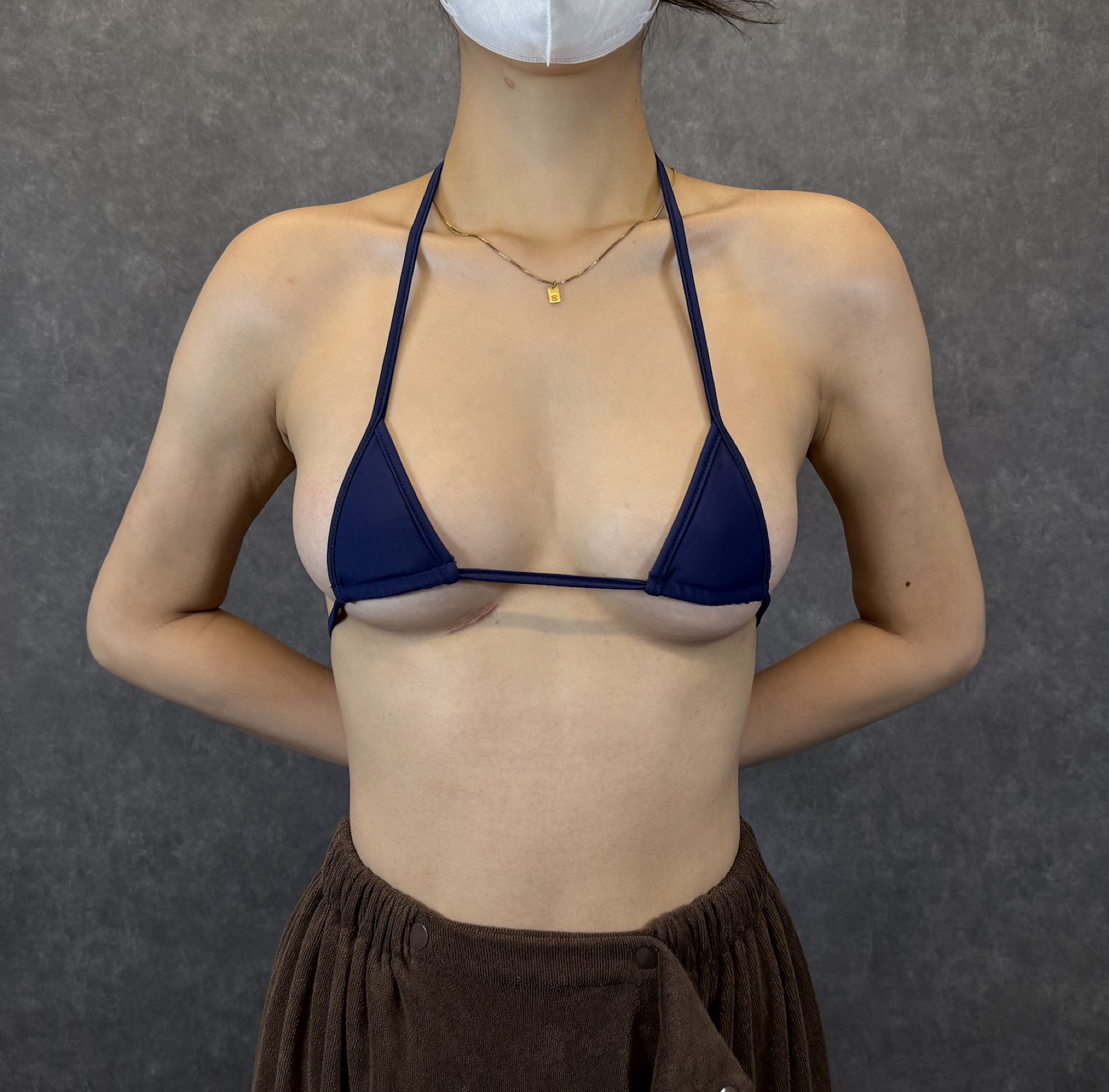
Treatment, fees, and risks in this case
Treatment: in a woman in her thirties, liposuction was performed circumferentially on the upper arms, flanks, accessory breast tissue, and the areas above and below the shoulder blades. The harvested fat was purified by centrifugation and placed bilaterally into the breasts across four planes using bi-needle fat grafting. Injection volumes were 260 ml on the right and 250 ml on the left.
Fees: total cost varies with the surgical range, number of donor sites, and volume injected. Please refer to our price page. The final estimate is confirmed at consultation.
Main risks and side effects: bruising, swelling, numbness, fibrosis, asymmetry, infection, fat necrosis, lumps (oil cysts, calcification), individual variation in graft survival, transient changes in nipple-areolar sensation, and unevenness or pigmentation at donor sites. Results vary between individuals and the photographs represent one case.
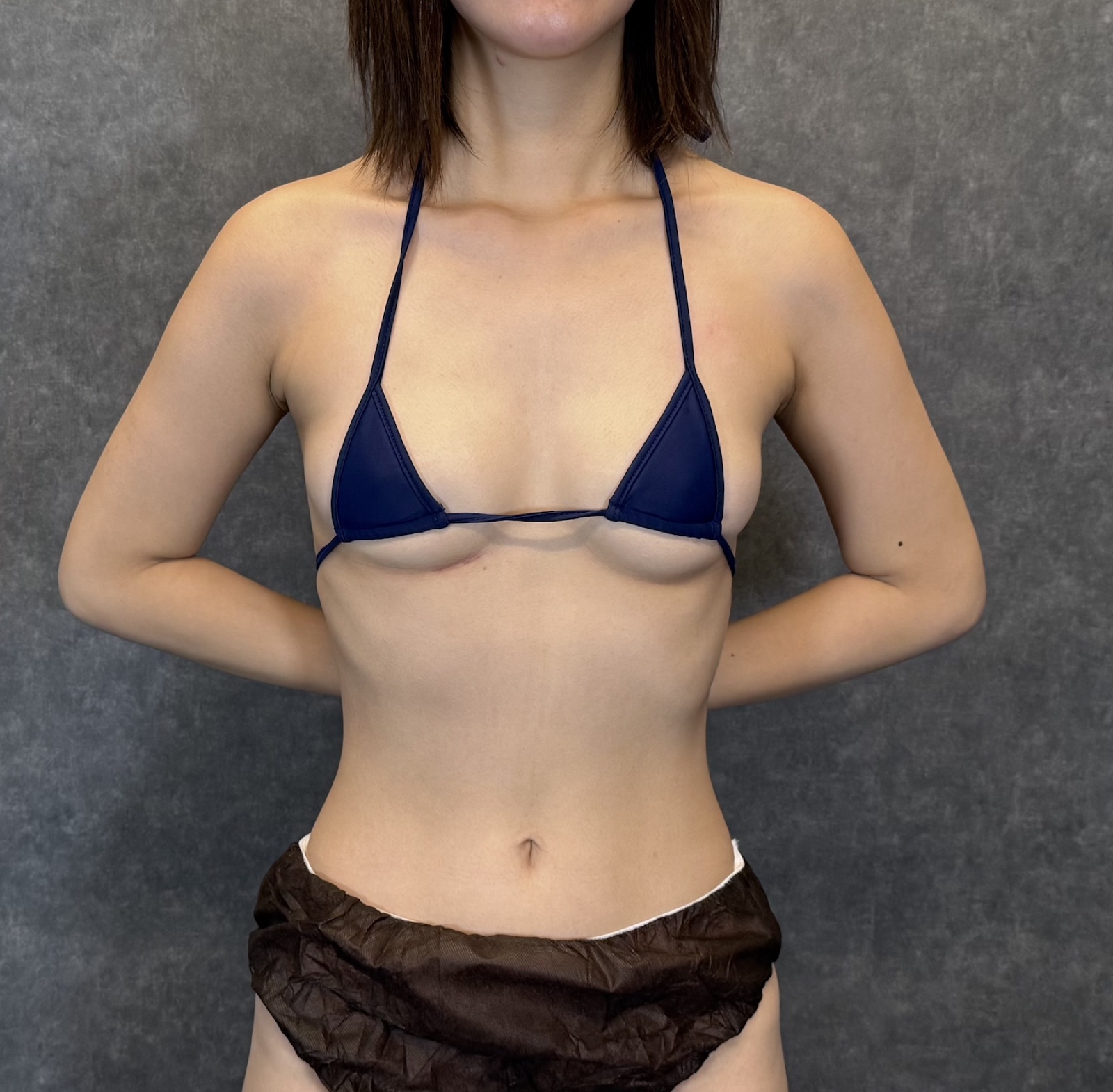
Donor-site design and the upper-body silhouette
The choice to harvest from the entire upper arm circumference, the flanks, accessory breast tissue, and the areas around the shoulder blades — the sites where the upper body tends to accumulate fat — reflects two considerations. First, taking a large volume from a single site is more likely to leave a divot there, so spreading donor sites reduces donor-site risk. Second, treating these sites together lets us design the whole upper-body silhouette — décolleté, breast, and shoulder line — as one continuous contour. A breast created with bi-needle fat grafting does not stand alone; its final appearance is shaped in tandem with the surrounding fat distribution.
Postoperative compression and the graft-take period
Post-operatively, a bolero-style compression garment controls oedema in the donor sites while the breasts themselves are protected from excessive pressure. From a graft-survival standpoint, it is advisable to avoid deep forward bending, prone sleeping, and tight-fitting bras for roughly a month after surgery. Excessive caffeine intake and smoking reduce peripheral circulation and are best restricted during the graft-take period. For general safety standards in cosmetic surgery, refer to the Japan Society of Aesthetic Surgery (JSAS). Related topics are collected in our liposuction and augmentation column index.
Frequently asked questions
Q. Does bi-needle fat grafting really give a higher graft survival rate than a conventional cannula?
The device alone does not determine graft survival, but a multi-port cannula makes it easier to keep single-stroke deposits thin, which theoretically reduces lump formation and fat necrosis. Actual graft survival is set by a combination of fat quality, donor site, plane-by-plane injection design, and postoperative management.
Q. Won’t dividing the injection into four layers make the breast feel harder?
As long as each plane is filled with thin, even strands, the result tends toward a more natural softness. Firm, concentrated deposits within a single plane — or heavy pressure or impact during the graft-take period — can, however, cause diffuse firmness or fibrosis.
Q. Only 520 ml was usable from 1000 ml harvested — is that normal?
Harvested fat is centrifuged to remove tumescent fluid, damaged cells, and blood components, so roughly 40–60% of the harvested volume becomes injectable pure fat. Using only high-purity fat is essential for both graft survival and lump prevention.
Q. Can bi-needle fat grafting reach the desired cup size in a single session?
Each session is limited by baseline breast size, chest-wall shape, skin extensibility, and how much fat can be harvested. When one session cannot reach the goal, planning a second round only after the graft has stabilised — typically after around six months — is safer than forcing a single large injection, which increases the risk of lumps and fat necrosis.
Q. Are upper-body donor sites enough on their own?
It depends on the case. Some patients can supply enough fat from the arms, flanks, accessory breast tissue, and around the shoulder blades; others benefit from additional harvesting from the thighs or abdomen. To avoid divots and asymmetry, we plan donor sites so that fat is drawn from several regions.
──────────────
Supervising physician: Dr. Shin Moriwaki
Member, Japan Society of Aesthetic Surgery (JSAS) / American Academy of Aesthetic Medicine
ECFMG Certificate (US medical licensure eligibility)
──────────────
📍AVAN TOKYO GINZA LIPOSUCTION CLINIC
English / 中文 / Tiếng Việt supported
Bookings and consultations: DM / LINE / Website / Phone.