


Hybrid Breast Augmentation Frontal Design for Slim Patients2026.09.20
“I want larger breasts. But I am slim, my glandular tissue is limited, and fat grafting alone may not reach my target size” — this is a familiar consultation at our clinic. In this article, based on one case of a woman in her twenties who underwent subglandular silicone implant placement (Modiva Mini 200cc) combined with fat grafting, the supervising surgeon explains how we approach the hybrid breast augmentation frontal design. From the roles of the implant and the fat, to the medical reasons for choosing Modiva Mini, to how we decide different injection layers on the right and left — we distill the key design principles that emerge from this case.
Key points
・In slim patients undergoing hybrid breast augmentation, the implant alone often fails to create frontal roundness or upper-pole fullness.
・Modiva Mini has a small base diameter and gains volume through projection, making it suitable for narrow chest widths.
・Hybrid breast augmentation frontal design layers the subcutaneous plane, subglandular plane and implant together to shape the roundness.
・Fat graft survival varies between individuals; the final shape settles over 3 to 6 months.
・Risks such as capsular contracture, rippling and nodule formation remain, so periodic follow-up is essential.
Why frontal roundness is hard to achieve in slim patients
“Frontal roundness” of the breast refers to fullness in the upper pole (near the décolleté) and a clearly rising slope from the nipple outward. When trying to create this roundness with fat grafting alone, if the combined mass of the glandular and subcutaneous tissue is not sufficient, the recipient bed for the graft is too thin, and the conditions for graft survival worsen.
In addition, slim patients have a limited amount of donor fat available. When skin elasticity is poor, injecting large volumes raises intratissue pressure, which is actually known to reduce graft survival.
Because of these constraints, when a slim patient wishes to achieve a well-defined frontal roundness, the realistic option is hybrid breast augmentation — using a silicone implant to build a stable base volume, and layering fat thinly above it. The implant does not resorb over time, so its volume is stable; the fat covers the implant contour and provides a natural texture. The two techniques compensate for each other’s weaknesses.
Three elements of hybrid breast augmentation frontal design
In my hybrid breast augmentation frontal design, three elements matter most.
First, the choice of implant shape and volume. If the base diameter is too wide for the chest width and skin elasticity, the implant edge protrudes toward the axilla; if too narrow, the upper pole is not filled.
Second, the choice of implant plane. Options include subglandular, submuscular and dual-plane, each with different shape expression and different visibility of the contour (rippling risk).
Third, into which layer and how much fat is grafted. Whether to spread a thin layer subcutaneously to smooth the surface, whether to also add to the subglandular plane, and whether to add extra on only one side — all of this is determined after implant placement, based on residual asymmetry and remaining upper-pole volume.
Combining these three, we aim for the upper-pole fullness, a clear breast footprint (Vergis line), and a smooth transition from the décolleté to the lateral breast when viewed from the front. Rather than simply summing volumes, it is closer to designing the frontal silhouette as a continuous surface.
The medical reason for choosing Modiva Mini
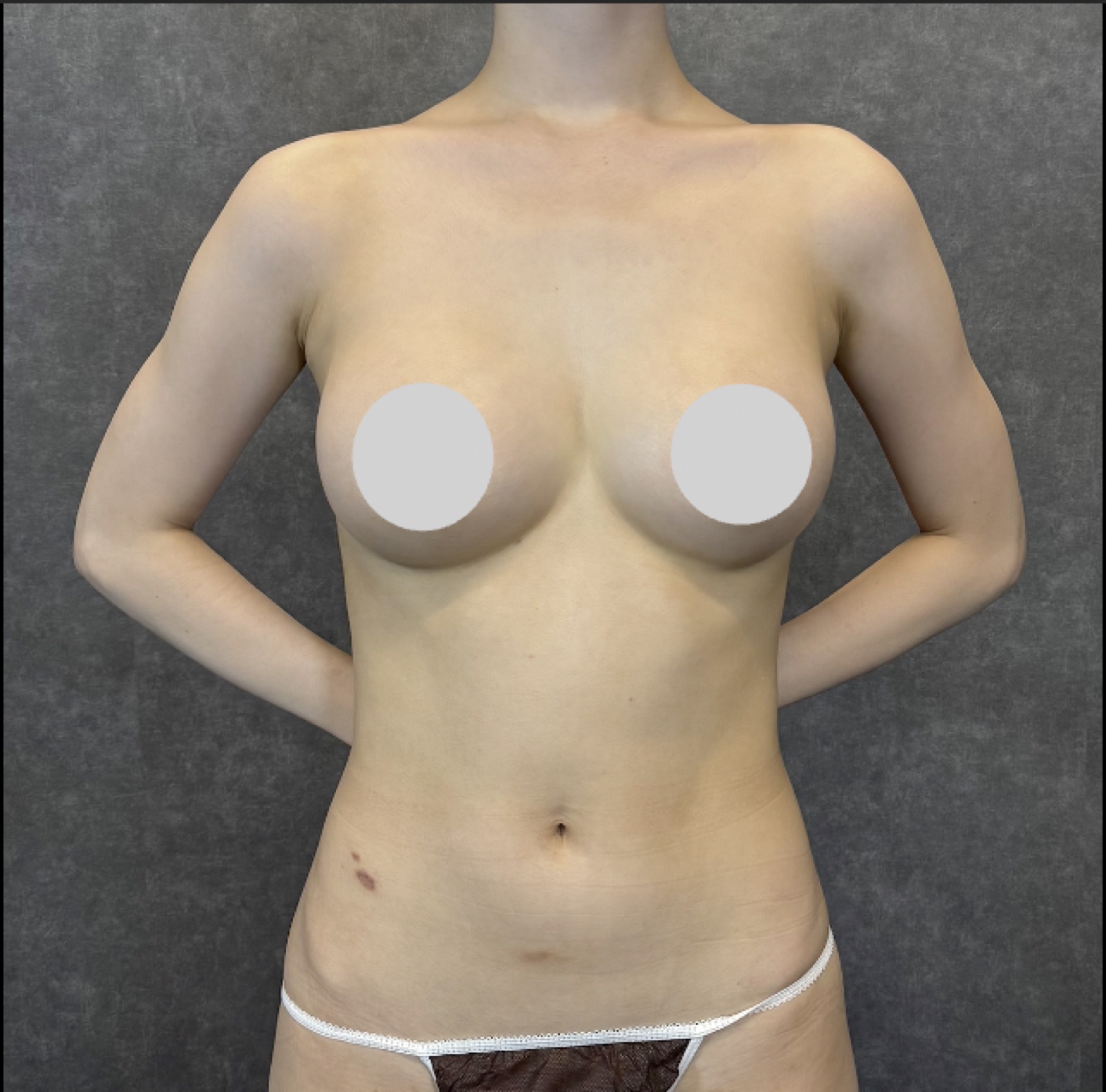
In this case we selected Modiva Mini 200cc. This series is a type of implant that, for the same volume, has a smaller base diameter and achieves volume through height (projection). Two features make this shape favorable for slim patients.
First, even in patients with a narrow chest width, the lateral edge of the implant is less likely to protrude into the axillary region. When an implant protrudes toward the axilla, patients may feel the edge when their arms are down, or feel that their upper arms do not close naturally.
Second, because volume is produced through projection, the upper pole (décolleté side) is filled efficiently. In hybrid breast augmentation frontal design, this upper-pole rise is a crucial factor for the frontal roundness.
On the other hand, a taller implant tends to reveal its contour or ripples where the skin is thin. To compensate, layering fat on top and building thickness beneath the skin is the guiding idea of hybrid breast augmentation. Combining the strengths of the implant and the fat, we shape the frontal silhouette.
Deciding to vary the fat injection layer between sides
In this case, the harvested fat totaled 300 ml from the thighs and 100 ml from the arms. After centrifugation separated anesthetic fluid and blood, 200 ml of concentrated fat was prepared. The injected volumes were: right breast 100 ml (subcutaneous 80 ml, subglandular 20 ml), left breast 80 ml (subcutaneous 80 ml).
The reason for varying volume and layer between sides is that the native glandular volume and chest wall shape were asymmetric, and slightly more volume was needed on the right. The subcutaneous plane serves surface roundness and prevents skin irregularity; the subglandular plane fine-tunes the rise directly above the implant. Distributing across layers and volumes makes it easier to fine-tune symmetry.
Injecting a large amount in one spot leaves the center poorly perfused and is a common cause of nodules and oil cysts. So we split into thin layers and disperse the deposits. Using binidle cannulas or microcannulas keeps the volume per unit area low, creating an environment favorable to survival.
For safety standards in aesthetic surgery, information from the Japan Society of Aesthetic Surgery is also a useful reference.
Treatment, cost and risks for this case
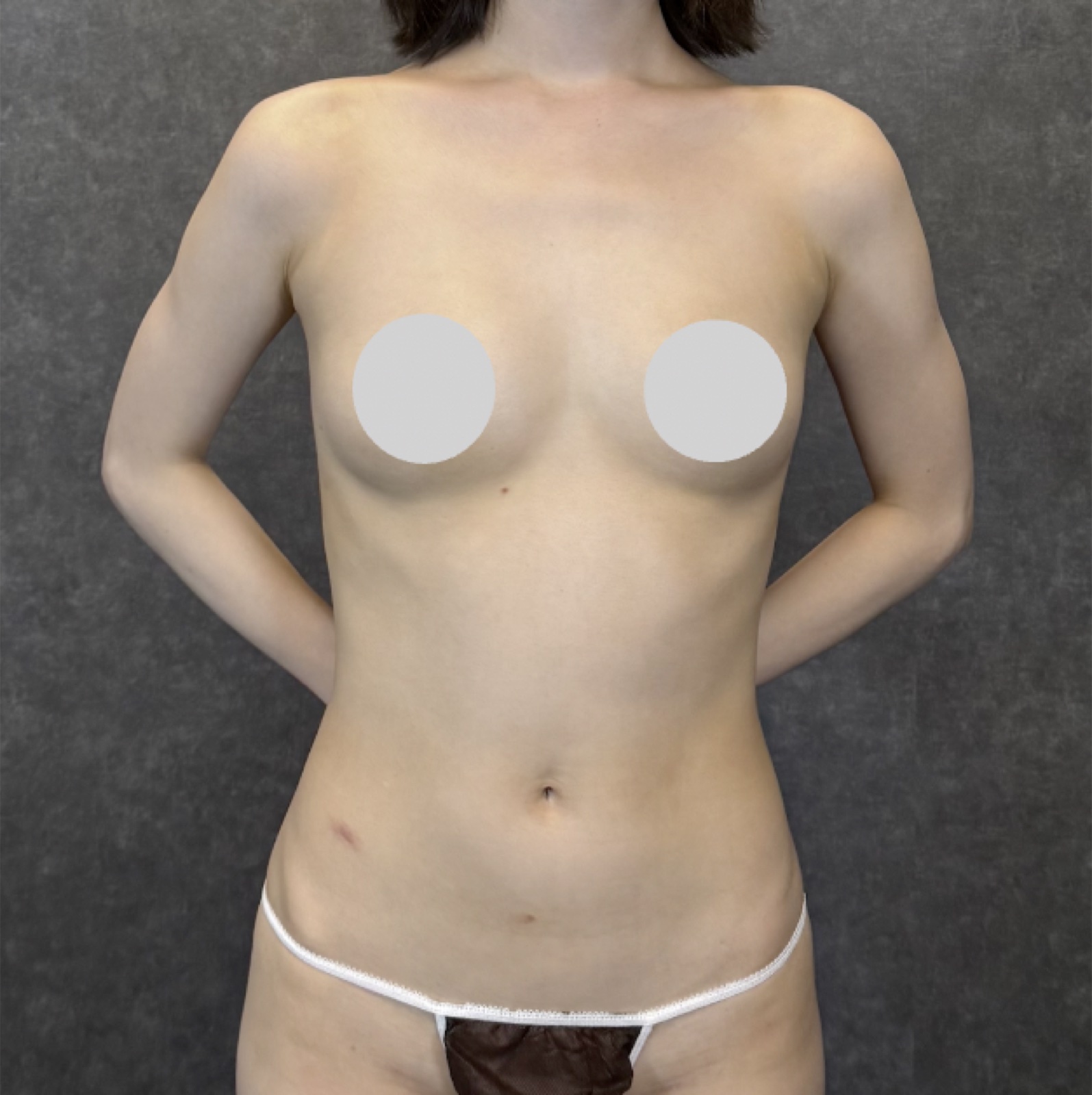
Treatment: Hybrid breast augmentation (Modiva Mini 200cc, transaxillary incision, subglandular placement plus fat grafting of 100 ml on the right and 80 ml on the left) combined with liposuction of the upper arms, shoulders, and medial/anterior thighs. Cost: JPY 1,594,000 (tax included, monitor price); the monitor price is conditional on consent to photo and video documentation. Please also see our price page for details.
Main risks and side effects include: swelling, bruising, pain, edema, capsular contracture, implant rupture or malposition, rippling, infection, changes in nipple or breast skin sensation, nodules, oil cysts, fat necrosis, individual variability in graft survival, irregularity, tightness or pigmentation at liposuction sites, and small incision scars. Results vary between individuals; the photographs shown are examples.
Progress at 3 months and future changes
At 3 months, swelling and firmness settle, and both graft integration and implant adaptation are progressing. Not all grafted fat survives — a proportion is resorbed, and the volume settles over 3 to 6 months. The way the capsule adapts and the appearance of any remaining asymmetry also stabilize over 3 to 6 months. Therefore, 3-month photographs represent an intermediate stage; the final result is decided a little later.
Related progress and technique explanations are gathered in our related column list.
Frequently Asked Questions
Q. Can slim patients achieve their target size with fat grafting alone?
In general, the size increase achievable with fat grafting alone depends on the amount of harvestable fat and skin elasticity. Slim patients have limited margin in both, so depending on the target size, combining with an implant (hybrid breast augmentation) is often more realistic. Suitability is judged at consultation.
Q. Whom is Modiva Mini suited for?
It is often indicated for slim patients with a narrow chest width who wish to gain volume in the upper pole. For the same volume it has a smaller base diameter and gains volume through projection, so it produces frontal upper-pole fullness efficiently. In patients with thin subcutaneous tissue, adding fat grafting on top is effective in preventing rippling.
Q. Is it common to vary injection volume and layer between the right and left?
Yes. Native asymmetry of the breasts or chest wall is common, and adjusting volume and layer between sides intraoperatively is routine. The aim is to improve symmetry of the final result.
Q. Is the appearance at 3 months the final result?
No. Fat graft integration and implant adaptation stabilize over 3 to 6 months, so the 3-month photograph should be considered an intermediate stage. Results and progress vary between individuals.
──────────────
Supervised by Dr. Shin Moriwaki
Member, Japan Society of Aesthetic Surgery (JSAS) / Member, American Academy of Aesthetic Medicine
ECFMG Certificate (US medical qualification)
──────────────
📍AVAN TOKYO GINZA LIPOSUCTION CLINIC
English / 中文 / Tiếng Việt available
Contact us via DM / LINE / Website / Phone for appointments and consultations.