


Thigh-Fat Hybrid Breast Augmentation: Single-Layer Subcutaneous Cover Design2026.09.13
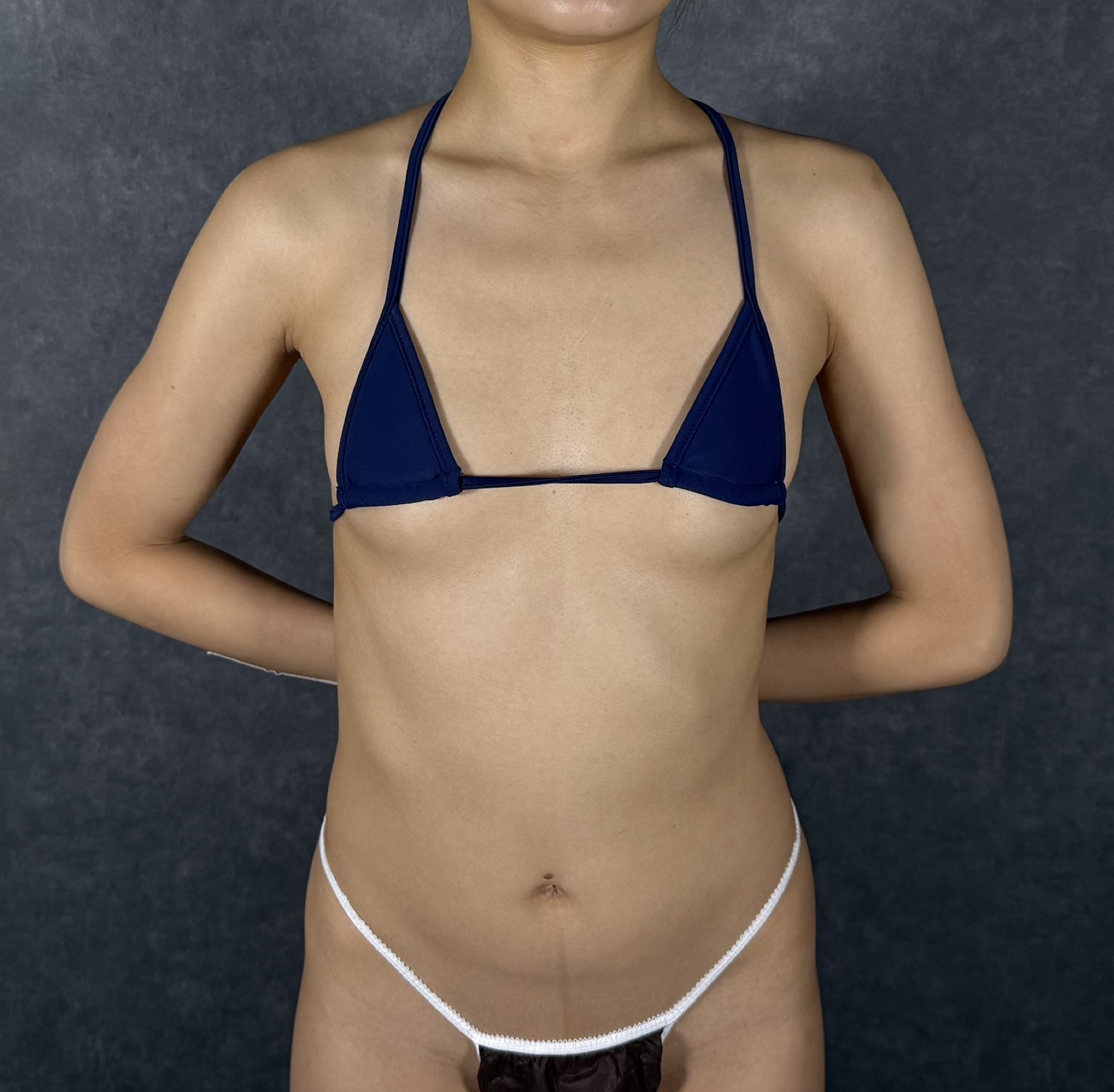
More patients are choosing hybrid breast augmentation — the combination of a silicone implant and autologous fat grafting — to reconcile size and a natural line. This article, based on one case in a woman in her 30s who received a 250 cc Motiva-Demi implant placed subglandularly with cover fat harvested from the anterior inner thigh, explains the design logic behind thigh fat hybrid augmentation and, from the operating surgeon’s perspective, why the cover fat was concentrated in a single subcutaneous layer.
Key Points
・In thigh fat hybrid augmentation, donor selection (where the fat is taken from) and injection-layer design (where the fat is placed) largely define the final result.
・In this case, subcutaneous fat was harvested from the anterior inner thigh, purified by centrifugation, and injected into the subcutaneous layer above the implant at 80–90 ml per side.
・When the silicone implant sits under the gland, concentrating the fat as a thin subcutaneous “cover layer” tends to stabilize both implant position and the graft environment.
・Small native left–right volume differences can be fine-tuned in 10-ml increments through cover-fat volume.
・Outcomes vary between individuals; bruising, swelling, fibrous contracture, asymmetry, and capsular contracture are unavoidable risks, so indication and post-operative care must be planned together.
Why We Chose the Anterior Inner Thigh for This Thigh Fat Hybrid Augmentation
In fat grafting, the site and depth of harvest directly influence graft survival and the delicacy of the finish. We chose the anterior inner thigh as the first-line donor for three reasons.
First, this patient had enough subcutaneous thickness in the anterior inner thigh to yield a large, cohesive volume. A cover fat layer that must sit thinly and broadly over an implant benefits from smooth, homogeneous tissue rather than pooled small aliquots.
Second, the anterior inner thigh has a relatively soft subcutaneous structure with fewer coarse fibrous septa (collagen-rich hard partitions), so harvest through a fine cannula tends to cause less cell damage — a well-preserved graft has an easier time in its new bed.
Third, harvest also improves the donor silhouette. Front-thigh fullness and inner-thigh lines strongly affect how the entire leg reads visually. We designed the harvest so that the process of collecting fat for hybrid augmentation also refines the lower-body line.
Role Division: Subglandular Implant and Cover Fat
In this case a silicone implant (Motiva-Demi 250 cc) was placed in the subglandular plane. The subglandular plane reflects the intrinsic shape of the implant more directly into breast form than the submuscular plane, and there is less distortion with movement — but in thin patients the upper edge or contour of the implant can become visible as a “step.”
Cover fat compensates for this weakness. By layering a thin subcutaneous fat cushion between the implant and the skin, the implant edge blends into light and shadow, the touch becomes softer, and rippling (implant waves seen through thin skin) becomes less prominent. In thigh fat hybrid augmentation, it may be clearest to think of the “thigh fat” not as fat that enlarges the implant but as fat that makes the implant invisible.
Concentrating the Cover Fat in a Single Subcutaneous Layer
In hybrid augmentation the cover fat can also be split across subcutaneous and submuscular (or subglandular) planes. In this case, however, all of the fat was placed in the subcutaneous layer directly above the implant. The reasoning was twofold.
First, when the implant is subglandular, injecting fat toward the submuscular direction risks disturbing the anatomical relationship around the implant, and it tends to be unfavorable as a graft environment from a perfusion standpoint. Second, the subcutaneous layer — when its recipient-bed perfusion is preserved — is the layer with the easiest access to oxygen among the three zones of the classical oxygen-diffusion model (peripheral, intermediate, and central). For a thin cover-purpose injection, concentrating in the subcutaneous layer also helps avoid the failure mode of “stacking too thick so the center cannot take.”
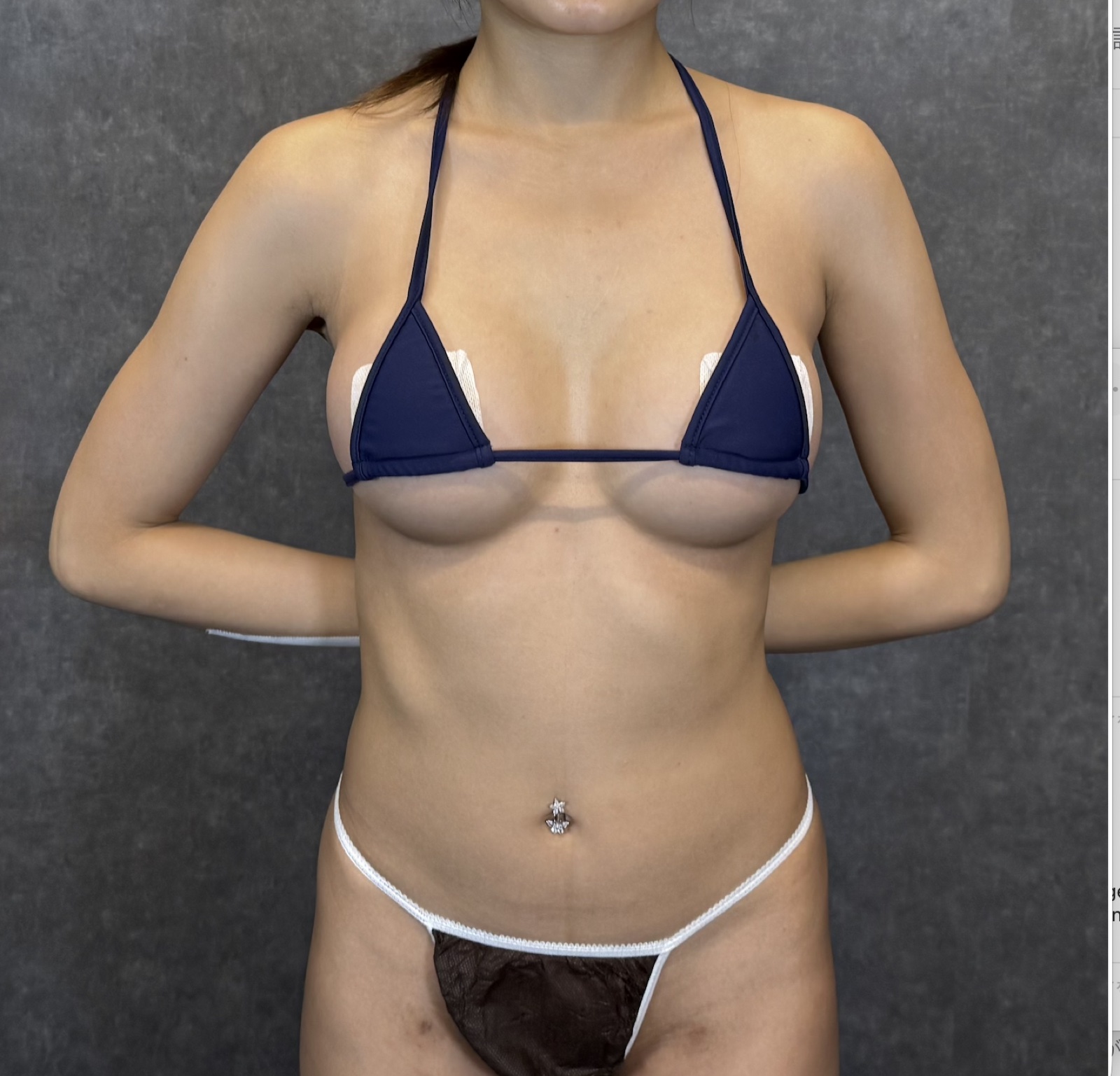
In this case, fat purified by low-speed short-duration centrifugation was placed into the right breast subcutaneously at 80 ml and into the left at 90 ml, in small aliquots through a fine cannula from multiple directions at shallow entry angles. The 10-ml right–left difference was designed to correct a pre-operative volume asymmetry documented in planning, and was fine-tuned intra-operatively with the torso brought close to an upright position. Even in a compound procedure such as thigh fat hybrid augmentation, the final “look” is built from many small intra-op decisions.
Treatment, Cost, and Risks for This Case
■ Treatment: Hybrid augmentation — subglandular silicone implant placement plus liposuction of the anterior inner thigh with subcutaneous injection of purified fat. The implant was placed through an axillary incision; fat injection was performed through small access points under the areola and at the inguinal crease. Anesthesia combined intravenous sedation with local tumescent anesthesia (specific drugs and doses are discussed in consultation).
■ Cost: Please see our pricing page. Total cost varies with implant type, liposuction area, and anesthesia management. The final quotation is confirmed at consultation.
■ Main risks / side effects: Bruising, swelling, pain, chest tightness; fibrous contracture and skin retraction at the thigh donor site; grafted-fat nodules (oil cysts, calcifications); asymmetry; capsular contracture; infection; hematoma; and rare complications such as pneumothorax or fat embolism. Smoking, undernutrition, and very low BMI reduce graft take. For general aesthetic surgery safety standards, refer to the Japan Society of Aesthetic Surgery.
■ Results vary between individuals; photos represent one example only. The same size, shape, and softness cannot be reproduced for every patient.
Post-Operative Points to Watch
Immediately after surgery, swelling from both the implant and the grafted fat adds up, so the breast looks a size larger than the true result. Edema typically settles over 1–1.5 months, the implant and subcutaneous cover fat integrate around 3 months, and a form close to the final shape is generally obtained at 6 months. On the thigh side, firmness and tightness are strongest during the contracture phase in months 1–3. Related themes are collected in our liposuction and augmentation column index.
Frequently Asked Questions
Q. Could upper-arm fat be used instead of thigh fat for the same result?
The available volume, the texture of the subcutaneous tissue, and the donor-silhouette benefit differ by site. A thin cover fat layer can be harvested from the upper arm, but the medial-to-anterior thigh is often chosen because it offers volume, fewer fibrous partitions, and smoother harvest. The donor is decided case by case with your goals and body composition in mind.
Q. Does concentrating the cover fat in the subcutaneous layer reduce the effect?
In hybrid augmentation the cover fat is not the primary driver of size — its role is to hide the implant outline and refine touch. Concentrating it in the subcutaneous layer is advantageous for graft take and less likely to disturb implant position. It is a design of “where” the fat is placed, not “how much.”
Q. How far can left–right asymmetry be corrected?
Differences on the order of 10–20 ml can be corrected with cover fat, as in this case. Larger differences in ptosis or in chest-wall shape itself may not be fully corrected with grafting alone and may require adjustments to implant size, incision, or injection plane.
Q. Which side is harder to care for post-operatively — thigh or breast?
It varies between individuals. The breast side has strong tightness in the first 1–2 weeks, while the thigh side requires ongoing self-massage and compression garments during the contracture phase (months 1–3). The care burdens arrive on staggered timelines, which makes management more predictable.
Q. What should I prepare before consultation?
A sense of the size you want (a reference-photo silhouette rather than a cup number), your medical history, current medications and supplements, menstrual cycle, and smoking status will make the consultation smoother.
──────────────
Medical Supervision: Shin Moriwaki, MD (Supervising Physician)
Member, Japan Society of Aesthetic Surgery (JSAS) / Member, American Academy of Aesthetic Medicine
ECFMG Certificate
──────────────
📍AVAN TOKYO GINZA LIPOSUCTION CLINIC
English / 中文 / Tiếng Việt supported
Bookings and consultations: DM / LINE / Website / Phone.