


Front-View Upper Arm Liposuction: Continuous Design With Accessory Breast — Dr. Moriwaki2026.10.20
Have you ever stood in front of a mirror with your arms at your sides and thought, “The back of my arm wasn’t bothering me, but from the front, the base of my arm still looks thick”? To make an upper arm look slimmer from a front view, it isn’t enough to liposuction only the back of the arm. The shoulder, front of the upper arm, and the fullness at the front of the armpit (the accessory breast) must be treated as one continuous circumferential zone. In this article, Dr. Shin Moriwaki explains how he decides which areas, layers, and incision placements to use in front-view upper arm liposuction, based on a 30s-female case in which the entire upper arm and the accessory breast were liposuctioned at the same time.
Key Takeaways
・In front-view upper arm liposuction, the back, shoulder, front, and accessory breast are treated as one continuous fat layer around the arm.
・The main reason the base of the arm looks thick from the front is usually the shoulder front, upper arm front, and accessory breast — not the back of the arm.
・Six small incisions (both elbows, both front axillae, both posterior axillae) allow the cannula to cross from multiple angles and reduce the risk of residual fat and irregularity.
・Because upper arm skin is relatively thin, taking too much from the superficial layer can cause irregularity and sagging. Palpating thickness and leaving a proper superficial layer is essential.
・At 2 months postop, fibrosis (contracture) is still ongoing; firmness and swelling can remain, and the final result continues to settle over several months.
Why Does the Base of the Arm Look Thick From the Front?
When patients come in wanting a slimmer upper arm, most focus on the back of the arm (the “wave” or “wing”). In reality, however, when the arm is resting at the side and viewed from the front, the thickness at the base of the arm is often caused by other areas, not the posterior fat.
There are three main reasons the arm looks thick from the front.
1. Fat at the front shoulder / anterior deltoid
Thick subcutaneous fat on the front of the shoulder keeps the transition from below the collarbone to the upper arm rounded, which makes the arm itself look thicker. Although the volume is not large here, leaving it uncorrected has a significant impact on the frontal view.
2. Fat on the anterior and inner upper arm
When fat is present on the anterior and inner-upper portion of the upper arm, the border between the arm, chest, and underarm becomes blurred, and the entire arm appears thicker. Because the skin here is thin, superficial suctioning volume must be carefully controlled.
3. Fullness in front of the armpit (accessory breast)
The accessory breast is a bulge in front of the axilla. Some people have it protruding past the front strap of their bra. If the accessory breast is left untreated while only the upper arm is suctioned, the fullness in front of the armpit remains, and the thickness at the base of the arm stands out even more.
Designing a Continuous Circumferential Zone in Front-View Upper Arm Liposuction
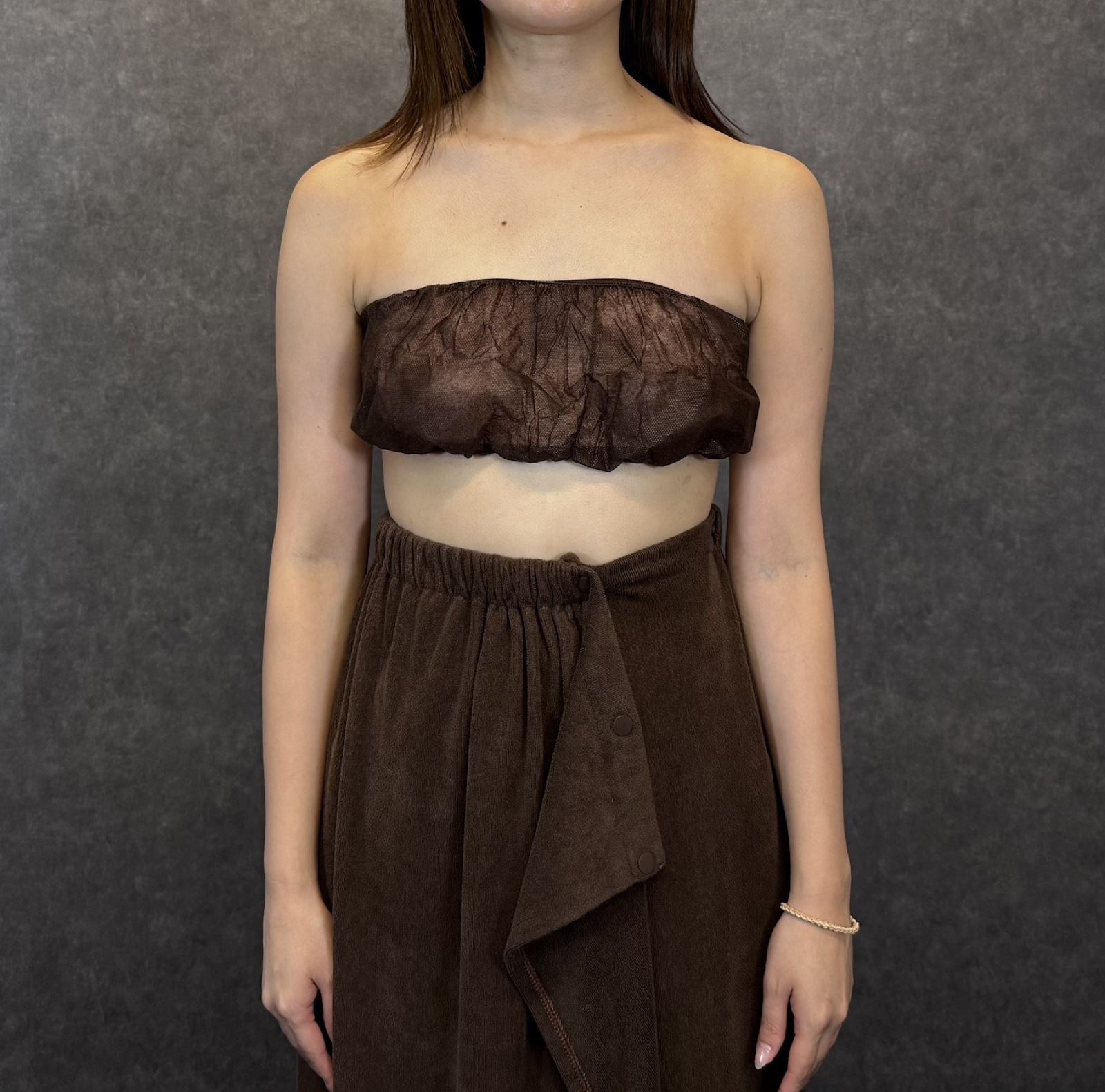
The patient in this case is in her 30s, and we performed liposuction of the entire upper arm (back, shoulder, front) together with the accessory breast. The core design principle is to treat “back + front + accessory breast” as one continuous zone.
Upper arm liposuction is often associated only with the back of the arm, but if any one of the shoulder, front, or accessory breast is left behind, the frontal arm-base line is interrupted and looks unnatural. Conversely, when these three zones are suctioned continuously, the contour from the shoulder down the arm and into the underarm becomes one smooth line, and the arm looks slimmer even from the front.
Zone 1: Shoulder / anterior deltoid
The amount of fat here is small, but leaving it rounds the base of the arm. To avoid skin laxity, we focus suctioning on the middle to deep layer rather than the superficial layer.
Zone 2: Entire upper arm (back, front, inner)
Not only the back of the arm but also the front and inner surfaces are suctioned layer by layer — superficial, middle, deep. Because skin on the front and inner arm is thin, we keep superficial-layer suctioning conservative to prevent irregularity.
Zone 3: Front of the armpit (accessory breast)
Flattening the accessory breast allows the front-of-armpit line to flow naturally into the upper arm. To avoid a step between the accessory breast and the front of the arm, we cross cannulas and transition gradually.
Treatment, Cost, and Risks for This Case
Treatment performed
In a female patient in her 30s, we performed simultaneous liposuction of the entire upper arm (back, shoulder, front) and the accessory breast. Six small incisions were used — both elbows, both front axillae, and both posterior axillae — with cannulas crossed to suction each layer. Anesthesia was intravenous sedation combined with nitrous oxide, and tumescent solution was infused into the suction areas.
Cost
Please see our price page for details. The final estimate — including suction range, anesthesia method, and compression garment — is confirmed at consultation.
Main risks and side effects
Possible risks include bruising, swelling, edema, firmness from fibrosis, asymmetry, surface irregularity, numbness, scarring, and infection. Most resolve over time; firmness related to fibrosis typically persists for 3 to 6 months, and the final result generally stabilizes around 6 months.
Individual variation
Results vary by individual, and the photos in this article represent one example. Skin thickness, fat distribution, and body type affect both the suction range and the final result.
Palpating Skin Thickness and Layered Suctioning
One of the key factors in a successful front-view upper arm liposuction is palpating skin thickness. The upper arm has relatively thin skin, and over-suctioning the superficial layer can cause irregularity, laxity, and uneven light reflection on the surface.
During surgery, we repeatedly pinch the skin between passes to confirm its thickness. In thinner areas, we adjust cannula depth and leave a uniform superficial layer. This keeps the postoperative skin surface smooth and reduces the risk of irregularity during the fibrosis phase.
Our layered-suctioning principle is: “take volume at the deep layer, create the line at the middle layer, and refine the surface at the superficial layer.” Taking only the deep layer reduces volume but does not shape the contour; taking only the superficial layer invites irregularity. We work through the three layers in order, prioritizing the continuity of thickness over raw volume.
Why Six Incisions Are Distributed Across Three Directions
In this case, incisions were distributed across six locations — both elbows, both front axillae, both posterior axillae. By placing incisions in multiple directions, the cannula can approach from multiple angles, reaching layers and planes that would be inaccessible from any single direction.
Approach from the elbow
From the elbow, the cannula travels along the long axis of the arm, allowing smooth, long strokes. However, the axillary side becomes distant and some areas near the armpit are harder to reach.
Approach from the front axilla
From the front axilla, the accessory breast and the front of the upper arm can be suctioned continuously from the same direction. This incision is key to avoiding a step between the two zones.
Approach from the posterior axilla
From the posterior axilla, the deep back-of-arm and posterior shoulder become accessible. It complements the elbow approach, which cannot reach the deep axillary region.
Combining these three directions enables cross-cannula layered suctioning, reducing the risk of residual fat and surface irregularity. Incisions are placed along the natural creases of the elbow and axilla, so scars tend to become less noticeable over time.
Anesthesia and Compression Garment Strategy
For simultaneous liposuction of the upper arm and accessory breast, we use intravenous sedation combined with nitrous oxide, and we infuse tumescent solution (a dilute local anesthetic) into the surgical area. Tumescent solution controls pain and bleeding and makes fat easier to suction.
After surgery, patients wear a bolero-type compression garment designed for the upper arms. The garment reduces swelling and bruising and helps the skin conform to the new contour. We choose a style that also compresses the accessory breast area. The baseline wearing period is about one month, adjusted based on how fibrosis progresses.
At 2 Months Postop: What Has Changed
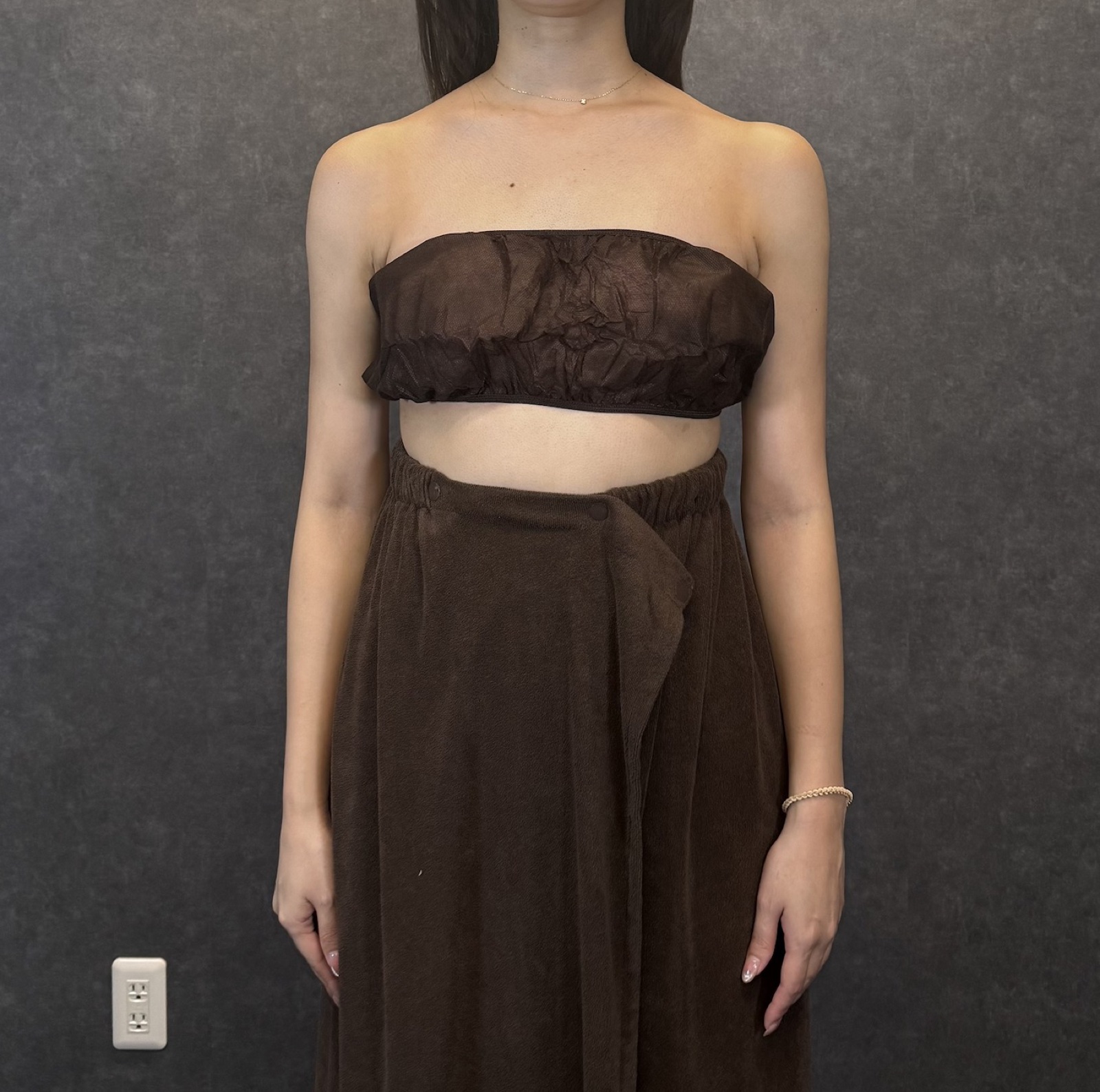
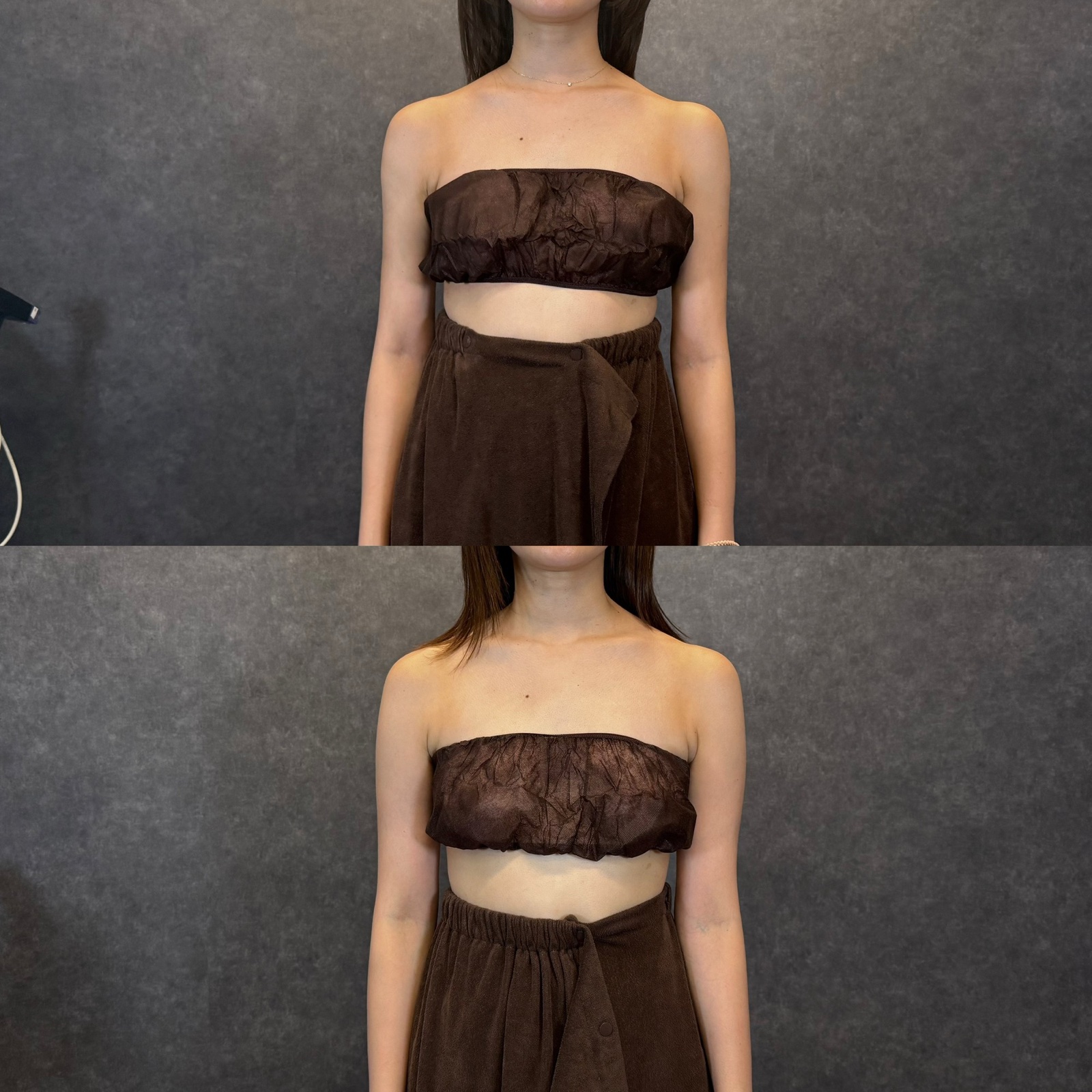
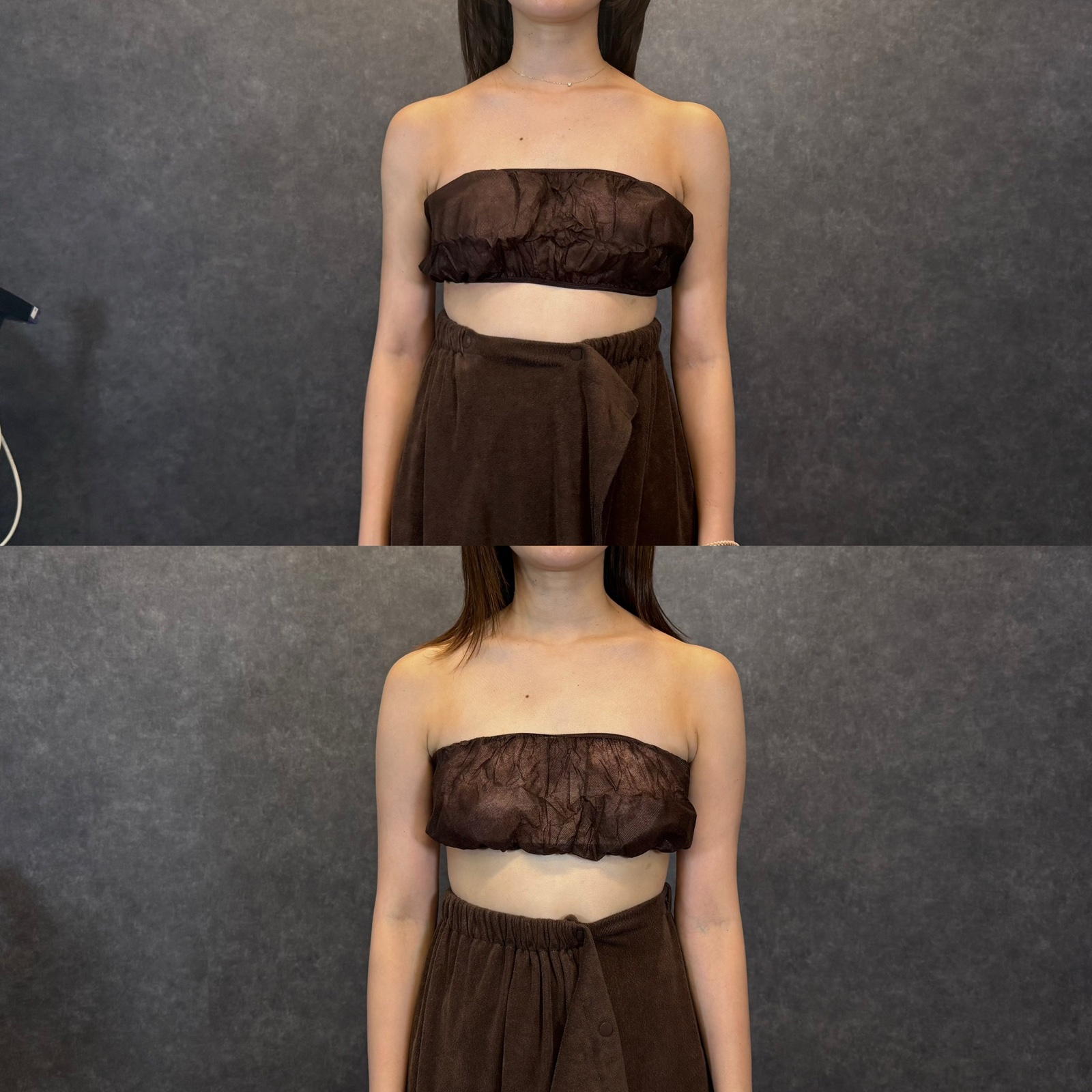
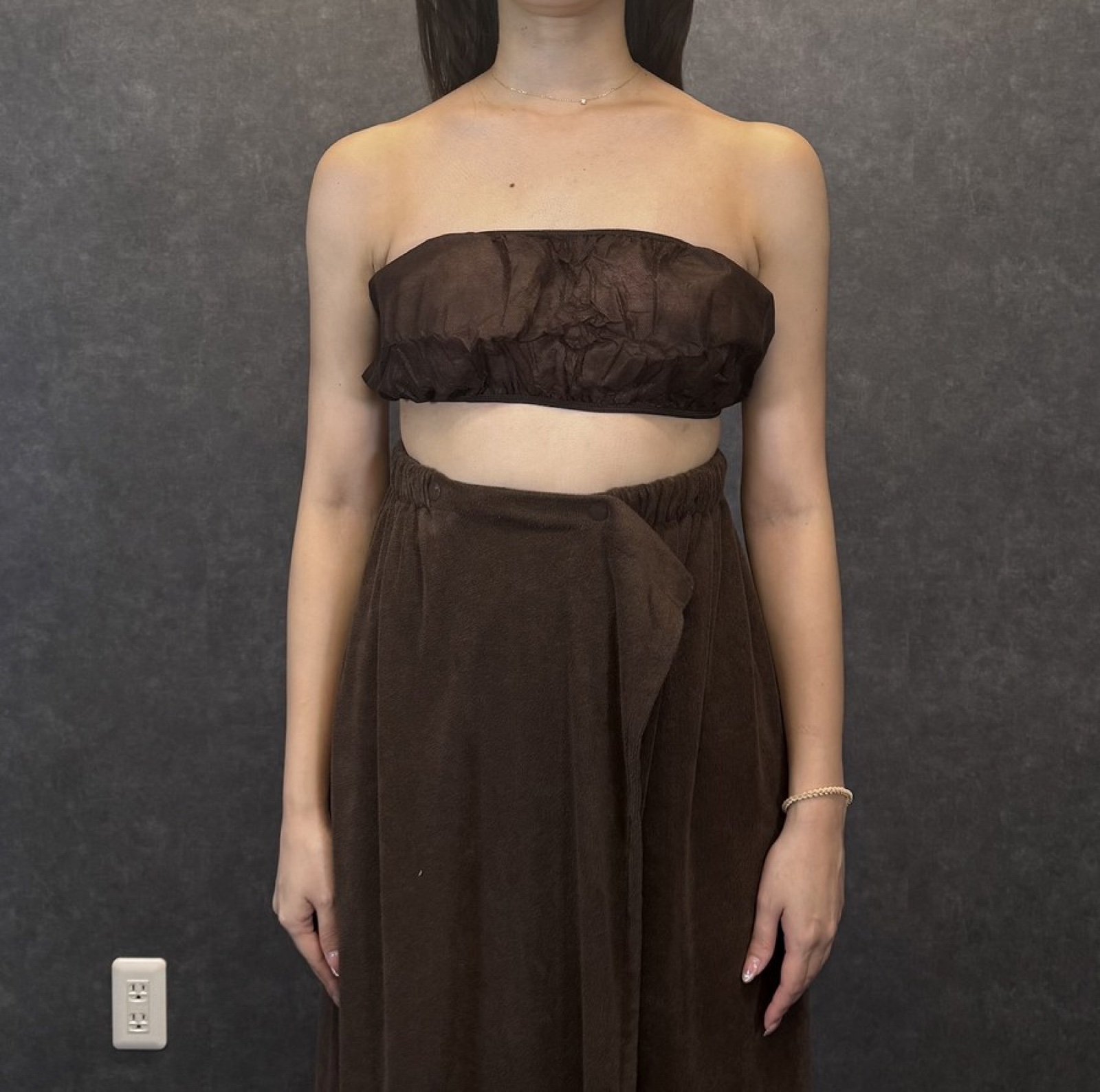
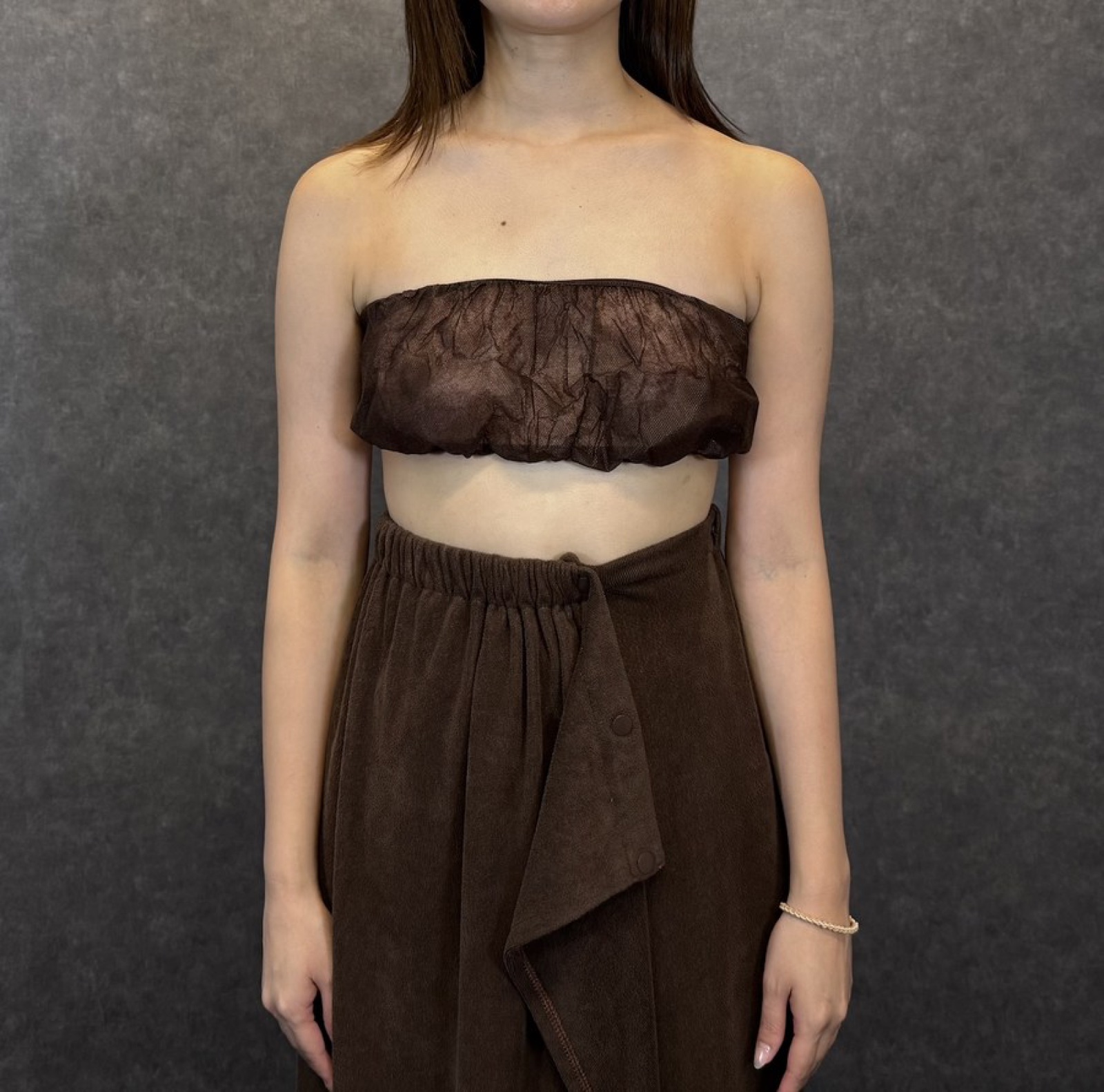
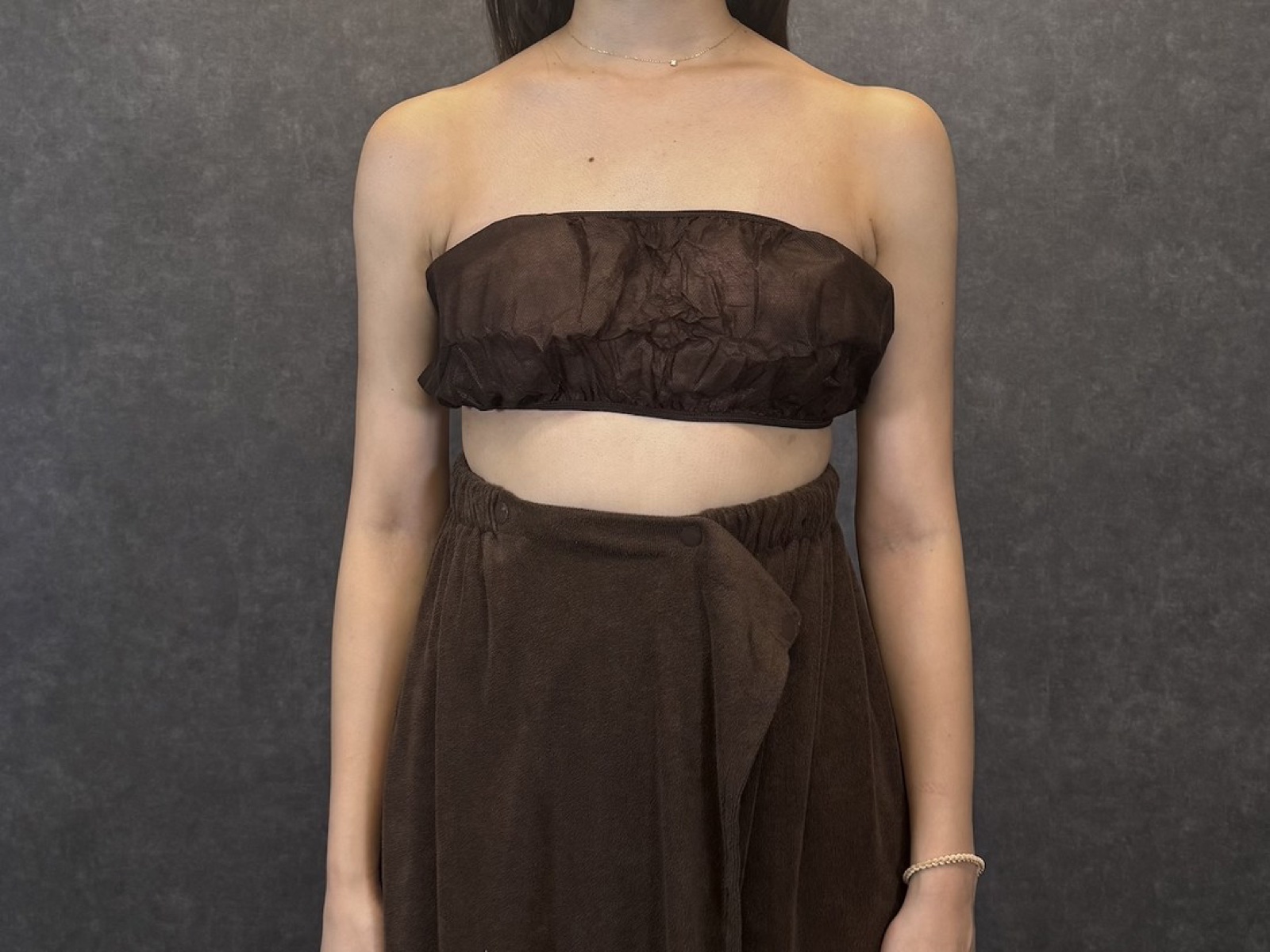
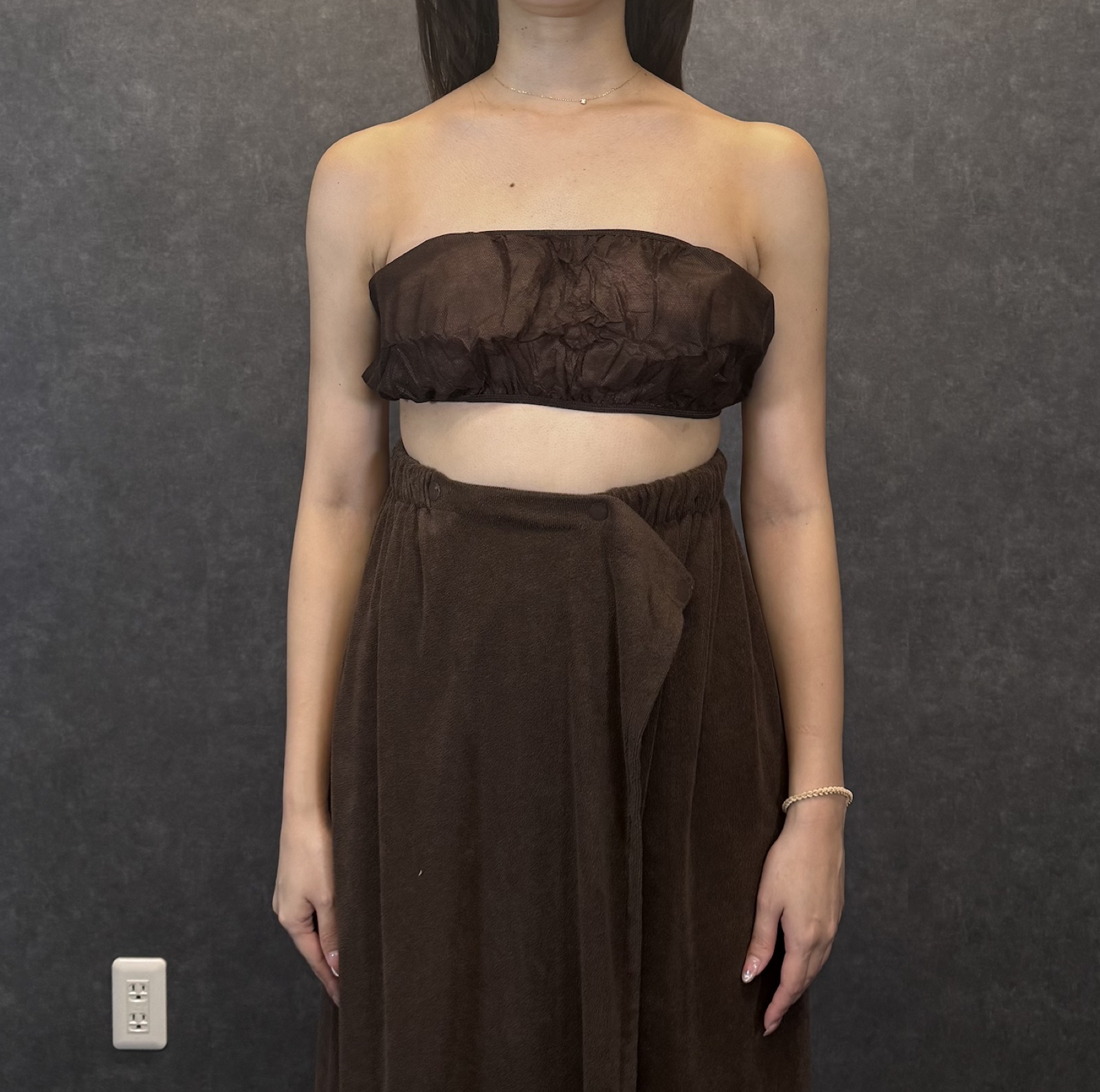
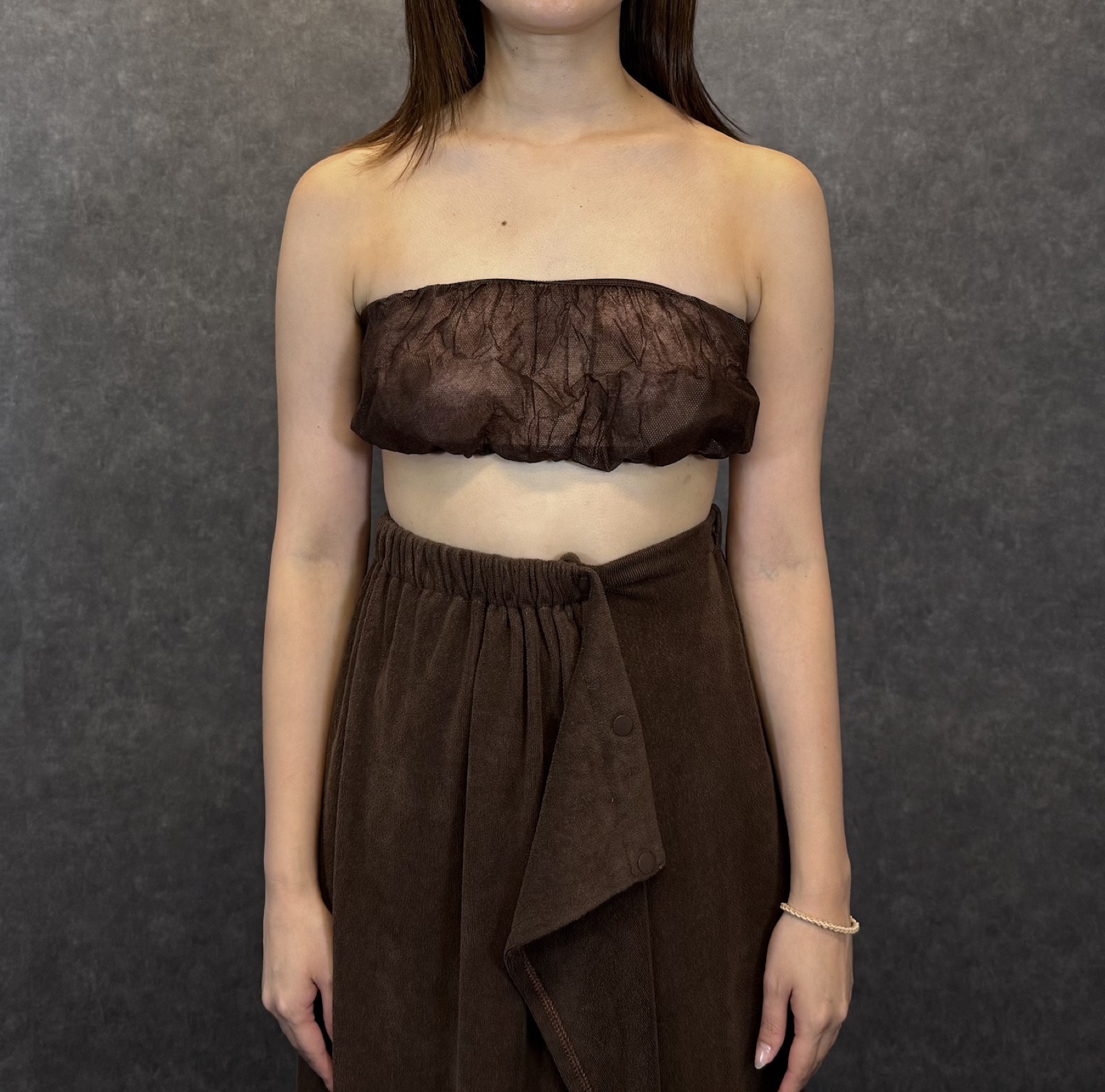
The photos show the state at 2 months postoperatively. Before surgery, there was thickness from the outer upper arm to the armpit, and the base of the upper arm appeared full when the arm was at the side. At 2 months postop, the outer line of the upper arm has become cleaner, the fullness at the front of the armpit is less visible, and the contour from the shoulder down the arm appears slimmer.
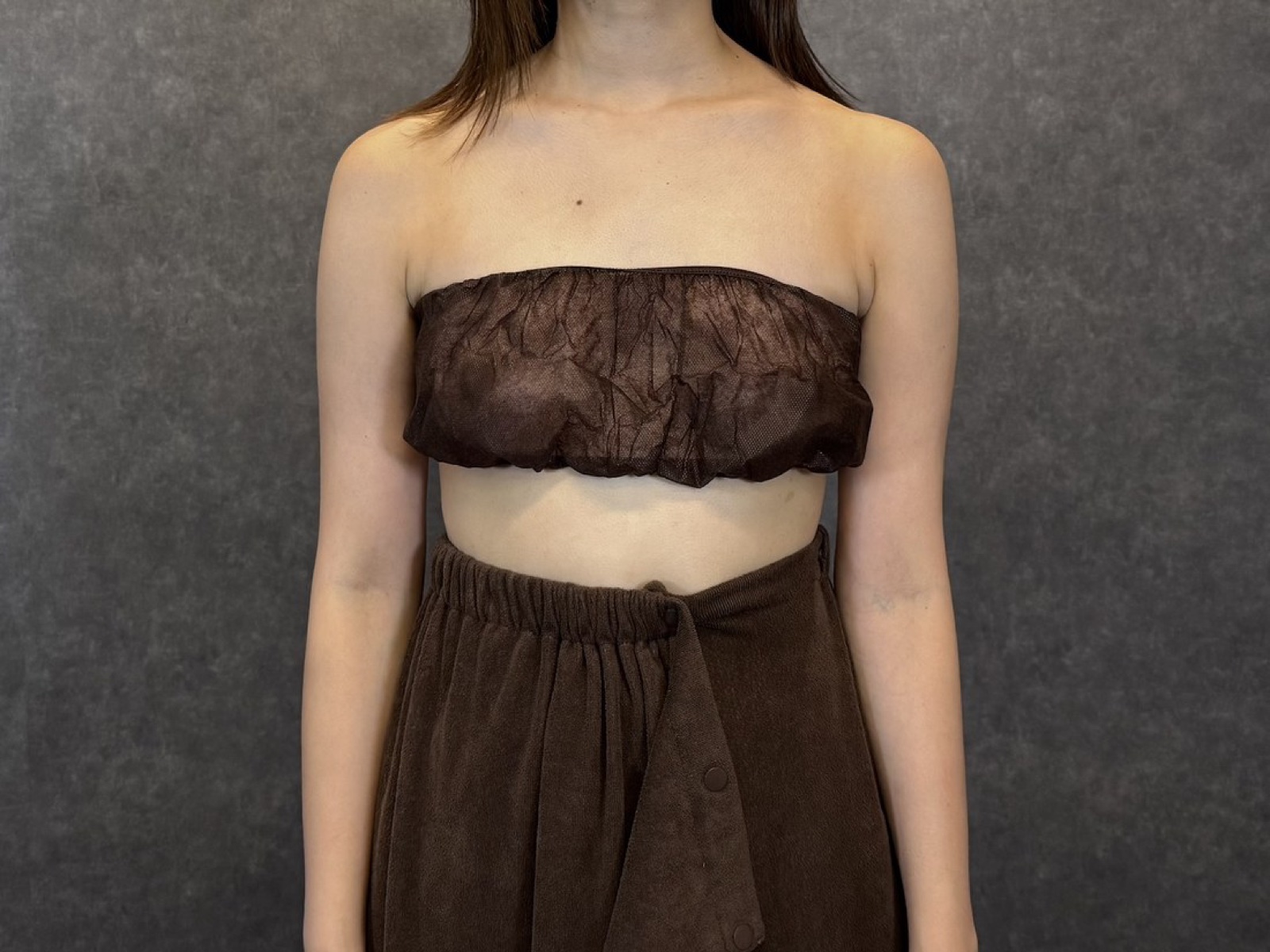
However, 2 months postop is still within the fibrosis phase. Fibrosis refers to the tightening of subcutaneous tissue in the suctioned area during healing, appearing as firmness, tightness, and swelling. There are periods when it temporarily shows up as surface irregularity, but as the tissue matures, it smooths out, generally settling around the 6-month mark.
In simultaneous suctioning of the upper arm and accessory breast, firmness tends to concentrate around the armpit. This is because two zones are treated continuously, and healing responses converge in the narrow axillary region. Firmness during the fibrosis phase is not an abnormality; it is part of normal healing. There is no need to apply forceful massage out of worry.
Points to Consider Before Front-View Upper Arm Liposuction
Even if you think “only my back-of-arm bothers me,” the real concern is often the thickness at the base of the arm as seen from the front. When considering front-view upper arm liposuction, stand in front of a mirror with your arms at your sides and check the contour from all three directions — front, side, and back.
If you are also concerned about an accessory breast, treating it at the same time as the upper arm makes it easier to achieve a continuous armpit line. Safety standards for cosmetic surgery are also published by the Japan Society of Aesthetic Surgery (JSAS). For related surgical topics and recovery details, see our column index on liposuction.
Frequently Asked Questions
Q. Can I liposuction only the upper arm and leave the accessory breast?
If the accessory breast is left, only the front of the armpit remains full, creating a visible step from the newly slimmer upper arm. If you want a slimmer front view, treating the accessory breast and upper arm together usually gives a more natural, continuous line. However, if your accessory breast is nearly absent, you may see little difference, so we always decide at consultation by palpation.
Q. Why are six incisions needed?
To evenly suction the entire upper arm and accessory breast, cannulas must cross from multiple directions. With only one or two incisions, some layers and planes are left behind, which leads to residual fat and irregularity. Incisions are placed along the natural creases of the elbow and axilla to minimize visibility over time.
Q. Is firmness at 2 months postop a failure?
Firmness at 2 months postop is called ‘fibrosis’ and is a normal healing response, not a failure. Fibrosis peaks between 1 and 3 months postop and gradually smooths out around 6 months. There is individual variation, but residual firmness does not mean a poor result. The key is patient follow-up over time.
Q. Will front-view upper arm liposuction narrow my shoulder width?
Shoulder bone structure does not change, but suctioning subcutaneous fat on the front shoulder and anterior deltoid tidies the shoulder-to-arm contour, which can make the shoulders look narrower from the front. If your shoulders are structurally broad, liposuction alone has limits, and we may propose combinations such as shoulder botox.
Q. When can I return to work?
If your work is mostly at a desk, most patients return within a few days. Movements that require raising the arms or lifting heavy objects should be avoided for about two weeks. Compression garments can be chosen in designs that are unnoticeable under clothing, allowing a discreet return to daily life.
──────────────
Supervised by Dr. Shin Moriwaki (Supervising Physician)
Member, Japan Society of Aesthetic Surgery (JSAS)
Member, American Academy of Aesthetic Medicine
ECFMG Certificate
──────────────
📍AVAN TOKYO GINZA LIPOSUCTION CLINIC
English / 中文 / Tiếng Việt available
For appointments and consultations:
DM / LINE / Website / Phone