


Can Acupuncture and Manual Therapy Be Combined With Joint Injections? Dr. Moriwaki on Roles and Sequence2026.09.27
“I’m already seeing an acupuncturist or osteopath for my joint pain — can I still combine it with stem cell conditioned media joint injections?” This is a question we hear more and more often. The short answer: combining joint injections with acupuncture and manual therapy is generally acceptable, because each modality targets a different tissue layer and can be designed as a division of roles. What matters is the order in which treatments are received and whether they are performed on the same day. This column organizes what each treatment actually targets and how to sequence them for a synergistic effect.
Key Points of This Article
・Combining joint injections with acupuncture and manual therapy is not contraindicated; each modality targets a different tissue layer and can be assigned a distinct role.
・Acupuncture targets autonomic tone and muscle tension, manual therapy targets joint mobility and alignment, and joint injections target the inflammatory environment inside the joint capsule.
・As a rule, avoid strong hands-on work on the injected joint for 48–72 hours after injection; resume with light needling or gentle manual therapy from the following day onward.
・In acute flares, calm intra-articular inflammation with the injection first, then layer in acupuncture and manual therapy during the subacute-to-chronic phase.
・Combining joint injections with acupuncture on the same day, targeting the same joint, stacks infection risk and should generally be avoided.
What Each Treatment Actually Targets
Acupuncture, manual therapy, and joint injections may all appear to “treat the same joint pain,” but the tissue layers they act on are different. Before designing the sequence, it helps to clarify what each modality is really doing.
What Acupuncture Targets
Acupuncture works primarily through fine mechanical stimulation of acupoints and trigger points, improving local blood flow and activating pain-modulating pathways via the autonomic nervous system. Around the knee or shoulder, it tends to release excess tone in supporting muscles such as the quadriceps or subscapularis. However, it does not directly repair degenerative cartilage or the chronic synovitis inside the joint capsule.
What Manual Therapy Targets
Osteopathic manipulation and physical-therapy-style manual work aim to restore the glide of joint capsules, fascia, and soft tissues, and to rebalance range of motion and center of gravity. In osteoarthritis, guarding gait — walking to protect the painful joint — creates secondary loads on other regions. Manual therapy reduces this secondary burden, but it also cannot directly interrupt the inflammatory cycle within the joint.
What Joint Injections Target
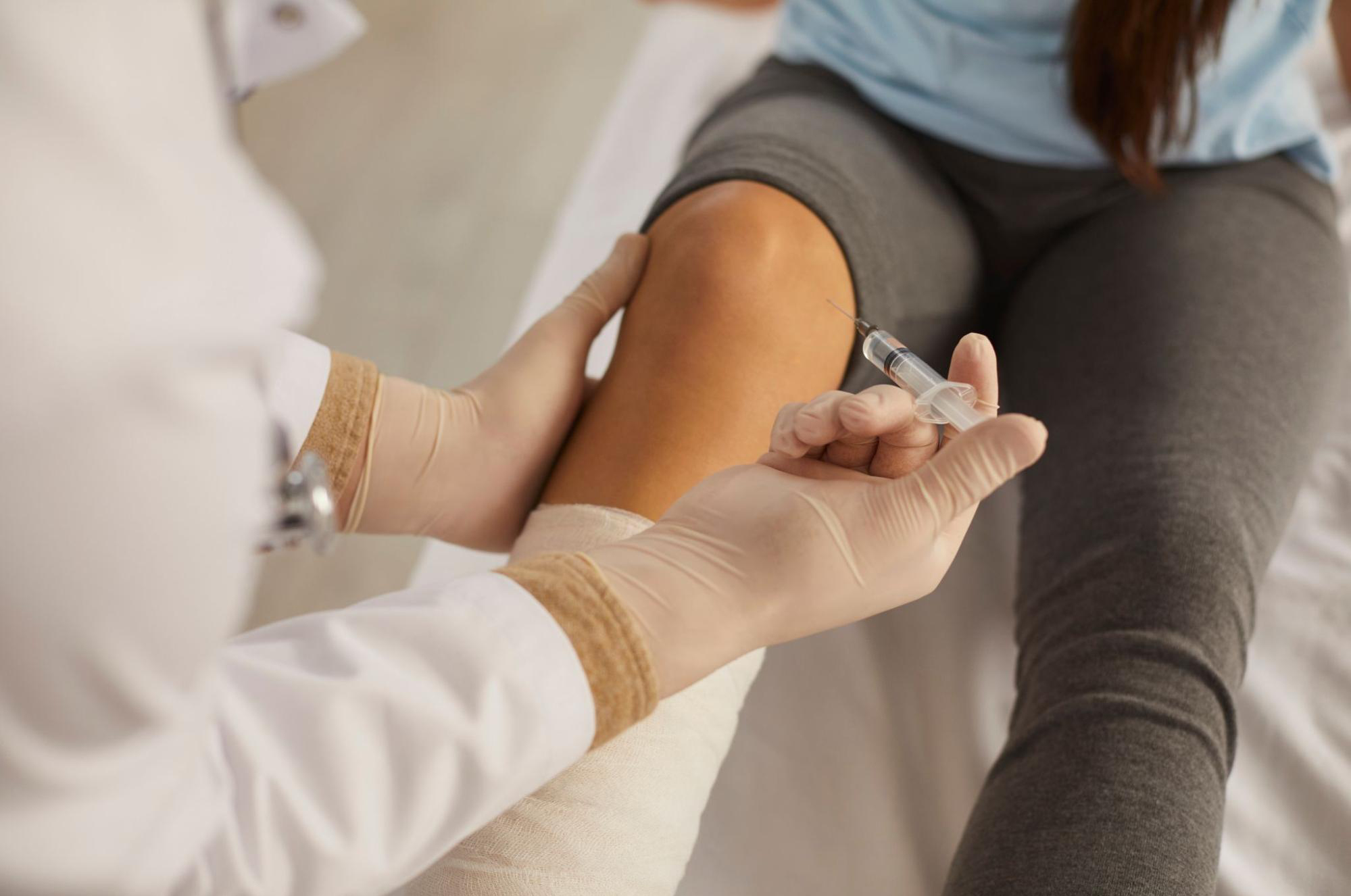
Stem cell conditioned media joint injections deliver anti-inflammatory cytokines and growth factors directly into the joint cavity — a layer that surface-based hands-on techniques cannot easily reach. For general information about joint disease, please also refer to the Japanese Orthopaedic Association. Because joint injections target the intra-articular environment itself, they do not compete with the layer that external manual approaches address. Rather, when injection first calms intra-articular inflammation, subsequent work on muscles and range of motion becomes easier to consolidate.
Combining Joint Injections With Acupuncture Works as a Division of Roles
When the three treatments are organized by role, they line up in the following layers:
・Intra-articular layer: joint injection (calming synovitis, correcting joint fluid quality, delivering growth factors)
・Muscle and soft tissue layer: acupuncture (releasing muscle tension, local circulation, autonomic-mediated analgesia)
・Alignment layer: manual therapy (range of motion, gait and center-of-gravity redesign)
Even for a single complaint such as “knee pain,” the responding treatment differs depending on whether the pain originates inside the joint, in muscle over-tension around it, or in a movement pattern. Combining joint injections with acupuncture and manual therapy is helpful precisely because chronic joint pain — as seen in osteoarthritis — usually spans multiple layers rather than one. Conversely, when the cause is clearly confined to a single layer, it is easier to treat that layer thoroughly first and only add other modalities based on the observed response.
Designing the Sequence
Acute Flare Phase (Swollen and Warm Joint)
Calming intra-articular inflammation comes first. Leading with strong needling or large-range joint manipulation during this phase can worsen pain and swelling. After the injection has settled the flare, avoid strong hands-on work on the joint itself for 48–72 hours; keep any work light and confined to upstream muscles (lumbar, gluteal, or trunk).
Subacute to Chronic Phase (Pain Persists but Inflammation Has Calmed)
From about one week after joint injection has stabilized the intra-articular environment, acupuncture and manual therapy can be layered in fully. This is where combining joint injections with acupuncture yields the greatest synergy. With reduced intra-articular pain, previously guarded ranges of motion become safer to open up, and gains from acupuncture and manual therapy are easier to consolidate. A common cadence is to resume acupuncture one to two weeks after injection, then progressively add manual and exercise therapy.
Maintenance Phase
Once the intra-articular environment is stable, injection intervals can be extended to several months, with day-to-day maintenance handled by acupuncture, manual therapy, and exercise. In this phase, the combination of acupuncture and joint injections helps delay re-flare and, in turn, lengthen the interval between injections.
What to Watch for on the Same Day
As a rule, on the day of a joint injection, avoid additional needling or strong manual work on the same joint. There are three reasons. First, adding another puncture around the same joint creates a second potential route for bacteria and stacks infection risk. Second, immediately after injection, micro-bleeding and drug distribution inside the joint are not yet stable, and external mechanical stimulation may skew that distribution. Third, if post-injection flare and post-manipulation reactive pain overlap, it becomes impossible to attribute symptoms to one cause, making it harder to fine-tune the next round of treatment.
Light needling of remote sites or gentle lymphatic-drainage-level manual work rarely causes problems on the same day, but when in doubt, consult the physician who performed the injection. Details of our clinic’s approach are available at joint injections with stem cell conditioned media — learn more here.
Frequently Asked Questions
Q. Can I receive acupuncture and a joint injection on the same day?
For the same joint, same-day treatment is best avoided because of stacked infection risk and the difficulty of distinguishing which treatment caused any reaction. Light needling of remote regions or gentle manual work is acceptable, but on the day of injection, we recommend not overdoing it and resuming full acupuncture from the following day.
Q. Is it a problem to receive a joint injection after strong osteopathic manipulation of the knee?
Strong manipulation can leave subtle inflammatory reactions around the joint. Postponing the injection to the following day makes it easier to distinguish the cause of any post-injection swelling or pain, and lets both the manual therapist and the physician assess the response more clearly.
Q. If acupuncture already relieves my pain, do I still need joint injections?
Even when pain is well controlled, intra-articular degeneration and chronic synovitis can continue to progress silently. If regular imaging or examination shows ongoing intra-articular change, joint injections may still be reasonable as part of maintenance even without symptoms. Judging the need for treatment by pain alone can be misleading.
Q. When combining joint injections with acupuncture and manual therapy, what sequence is most efficient?
When pain and swelling are strong, the rational order is joint injection → light acupuncture → manual therapy. Settling the intra-articular environment first lets the subsequent acupuncture and manual work land more cleanly. In chronic maintenance, acupuncture and manual therapy carry the day-to-day load, with joint injections layered in every few months.
Q. Should I tell my acupuncturist or osteopath that I’m receiving joint injections?
Yes — always disclose it. Immediately after injection, the joint should not receive strong stimulation, and knowing this lets the practitioner calibrate the intensity and target site. It also helps them recognize signs of infection (strong pain, redness, fever) sooner. Similarly, sharing the details of your acupuncture or manual therapy with the injecting physician lets them time the next injection more precisely.
──────────────
Supervised by Dr. Shin Moriwaki (Medical Supervisor)
Member of the Japan Society of Aesthetic Surgery (JSAS) / Member of the American Academy of Aesthetic Medicine
ECFMG Certificate
──────────────
📍AVAN TOKYO Ginza Joint Regenerative Medicine
English / 中文 / Tiếng Việt supported
Inquiries via DM / LINE / Website / Phone are welcome.