



When Joint Pain Drags Mood Down: Breaking the Chronic Pain-Depression Cycle2026.10.09
When pain in the knees, shoulders, or hips persists for months, many people notice that their mood sinks and they lose the motivation to go out. Chronic joint pain depression is not a matter of willpower or personality; it is a medically documented vicious cycle in which pain signals, the brain’s emotional circuits, activity levels, and the autonomic nervous system all influence one another. This article explains the neural mechanisms by which joint pain lowers mood, and outlines a treatment design to break the chronic joint pain depression cycle, from the perspective of a physician practicing regenerative medicine.
Key Points of This Article
・Chronic joint pain depression is a medical phenomenon arising from the interaction between pain signals and the brain’s emotional circuits, not a flaw in character or motivation.
・The longer pain persists, the more activity declines, with sleep, appetite, and motivation deteriorating and pain sensitivity increasing further.
・Breaking the cycle requires moving three axes simultaneously: calming inflammation, expanding the range of movement, and reshaping how pain is interpreted.
・Joint injections quiet the inflammatory environment inside the joint, acting as a starting point for recovery of activity and indirectly supporting the mood cycle.
・When depressive symptoms are strong enough to disrupt daily life, coordinated care with psychiatry or psychosomatic medicine is desirable.
The Neural Mechanism by Which Joint Pain Lowers Mood
Pain is never merely a “local signal.” Nociceptive signals generated in the joint travel through the spinal cord to the brain, where they are projected not only to the sensory cortex but also simultaneously to emotion-governing regions such as the anterior cingulate cortex, insula, and amygdala. In other words, pain is processed from the outset together with discomfort, fear, and sadness. This is the neuroscientific basis for the fact that chronic joint pain depression is a real phenomenon rather than something imagined.
When chronic pain continues, the descending pain inhibitory system (the brain’s intrinsic pain-dampening network) weakens, and the same stimulus is felt as more painful. Neurotransmitters such as serotonin and noradrenaline, which govern both mood regulation and pain inhibition, are depleted through the same pathway. This central change also explains why the severity of joint damage and the depth of mood decline do not always line up.
How Reduced Activity Accelerates the Cycle
When periods of avoiding movement are prolonged, the muscles around the joint lose strength within weeks, and the joint’s supportive capacity declines. Daily tasks then place greater load on the joint and intensify pain, creating a physical vicious cycle. The way quadriceps atrophy accelerates knee osteoarthritis is precisely this mechanism.
In addition, when outings and social participation decrease, everyday rewards such as achievement, connection, and enjoyment are lost. When the reward system’s activity falls, the brain tends to pay more attention to pain, and even the same joint sensation feels more intense. Chronic joint pain depression thus traces a vicious cycle across three layers: body, mind, and lifestyle.
Sleep quality is another often-overlooked factor. If repositioning at night causes pain, nighttime awakenings increase and deep sleep is cut short. Because deep sleep is also when the brain reorganizes its processing of pain, disturbed sleep itself amplifies the next day’s pain. It is critical not to miss the pivot point where “too painful to sleep” turns into “too sleepless to tolerate pain.”
Three Axes to Break the Chronic Joint Pain Depression Cycle
1. Calm Inflammation Inside the Joint
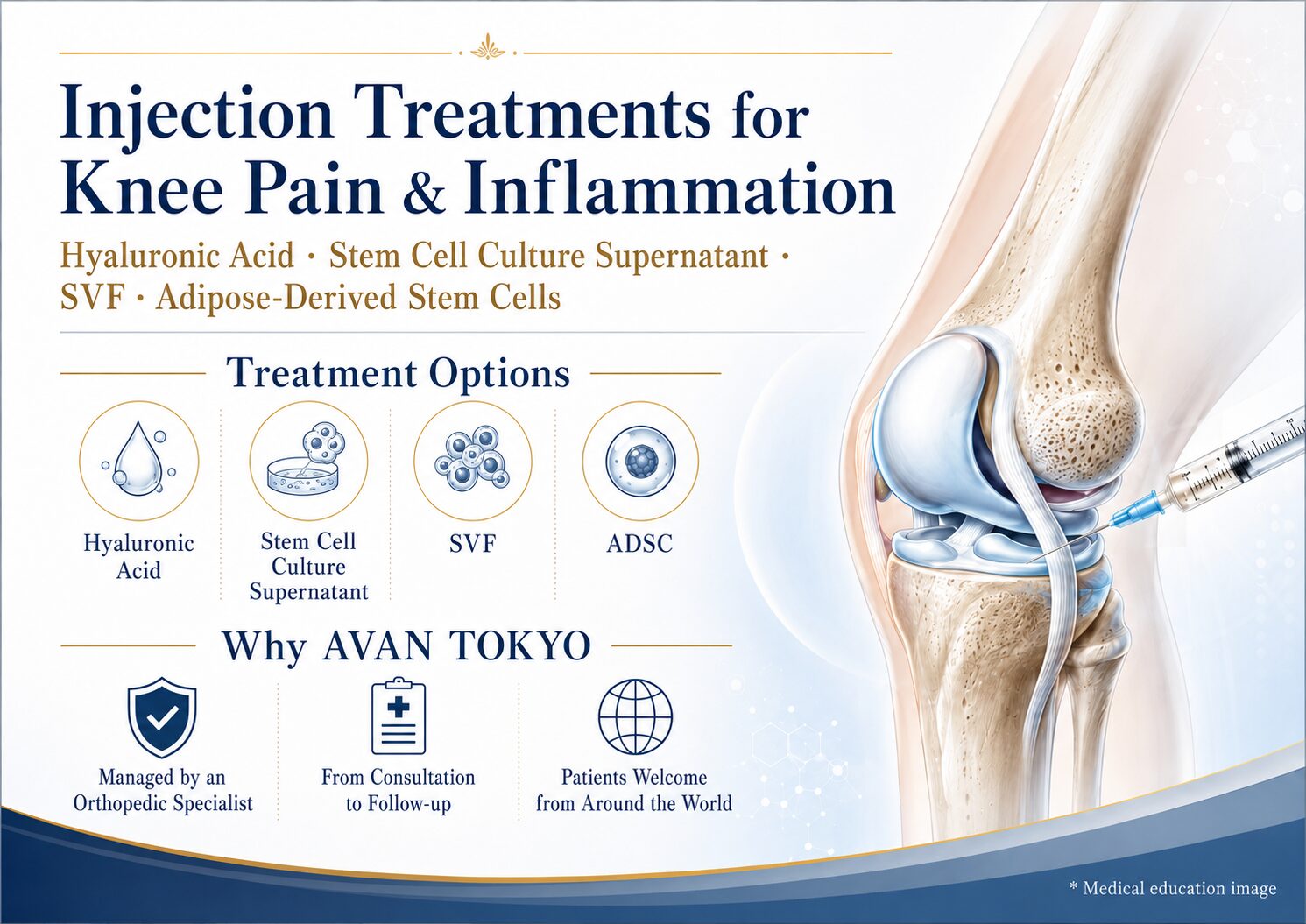
Addressing the source of pain should be attempted before psychological intervention. In osteoarthritis and enthesopathies, chronic inflammation of the synovium and joint capsule continuously generates pain signals; unless this is calmed, the premise of “movement equals pain” cannot change. Hyaluronic acid, steroids, and stem cell culture supernatant injections each regulate the intra-articular environment through different mechanisms. For information on joint diseases, please also refer to the Japanese Orthopaedic Association.
2. Expand the Range of Movement Gradually
Waiting until pain disappears completely before moving usually fails. Instead, “regaining daily activities in small increments within a pain-free range” simultaneously restores the descending inhibitory system and the reward system. Walking for five minutes to start, or using a handrail when standing after desk work—these small resumptions return the sensation of “I was able to move” to the brain. The period right after an injection, when pain is reduced, is the ideal timing to drive this activity-restoration plan.
3. Reshape How Pain Is Interpreted
For the same pain intensity, the brain’s emotional circuits respond differently depending on whether one thinks “this pain is a sign my joint is breaking down” versus “this is a reaction on a day when inflammation is high.” Having a physician explain the current imaging findings and disease stage specifically helps reshape the “meaning of pain” and softens depressive interpretations. When depressive symptoms are strong and interfere with daily life, please consider coordinated care with psychiatry or psychosomatic medicine without hesitation.
How Stem Cell Culture Supernatant Joint Injection Relates to the Mood Cycle
Stem cell culture supernatant contains a group of growth factors that act to suppress inflammatory cytokines, and is expected to calm the chronic inflammatory environment inside the joint. As inflammation subsides, “movement equals pain” is gradually replaced by “movement is fine,” making the activity-resumption axis easier to move. This is not a treatment that directly lifts mood, but by breaking one link in the chain of the vicious cycle, it is designed to produce ripple effects across both body and mind. For more about this treatment, please also see our page on stem cell culture supernatant joint injections.
However, a joint injection alone does not treat depression. When depressive symptoms are moderate or more, receiving a parallel specialist evaluation for mental and physical health is important.
Frequently Asked Questions
Q. Is it a matter of personality that joint pain depresses mood?
No. Chronic joint pain depression is a neuroscientifically real phenomenon. It arises when chronic pain signals continuously enter the brain’s emotional circuits and deplete neurotransmitters involved in mood regulation. It is not a matter of weak character or weak will, but a condition requiring medical attention.
Q. Should I avoid joint injections while my mood is down?
Depressive symptoms are not a contraindication to joint injections. In fact, as pain eases and the range of movement expands, the vicious cycle may loosen. However, when depression is severe, parallel care with a psychiatrist or psychosomatic physician is advisable.
Q. Do the effects of joint injections extend to mood?
There is no direct antidepressant action. As intra-articular inflammation subsides and daily activity such as walking and outings is restored, the reward system, sleep, and the autonomic nervous system all begin to recover, producing an indirect ripple effect on the mood cycle.
Q. Can I receive psychiatric care and joint care at the same time?
Yes. In principle there is no issue with pursuing both simultaneously. Because chronic pain and depression influence each other, treating both the joint and mind-body axis is the fastest way to break the cycle. If you are on prescribed medication, please always inform your joint care physician.
Q. After how long should pain be treated as “chronic”?
Generally, pain lasting three months or more is treated as chronic pain. At this stage, neural mechanisms different from those of the acute phase begin to operate, so this is the time to actively reconsider the treatment design rather than “wait a little longer.” If you are also noticing changes in your mood, we strongly recommend consulting a medical professional sooner.
──────────────
Medical Supervisor: Shin Moriwaki, MD
Member, Japan Society of Aesthetic Surgery (JSAS) / Member, American Academy of Aesthetic Medicine
ECFMG Certificate
──────────────
📍AVAN TOKYO Ginza Joint Regenerative Medicine
English / 中文 / Tiếng Việt supported
Inquiries welcome via DM / LINE / Website / Phone.