


Prevention for People with a Family History of Osteoarthritis — Playing Ahead of Genetics and Lifestyle, Explained by Dr. Moriwaki2026.09.05
“Both my parents and grandparents had knee osteoarthritis,” “my siblings say their knees started aching in their forties too” — people with a family history of osteoarthritis often worry that they too are destined to walk the same path. It is true that genetic predisposition plays a role in the onset of osteoarthritis. However, “having a family history” does not mean “onset is inevitable.” Even in a body with genetically higher risk, lifestyle — an environmental factor — leaves considerable room to change when the trigger is pulled and how quickly the disease progresses. In this article, Dr. Moriwaki of AVAN TOKYO Ginza organizes the “preemptive moves” that people with a family history of osteoarthritis can start playing today.
Key Points
・People with a family history of osteoarthritis tend to have higher onset risk, but onset is not determined by genes alone.
・Environmental factors — body weight, quadriceps strength, lower-limb alignment, and joint-loading patterns — pull the trigger.
・Precisely because there is a family history, a “preemptive” lifestyle design that protects the joint before symptoms appear pays off over the long term.
・Once cartilage metabolism or the intra-articular inflammatory environment begins to be disturbed, joint injection of stem cell conditioned media becomes one option.
・Joint injection is effective at correcting the intra-articular inflammatory environment, but it does not change the genetic predisposition or the bone geometry itself.
Is Osteoarthritis Really Decided by “Genes” Alone?
What genetic predisposition actually is
For osteoarthritis, especially of the knee, hip, and hand, familial clustering has long been reported. Monozygotic twin studies and large-scale genome-wide association studies (GWAS) have shown that multiple genetic polymorphisms — in cartilage matrix genes (COL2A1, COL11A1, etc.), genes regulating cartilage metabolism, and bone-formation genes shaping joint geometry — are associated with the risk of osteoarthritis. Familial clustering is particularly striking for Heberden’s and Bouchard’s nodes of the fingers, with reports estimating a genetic contribution above 50%. For knee osteoarthritis, roughly 30–40% is said to be explained by genetic factors.
Still, what genes carry is information about “how easily cartilage and bone are built and broken down,” not “the exact age at which onset must occur.” Some people with strong genetic predisposition never develop the disease, while others with no family history develop it young after trauma or heavy occupational load. A family history of osteoarthritis is best received as information indicating a “body in which the trigger is easily pulled.”
Environmental factors pull the trigger
Against the “loaded cartridge” of genetic predisposition, environmental factors serve as the “trigger.” Representative ones include weight gain, quadriceps weakness, lower-limb alignment abnormalities such as varus (O-leg) or valgus (X-leg), history of meniscus or cruciate ligament injury, long-standing occupational loads such as prolonged standing or heavy lifting, and post-menopausal estrogen decline. Body weight in particular multiplies the load on the knee joint by about three times body weight during level walking and roughly six times when climbing stairs; epidemiological studies show that a gain of just 5 kg significantly raises the risk of knee osteoarthritis onset.
In other words, a person with a family history has a body in which “the trigger is light.” Conversely, controlling environmental factors from an early stage can delay onset by several to more than ten years. For an overview of joint-disease prevention and treatment, please also consult the guidelines of the Japanese Orthopaedic Association.

Preemptive Moves People with a Family History of Osteoarthritis Can Play Today
Weight management, the single largest modifiable factor
The most strongly evidenced intervention for osteoarthritis prevention is weight control. Overweight or obesity with BMI over 25 is one of the greatest risk factors for knee osteoarthritis, and intervention studies have shown that losing just 5% of body weight can improve knee pain and functional disability. People with a family history should become conscious, from a young and asymptomatic age, of keeping weight within a few kilograms of standard. Rather than crash dieting, a realistic combination is dietary quality review together with low-impact exercise such as aerobics, aquatic exercise, and cycling.
Maintaining muscle strength and lower-limb alignment
At the knee joint, the quadriceps — especially the vastus medialis — act as a shock-absorbing device that stabilizes the joint. When this strength declines, ground reaction forces during walking transmit directly to the cartilage, and microdamage accumulates. For people with a family history, quadriceps-targeted training such as slow sit-to-stand from a chair, shallow squats, and leg extensions is recommended at a pace of two to three times per week.
For those with a varus (O-leg) tendency, weight concentrates on the medial joint space, making progression toward medial-compartment knee osteoarthritis more likely. Having a specialist evaluate lower-limb alignment and, when needed, using insoles/orthotics and gait instruction to distribute mechanical load is another “preemptive move.” Smoking impairs the microcirculation needed for cartilage repair, so quitting smoking also contributes to long-term joint protection.
Joint Injection of Stem Cell Conditioned Media as One Option
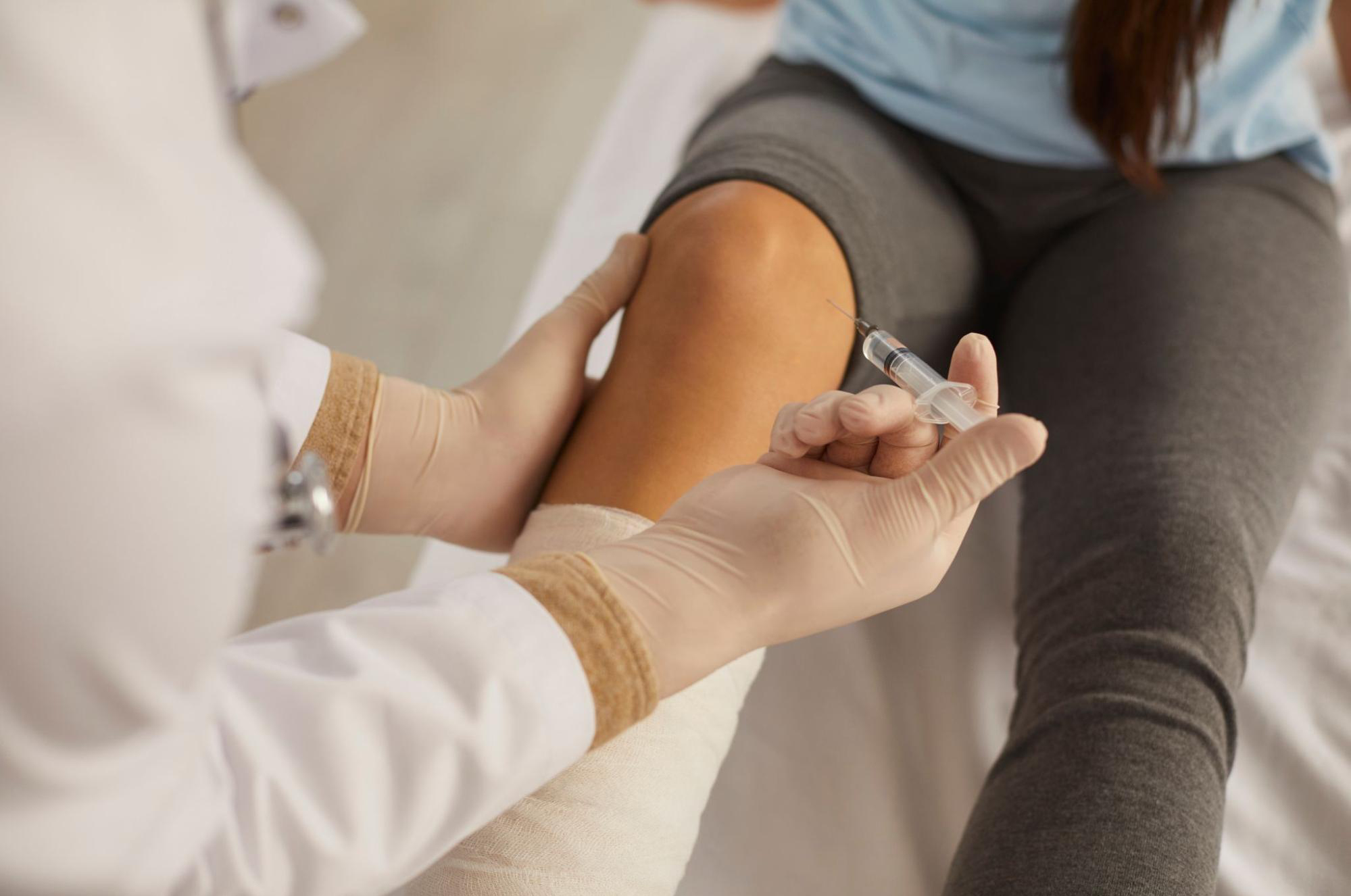
Even with a preemptive lifestyle, mild morning stiffness or start-of-walking pain can appear from the forties or fifties onward. One option to consider at that early stage is joint injection of stem cell conditioned media. Stem cell conditioned media contains a range of bioactive molecules — growth factors, cytokines, exosomes — thought to act on the intra-articular inflammatory and cartilage-metabolism environment. Intervening while joint-space narrowing is still mild and pain is only “occasional” is expected to help calm the chronic synovitis cycle inside the joint.
However, what joint injection of stem cell conditioned media can target is strictly the correction of the intra-articular inflammatory and cartilage-metabolism environment — not the genetic predisposition itself, not the bone geometry itself, and not the anatomical restoration of joint-space narrowing that has already progressed. Sharing this line between “what it can and cannot reach” with your physician, and building the treatment plan in combination with weight control and strength training, is essential. Please also refer to our page on joint injection with stem cell conditioned media for details.
Frequently Asked Questions
Q. My parents have had total knee replacements on both sides. Will I inevitably walk the same path?
Not necessarily. A family history of osteoarthritis is one factor that raises onset risk, but the timing and speed of progression change greatly with environmental factors such as body weight, muscle strength, activity history, and alignment. It is precisely those with a family history who can meaningfully delay onset by keeping up with weight control and quadriceps training from a young age.
Q. Does it make sense to give joint injections of stem cell conditioned media before any symptoms appear?
At present, there is no established evidence for prophylactic joint injection in the completely asymptomatic stage. It is more appropriate to consider it once early symptoms — morning stiffness, a slight sense of resistance at the first steps — begin to appear, as a response to pain and inflammation. Before that, we recommend prioritizing preventive lifestyle design informed by your family history.
Q. Can genetic testing tell me my personal risk of osteoarthritis in advance?
Multiple risk-associated polymorphisms have been identified in research, but no clinically applicable test can yet predict individual risk with high accuracy. At present, careful history-taking of family history combined with physical examination, X-ray, and MRI assessment is a more practical risk-evaluation method.
Q. Can supplements said to be “good for joints” prevent onset?
For oral supplements such as glucosamine and chondroitin, no clear preventive effect on onset has been demonstrated in people with a family history. Basic interventions — weight control, quadriceps strength maintenance, and lower-limb alignment evaluation — are far more strongly evidenced preventive measures.
Q. Should I hold back on exercise because of my family history?
On the contrary — appropriate exercise is essential for maintaining periarticular muscles and controlling body weight. That said, activities with large impact on the knee — running, mountaineering, heavy squats — will need load adjustment once symptoms begin. Building a foundation around “joint-friendly exercise” such as aquatic exercise, cycling, and level-ground walking is the long-term rational choice.
Summary
Having a family history of osteoarthritis means not “onset is decided,” but rather “a body in which the trigger is light.” Precisely for that reason, “preemptive moves” against environmental factors — weight control, quadriceps training, lower-limb alignment evaluation, quitting smoking — have the potential to delay onset by several to more than ten years. Once early symptoms appear, joint injection of stem cell conditioned media becomes an additional option, but it should be used with the understanding that it corrects the inflammatory environment, not the genetic predisposition itself. Reframe having many relatives with osteoarthritis not as a source of anxiety but as “information that lets you act early,” and make joint care from a young age a habit.
──────────────
Medical Supervisor: Shin Moriwaki, MD
Member, Japan Society of Aesthetic Surgery (JSAS) / Member, American Academy of Aesthetic Medicine
ECFMG Certificate
──────────────
📍AVAN TOKYO Ginza Joint Regenerative Medicine
AVAN TOKYO Ginza Joint Regenerative Medicine
English / 中文 / Tiếng Việt supported
For consultations, please contact us via DM / LINE / Website / Phone.