


What to Wear, What to Bring, and How to Spend Joint Injection Day — A Practical First-Timer’s Guide by Dr. Moriwaki2026.10.03
For patients receiving a joint injection for the first time, it is common to feel uneasy about what to wear, what to bring, and what the in-clinic flow will look like. Understanding joint injection day preparation in advance helps you avoid delays at check-in and intake, and lets you calmly plan the post-injection rest window and your trip home. In this column, Dr. Moriwaki walks through practical, joint-by-joint preparation for the knee, shoulder, hip, and lower back, along with a time breakdown from arrival to departure.
Key Points
・Good joint injection day preparation means designing your clothing, in-room sequence, and rest time around the specific injection site to reduce bodily strain.
・The top priority for clothing is “exposing the injection site quickly” — loose pants work well for knee injections, and a front-opening top is easier for shoulder injections.
・Insurance card, medication record (okusuri-techo), image data from any referring clinic, and a note of your regular medications are must-haves so that the check-in flow does not stall.
・Plan on 15–30 minutes of in-clinic rest right after the injection, confirming no lightheadedness or local discomfort before heading home.
・On the day, avoid long-distance driving, extended standing, and strenuous exercise; keeping the next day’s schedule light is the safer plan.
Joint Injection Day Clothing: The Optimum Changes by Site
The first condition when choosing clothes for a joint injection is “being able to expose the injection site quickly while keeping it clean.” Clothing that cannot be rolled up far enough interferes with disinfection and needle insertion, and even with placing an ultrasound probe for guided injection. Holding an uncomfortable posture tenses the muscles and increases the risk of a vasovagal response, so loose clothing that lets you stay relaxed also has safety value.
For a Knee Injection
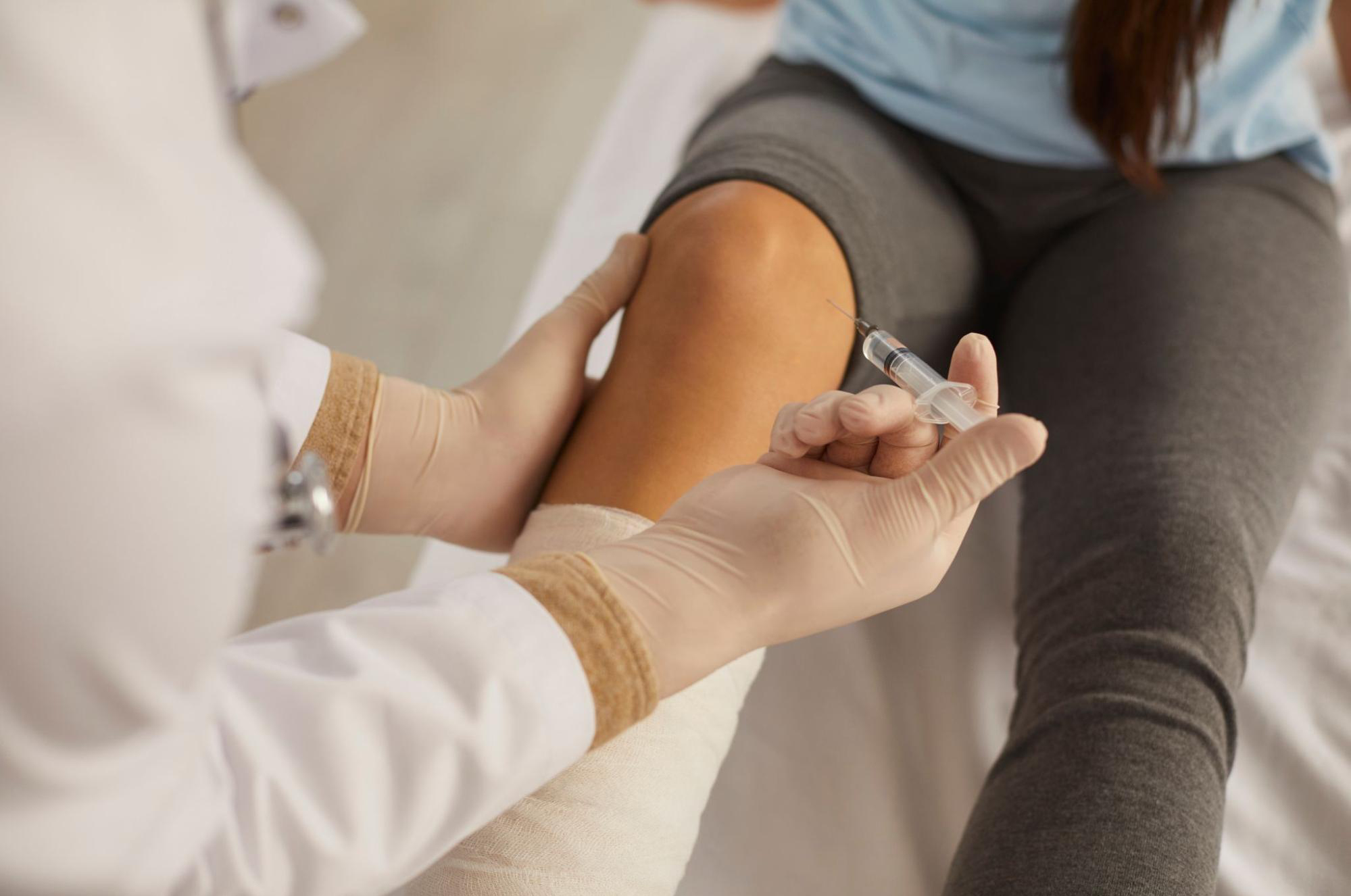
For knee injections, the key is whether you can lift the hem up to mid-thigh. Slim skinny jeans and tight leggings tend to slide down during the procedure, making it hard to maintain the right position. Loose wide pants, shorts, or an above-the-knee skirt make it easier to change positions on the bed. Short socks that expose the ankle are preferred; boots and lace-up shoes take too long to put on and off and are best avoided.
For a Shoulder Injection
For injections into the glenohumeral joint, subacromial bursa, or rotator cuff enthesis, you want clothes that expose the shoulder blade through the collarbone area. A front-opening shirt, cardigan, or gown-style dress means you do not need to pull anything over your head like a turtleneck, and you can avoid forced arm elevation after the injection. For women, a camisole whose strap can be dropped, or a bra with an accessible back closure, makes it easier to maintain the disinfected field.
For a Hip or Lower Back (Sacroiliac / Facet Joint) Injection
For injections around the hip or lower back, pants with a soft waistband or a wide skirt that is easy to slip on and off are the most practical. Jeans and stiff fabrics get in the way when accessing the greater trochanter or inguinal area. For underwear, avoid high-waisted or shapewear-style briefs; soft-fabric underwear moves the exam, ultrasound, and disinfection stages along smoothly.
What to Bring: Items That, If Forgotten, Will Derail the Day
Must-Bring Items
To keep the flow from check-in to injection moving, bring your insurance card (used for identification even in self-pay care), medication record (okusuri-techo), and any referral letter or image data from another clinic (CD-R, USB, or PDF on your phone). A list of regular medications — especially anticoagulants such as warfarin or DOACs, NSAIDs, diabetes medications, and steroids — written down on paper speeds up the consultation. For general information on joint diseases, reviewing patient-facing materials from the Japanese Orthopaedic Association in advance also helps you organize questions for the physician.
Nice-to-Have Items
A note tracking your pain history (when, during what activity, how intense), a list of movements that are currently difficult within your range of motion, a smartphone (to log the consultation), a brace or elastic bandage (only if your physician has advised one), and a small cooler bag for an ice pack (useful if cooling is prescribed for the knee or ankle) all make the trip home easier. For more on joint injections using stem cell conditioned media, please also see here.
Joint Injection Day Preparation: Time Allocation from Arrival to Departure
Before You Arrive
“Eat light” is the baseline for breakfast or lunch. An empty stomach raises the risk of a vasovagal response (vasovagal syncope) during the injection, while being overly full often leads to discomfort in a lying position. Practically, eating easily digestible food to about 70% full before coming in is realistic. You can hydrate as usual. Avoid alcohol as part of joint injection day preparation, and keep intake modest the night before as well, so that the effect of local anesthetic and antiseptic can be judged accurately.
Flow Inside the Clinic
The typical flow is: check-in → medical history form → examination (inspection, palpation, range of motion, ultrasound) → informed consent → positioning in the procedure room → disinfection → local anesthesia → ultrasound-guided puncture → injection. As part of joint injection day preparation, plan on 60–90 minutes in the clinic for a first visit and 30–60 minutes for a follow-up. The needle itself only reaches the joint in seconds to tens of seconds, but mapping a safe approach by ultrasound and avoiding tendons, nerves, and vessels takes time — so leave room in your schedule rather than rushing.
In-Clinic Rest After the Injection and Going Home
Take 15–30 minutes of in-clinic rest right after the injection to confirm you have no lightheadedness, cold sweating, or nausea. If all is well, you can walk out, but on the day itself it is safer to avoid long-distance driving, outings with many stairs, and extended standing. Coming in by public transit or being dropped off by family — and planning so the walking distance home is short — fits naturally within sound joint injection day preparation. Timing-specific guidance for bathing, exercise, and alcohol after the injection is covered in a separate article; the basic principle for the same day is to avoid both heat on the injected area and strong impact.
Frequently Asked Questions
Q. What should I wear on the day?
It depends on the joint being injected: loose pants or shorts for the knee, a front-opening top for the shoulder, and a soft-waistband bottom for the hip or lower back. Avoid skinny pants, tight skirts, and pull-over tops — they interfere with disinfection and ultrasound handling.
Q. What are the absolute must-bring items?
Your insurance card, medication record, any referral letter and image data from another clinic, and a list of regular medications (especially anticoagulants, NSAIDs, diabetes medications, and steroids). Adding a pain-history note and your smartphone will shorten the time needed for intake, examination, and informed consent.
Q. Can I drive myself home after the injection?
If only local anesthesia is used, driving home is not strictly contraindicated, but lightheadedness right after the injection and heaviness in the injected area can reduce concentration. For a first visit we recommend public transit or being driven by family. If sedation is used, driving on the day is not permitted.
Q. Can I eat before the injection?
Fasting is not required for joint injections under local anesthesia, but avoid both an empty stomach and overeating. Have something easy to digest, filling you to about 70%, before coming in. An empty stomach raises vasovagal syncope risk, while overeating raises the risk of discomfort while lying supine.
Q. Can I go back to work the same day?
If your work is mostly desk-based, returning to light duties in the afternoon is often possible, but avoid jobs that involve prolonged standing, heavy lifting, or strenuous activity on the day. For a first visit, scheduling a half-day or full day off makes it easier to respond calmly to any change in condition.
──────────────
【監修】森脇 進 / Shin Moriwaki (Supervising Physician)
Member, Japan Society of Aesthetic Surgery (JSAS) / Member, American Academy of Aesthetic Medicine
ECFMG Certificate
──────────────
📍AVAN TOKYO 銀座 関節再生医療
AVAN TOKYO Ginza Joint Regenerative Medicine
English / 中文 / Tiếng Việt supported
Inquiries welcome via DM / LINE / Website / Phone.