


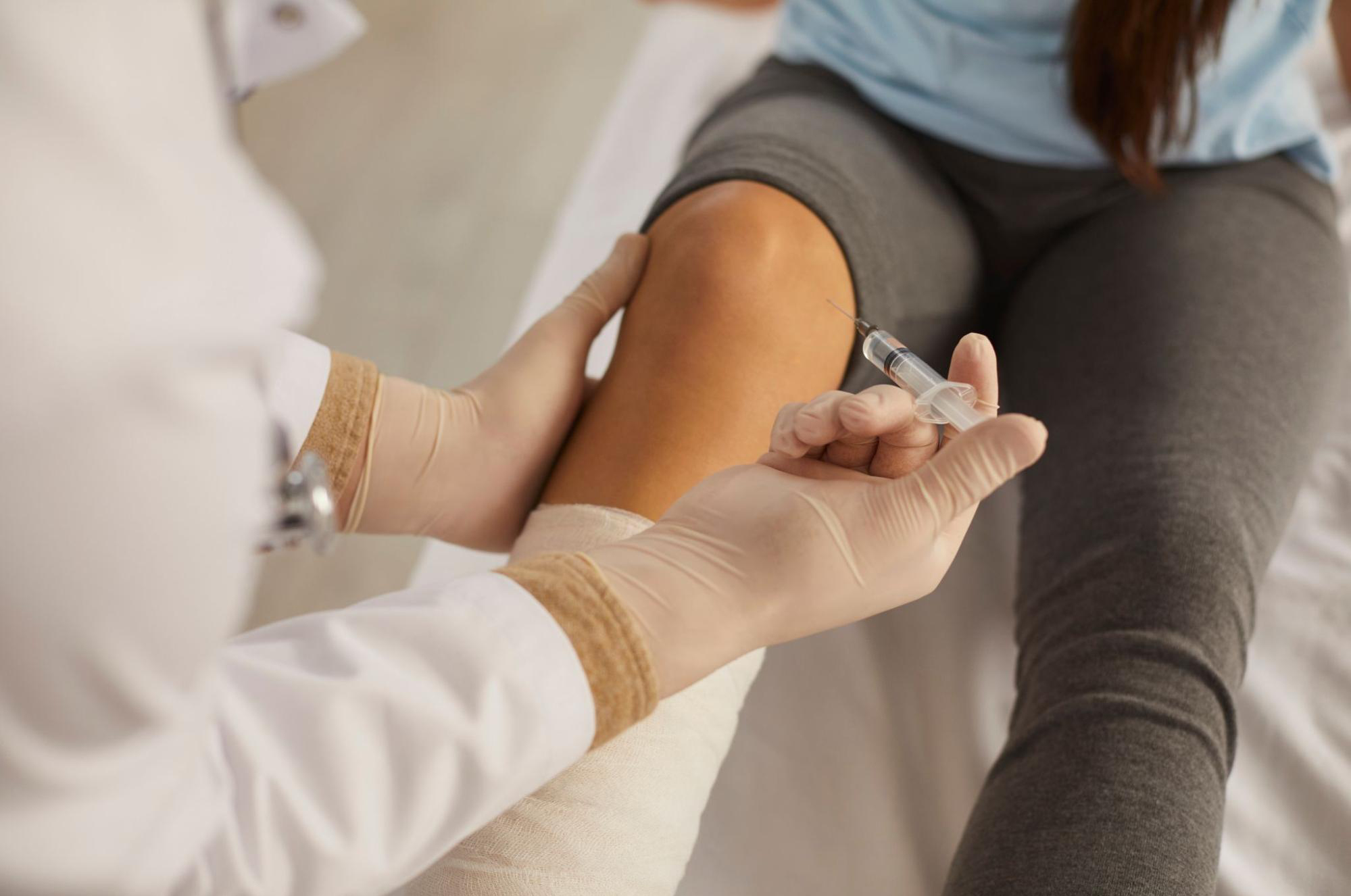
Don’t Mistake Olecranon Bursitis (“Student’s Elbow”) for Elbow Osteoarthritis or Triceps Enthesopathy — The Pathology of Chronic Recurrent Bursitis Behind a Doughy Swelling at the Back of the Elbow, and the Line Dr. Moriwaki Draws Between What Peri-Elbow Injection of Stem Cell Conditioned Media Can Target (Inflammatory Environment Inside/Around the Bursa) and What It Cannot (Avoidance of the Repetitive Mechanical Stress Itself)2026.08.13
“The back of my elbow has puffed up and feels doughy when I lean on the table.” “It doesn’t hurt when I touch it, but a knock sends a sharp jolt through it.” — that kind of swelling at the back of the elbow is, in most cases, not a disease of the elbow joint itself but olecranon bursitis. It is common in people who lean on their elbows at a desk, work on floors or plumbing where the elbow is repeatedly pressed, or use wheelchairs and crutches long-term — anyone whose posterior elbow is subject to repeated compression and friction — and it has long been called “student’s elbow.”
The problem is that this condition is often mistaken for “swelling from elbow osteoarthritis” or “pain from triceps enthesopathy,” and treatment proceeds down the wrong path. The site of swelling, the situations that produce pain, and the tissue targeted by treatment are all different. Without sorting this out, repeatedly performing peri-elbow injections of stem cell conditioned media cannot yield a good course because the target itself has been misidentified.
Key Points of This Article
・Olecranon bursitis is not a disease “inside” the elbow joint; it is chronic inflammation caused when repeated compression, friction, and micro-trauma act on the subcutaneous bursa overlying the olecranon.
・It differs from elbow osteoarthritis (range-of-motion limitation, osteophytes) and triceps enthesopathy (tendon degeneration painful on force) in both pathology and painful situations; misidentification derails treatment design.
・Peri-elbow injection of stem cell conditioned media can target correction of the inflammatory environment inside/around the bursa, but avoidance of repetitive mechanical stress and etiologic treatment of septic or crystal bursitis must be handled separately.
・If skin redness, warmth, severe pain, or fever appear, suspect infection: hold off on the conditioned media injection and seek prompt orthopedic evaluation as the top priority.
What Is Actually Happening in Olecranon Bursitis (“Student’s Elbow”)
The olecranon bursa is a cushion that separates the ulnar prominence (the olecranon) at the back of the elbow from the skin; normally it is a flat, membranous structure. When repeated pressure and friction against a desk or floor — or a single strong contusion — act on it, the bursal wall is irritated and reactive fluid accumulates in the cavity, causing swelling. Acute cases carry pain and warmth, but chronic cases often show fibrotic wall thickening and a painless “doughy lump” that simply persists.
The “Inflammation” Is Not Just One Thing
Even grouped as one condition, the internal breakdown is diverse: aseptic reactive bursitis from repeated compression; septic (suppurative) bursitis when bacteria enter; crystal bursitis triggered by gout or pseudogout; and cases with an autoimmune background such as rheumatoid arthritis. In septic and crystal forms, etiologic treatment is the top priority — these should never be addressed with peri-joint conditioned media injection alone.
Elbow Conditions Easily Confused, and Points for Differentiation
Difference from Elbow Osteoarthritis
Elbow osteoarthritis involves degeneration of the “joint space itself” between the humerus and the ulna/radius, plus osteophytes; the main symptoms are range-of-motion limitation (the elbow does not fully extend or flex) and pain deep in the joint on movement. Any swelling is a whole-cavity tightness, distinct in feel from a localized subcutaneous “doughy” lump. Intra-articular injection of conditioned media targets the joint cavity, whereas the conditioned media injection for this condition is aimed at the subcutaneous bursa — the target layer is different.
Difference from Triceps Enthesopathy
Triceps enthesopathy produces pain slightly above the olecranon during elbow extension, pushing heavy objects, or forceful extension of the upper arm. Swelling is not prominent; the hallmarks are “a single painful spot on pressure” and “pain when force is applied.” Because the swelling of this condition rises like a dome “directly behind” the olecranon, it can be distinguished by the location of swelling and how pain is produced under load.
What Peri-Elbow Injection of Stem Cell Conditioned Media Can and Cannot Target
For chronic reactive olecranon bursitis, peri-elbow injection of stem cell conditioned media is a treatment that “targets” — via growth factors and anti-inflammatory cytokines acting on tissue inside and around the bursa — the calming of a chronic inflammatory cycle (synovial cell proliferation, fibrosis, recurrent exudation). However, the injection itself does not shrink the physical sac of the bursa, and recurrence is inevitable if repeated compression and friction continue; environmental modification such as elbow pads, revised leaning habits, and work-posture redesign is the foundation.
Also, when repeated swelling is driven by gout, pseudogout, rheumatoid arthritis, or infection, evaluating and treating those causes takes precedence. If signs of infection — reddened skin, marked warmth, pulsating pain, or fever — appear, defer the conditioned media injection and seek prompt orthopedic work-up. Since responses vary between individuals and improvement is not guaranteed, decisions should be made after sharing indications and limits with a physician.
For an overview of the treatment, see Details on stem cell conditioned media joint injection. General information on joint disorders is also available on the Japanese Orthopaedic Association website.
Order of Treatment — Don’t Settle for “Just an Injection”
Olecranon bursitis is initially managed with conservative measures — avoiding repetitive stimulation, compression, cooling, and NSAIDs. When swelling is severe and interferes with daily life, aspiration is chosen; if infection is suspected, culture and antibiotic therapy follow; if crystalline, crystal identification and treatment of the underlying disease proceed. In aseptic cases with chronic recurrence, when the risks of steroid injection (skin atrophy, subcutaneous fragility, repeat-related infection) are to be avoided, peri-elbow injection of stem cell conditioned media becomes one option to consider.
“The swelling has shrunk with the injection” and “it’s now safe to lean on the elbow again” are separate matters. Only by using elbow pads consistently, reconsidering desk height, and switching to postures that don’t press the elbow can recurrence truly be reduced. Rather than relying solely on injection, combining it with a redesign of daily and work environments — while it looks like a detour — is actually the shortcut.
Frequently Asked Questions
Q. Does the swelling of olecranon bursitis resolve on its own?
Mild acute reactive bursitis may improve over days to weeks with avoidance of repeated stimulation, cooling, and compression. However, chronic cases lasting months or those with repeated swelling tend to relapse if left to natural course, and specialist evaluation is recommended.
Q. Can peri-joint conditioned media injection be used for septic bursitis?
No. When accompanied by skin redness, warmth, severe pain, or fever, infection is strongly suspected, and conditioned media injection is not performed. Culture and antibiotic therapy are the priority; incision and drainage or other orthopedic treatments are chosen as needed. Only after etiologic treatment has ended and inflammation has settled should injection be considered for any chronic residual portion.
Q. What is the difference from steroid injection?
Steroid injection offers strong, rapid inflammation control, but at this site the risks — skin atrophy, subcutaneous fragility, and repeat-related infection — become problematic. Peri-joint injection of stem cell conditioned media aims to modulate the inflammatory environment via growth factors and anti-inflammatory cytokines; the axis of action differs. Which is appropriate is judged individually based on pathology and course.
Q. How many sessions are needed to judge efficacy?
In reactive/chronic cases, swelling size, pain, skin color, and daily activity are objectively evaluated over weeks to months. Judgment is not made from a single session; changes after 2–3 administrations, combined with the effect of environmental modification, are used to decide whether to continue, change, or proceed to orthopedic re-evaluation. Response varies between individuals, and improvement is not guaranteed.
Q. Can I return to work on the day of the procedure?
With a small-volume injection around the olecranon bursa, most people return to daily activities on the same day, but on that day please avoid work that involves leaning on the elbow, strong compression, and prolonged warm-water soaking during bathing. Record any changes in pain or swelling from the next day onward, and see a physician promptly if redness, warmth, or severe pain occurs.
──────────────
Supervising Physician: Shin Moriwaki, MD
Member, Japan Society of Aesthetic Surgery (JSAS) / American Academy of Aesthetic Medicine
ECFMG Certificate
──────────────
📍AVAN TOKYO Ginza Joint Regenerative Medicine
English / 中文 / Tiếng Việt available
Inquiries via DM / LINE / Website / Phone.