


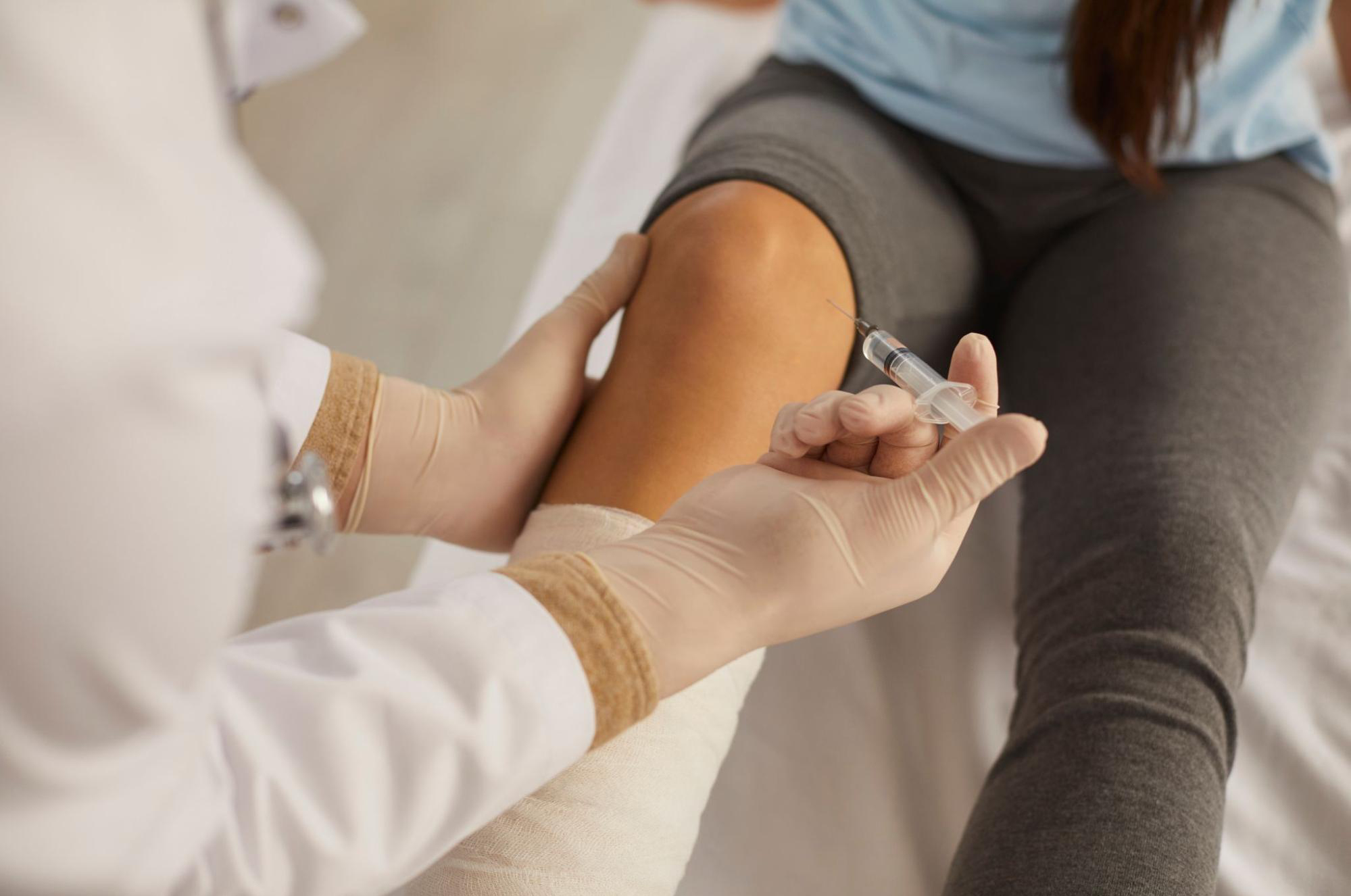
Persistent Lateral Knee Pain? Don’t Miss Proximal Tibiofibular Joint Osteoarthritis — Dr. Moriwaki Distinguishes It from Iliotibial Band Syndrome and Lateral Meniscus Injury, and Clarifies What Stem Cell Conditioned Media Peri-Articular Injection Can and Cannot Target2026.08.13
“My lateral knee keeps hurting,” “It aches when I press just below the fibular head” — when such symptoms are treated as “iliotibial band syndrome” or “lateral meniscus injury” but never quite resolve, one commonly overlooked condition is proximal tibiofibular joint osteoarthritis. This is a degenerative, mechanical disorder not of the knee joint itself, but of the small joint between the lateral tibial condyle and the fibular head (the proximal tibiofibular joint). It manifests as posterolateral knee pain, discomfort, and tenderness directly under the fibular head. Here, Dr. Moriwaki outlines the differential diagnosis and clarifies which layers stem cell conditioned media peri-articular injection can — and cannot — target for proximal tibiofibular joint osteoarthritis.
Key Points of This Article
・Proximal tibiofibular joint osteoarthritis causes lateral to posterolateral knee pain and is often overlooked; differentiation from iliotibial band syndrome, lateral meniscus injury, and peroneal nerve entrapment is essential.
・It falls into three clinical types — chronic degenerative, subluxating (unstable), and inflammatory — and diagnosis begins with tenderness under the fibular head and pain reproduction on resistance testing.
・Stem cell conditioned media peri-articular injection is positioned as an intervention on the chronic inflammatory cycle within the joint and at its entheses; it does not correct bony deformity or ligamentous instability.
・Before injection, X-ray and MRI must confirm joint-space narrowing and subchondral edema, and red flags (infection, malignancy, fracture) must be excluded.
・Combination design with conservative care — bracing, footwear review, and rehabilitation of lateral leg muscles — stabilizes the response.
Where Is the Proximal Tibiofibular Joint?
The proximal tibiofibular joint is a small plane joint between the lateral tibial condyle and the fibular head. It is supported by the joint capsule and the anterior and posterior proximal tibiofibular ligaments. Its mobility is limited, but the fibula slides slightly in anteroposterior and superoinferior directions with ankle dorsi-/plantarflexion and lower-leg rotation. It does not, in principle, articulate with the femur or the tibia directly and is a structure independent of the knee joint cavity. However, when this joint receives repeated microtrauma or undergoes degeneration, chronic inflammation persists and is perceived as “lateral knee pain” — this is the pitfall in the differential.
Three Clinical Types
Clinically, the condition is broadly divided into (1) chronic degenerative type (joint-space narrowing due to aging or coexisting knee OA), (2) subluxating type (anteroposterior instability of the fibular head with snapping), and (3) inflammatory type (joint effusion and synovial thickening). Each has a different pain character and response. What stem cell conditioned media peri-articular injection can most reliably target is the inflammatory type and the chronic inflammatory component that coexists with the degenerative type.
Conditions Easily Mistaken for Proximal Tibiofibular Joint Osteoarthritis
Difference from Iliotibial Band Syndrome
Iliotibial band syndrome (runner’s knee) is inflammation of the enthesis and bursa due to friction between the lateral femoral epicondyle and the iliotibial band. Pain occurs above the fibular head, around the lateral femoral epicondyle to Gerdy’s tubercle on the tibia. It typically worsens on downhill running and stabs at foot strike. In contrast, this condition concentrates tenderness “directly under the fibular head,” and pain is reproduced by pressing the fibular head anteroposteriorly.
Difference from Lateral Meniscus Injury
Lateral meniscus injury produces pain along the joint line of the knee on squatting or twisting, and the McMurray test may be positive. Proximal tibiofibular joint osteoarthritis concentrates pain “below” the joint line at the fibular head, and symptoms are more readily reproduced by ankle dorsi-/plantarflexion or lower-leg rotation.
Difference from Common Peroneal Nerve Entrapment
Just below the fibular head, the common peroneal nerve runs subcutaneously; when numbness or foot drop is present, nerve entrapment is suspected. If tapping the fibular head elicits Tinel-like tingling radiating to the lateral lower leg, nerve involvement should be considered.
Please also refer to our detailed page on joint injection with stem cell conditioned media.

Layers That Stem Cell Conditioned Media Peri-Articular Injection Can and Cannot Target
Behind the chronic pain of proximal tibiofibular joint osteoarthritis lie a low-grade intra-articular synovitis, degeneration of surrounding ligamentous entheses, and an inflammatory cycle driven by repeated mechanical stimulation. The growth factors (TGF-β, IGF-1, FGF, VEGF, and others), cytokines, and exosomes contained in stem cell conditioned media are thought to influence the balance of inflammatory cytokines inside and around the joint, and to induce repair signals.
Layers That Can Be Targeted
・Correction of low-grade inflammation in the intra-articular synovium
・Correction of the chronic degenerative environment at surrounding tendon/ligament entheses
・Modulation of the cartilage metabolic environment (only as environmental adjustment)
Layers That Cannot Be Targeted
・Reconstruction of bony joint-space narrowing itself
・Anatomical fixation of a fibular head that has become unstable in the subluxating type
・Reattachment of a completely torn ligament
“Adjusting the inflammatory environment” and “reconstructing the structure itself” are different processes; this injection is positioned as a conservative approach chiefly responsible for the former. Individual response varies, and we always share up front that this is neither a first-line therapy nor a panacea.
Imaging Findings and Red Flags to Confirm Before Injection
Plain X-rays (AP and lateral) are used to confirm joint-space narrowing, osteophytes, and loose bodies, and MRI is added as needed to evaluate subchondral bone edema, joint effusion, and surrounding ligament degeneration. If any of the following signs are present, orthopedic workup takes precedence over injection.
・Sudden fever, redness, or severe pain (suspected septic arthritis)
・Weight loss or general malaise (suspected systemic disease including malignancy)
・History of trauma with inability to walk (suspected fracture)
・Progressive foot drop or numbness (suspected peroneal nerve entrapment)
For information on joint disease, we also recommend consulting the site of the Japanese Orthopaedic Association.
Treatment Design for Proximal Tibiofibular Joint Osteoarthritis — Conservative Care in Combination Is the Foundation
Treatment is not built on injection alone but on combination with conservative care that reduces mechanical load.
Elements of Conservative Care
・Knee braces or elastic taping to limit excessive gliding at the fibular head
・Review of shoe heel height and shank stiffness to reduce excessive ankle rotation
・Stretching and strengthening of the lateral thigh muscles (vastus lateralis, tensor fasciae latae) and peroneal group
・Temporary limitation of downhill running and jump-landing activity
Running stem cell conditioned media peri-articular injection in parallel with these measures — quelling the intra-articular inflammatory cycle while rebuilding functional load distribution — is a realistic design.
Timing of Efficacy Assessment
We evaluate the course along three axes: pain scales (NRS or VAS), tenderness at the fibular head, and pain on activity. Because repair of tendon, ligament, and cartilage environments takes time, initial assessment is done at 4–6 weeks and mid-term assessment at 3 months. If response is poor, we switch to reviewing the exercise program or to orthopedic reassessment.
Frequently Asked Questions
Q. Can proximal tibiofibular joint osteoarthritis heal on its own?
When mild, and if triggers such as ill-fitting shoes or excessive downhill running are removed, it may improve. However, once chronic joint-space narrowing or instability remains, spontaneous improvement is unlikely, and a design combining conservative care, injection, and — in some cases — surgical management is required.
Q. Is stem cell conditioned media joint injection covered by insurance?
It is a private-pay treatment and is not covered by Japan’s public health insurance. Fees vary between facilities, and we explain them before administration. We recommend evaluating it by total cost, including efficacy assessment, additional dosing, and combined rehabilitation.
Q. How many sessions are typically needed to judge efficacy?
This depends on symptom severity and disease stage. In general, a concentrated set of sessions is given in the induction phase, followed by evaluation of pain and functional change over about three months. Rather than a treatment that produces a clear change in a single session, it is an approach that adjusts the environment gradually while tracking the course.
Q. Are there cases in which surgery is required?
When severe degeneration or subluxation persists and does not improve with injection or exercise, procedures such as proximal tibiofibular joint arthrodesis or fibular head resection may be considered. However, indications are determined carefully by an orthopedic surgeon, and it is important to first assess how far a conservative approach can carry the case.
Q. Are there any side effects of peri-articular injection at the proximal tibiofibular joint?
Transient injection-site swelling and pain (post-injection flare) and, rarely, bruising have been reported. Even with strict aseptic technique, injection-site infection and septic arthritis cannot be reduced to zero; please contact us immediately if fever, severe pain, or joint swelling suddenly worsens.
──────────────
Supervising Physician: Shin Moriwaki, MD
Member, Japan Society of Aesthetic Surgery (JSAS) / American Academy of Aesthetic Medicine
ECFMG Certificate
──────────────
📍AVAN TOKYO Ginza Joint Regenerative Medicine
English / 中文 / Tiếng Việt available
Inquiries via DM / LINE / Website / Phone.