


Quadriceps Training to Prolong the Effect of Knee Joint Injections — Explained by Dr. Moriwaki2026.10.05
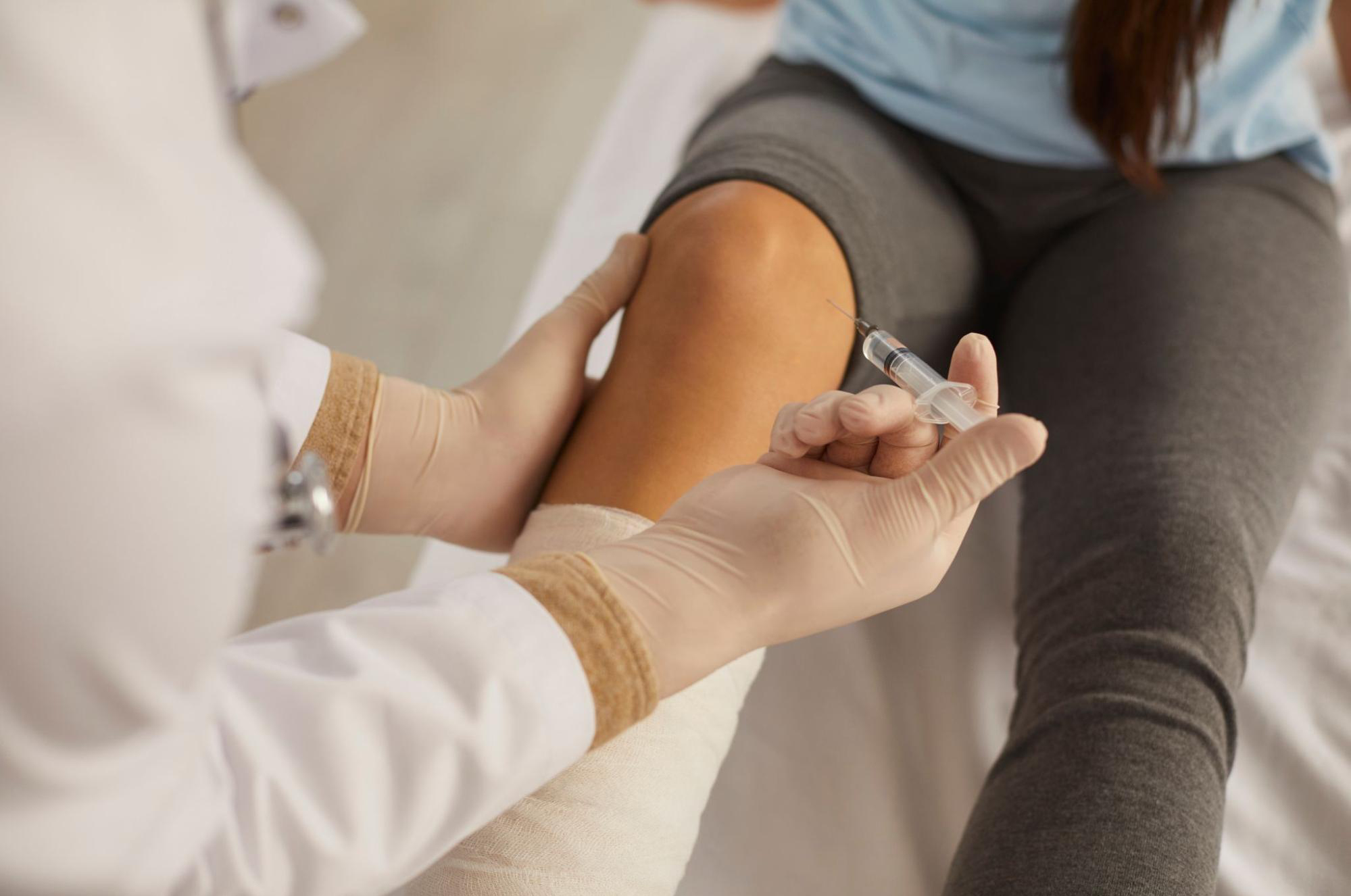
“The pain in my knee eased right after the joint injection, but a few months later it was back to where it started.” We hear this frequently. In reality, how long a joint injection’s effect lasts is not determined by the injection alone — how you use the muscles after it is a major factor. In this column, Dr. Moriwaki focuses on the relationship between quadriceps strengthening and joint injection, laying out a concrete muscle-training design to restore knee joint stability and keep the effect of injection going longer.
Key Points
・How long a joint injection’s effect lasts is shaped not only by the injected material but also by the magnitude of mechanical stress on the joint.
・When the quadriceps is weak, walking and stair use send increased impact to the knee, which can tip the cartilage environment the injection just calmed back toward inflammation.
・Combining quadriceps strengthening and joint injection can extend the duration of effect compared with injection alone.
・The training to choose depends on the phase after injection: isometric setting in the acute phase, SLR in the recovery phase, and loaded exercises in the maintenance phase.
・Loading the knee while it collapses inward tends to backfire — staying within an alignment you can maintain is a condition of safety.
Why Injection Effects Fade Over Time
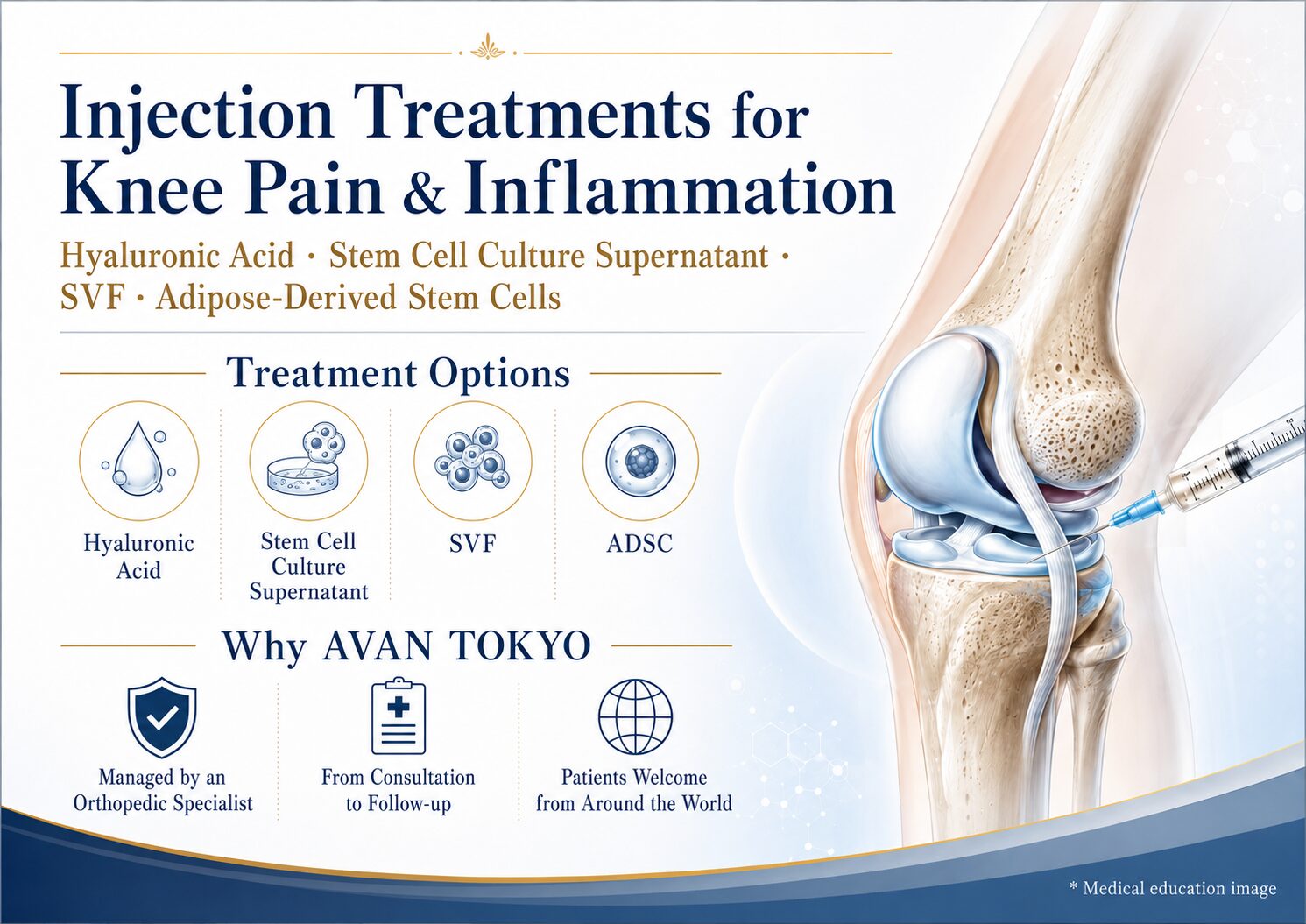
Joint injections — especially those using stem cell conditioned media — suppress the expression of inflammatory cytokines in the joint and deliver growth factors and exosomes that promote tissue repair. For a while after injection, pain settles and the knee feels lighter, but how long that lasts varies between individuals. One factor driving that variation is the “extra-articular mechanical environment” — how much shock the muscles around the joint absorb.
Mechanical stress that reignites inflammation
Even after the injection temporarily calms the inflammation, if the same intense mechanical stress keeps hitting the knee as before, the synovium begins secreting inflammatory cytokines again. The knee wobbling inward during gait, the knee shooting forward on stand-up, the full body weight landing on one leg on stair descent — these all become excessive loads on the knee cartilage and quickly neutralize the injection’s gains. Whether re-ignition is delayed depends heavily on the quality of everyday motions such as walking and standing up.
Insufficient muscular shock absorption
The knee does not take load through bone and cartilage alone — surrounding muscles contract to absorb shock. In particular, the quadriceps, which extends the knee, is the main player absorbing ground reaction force through eccentric contraction (braking while being stretched) during landing and stair descent. When this strength drops, the shock the muscle should have absorbed goes straight into the cartilage and subchondral bone, and the joint environment restored by the injection breaks down more easily.
Quadriceps Strengthening and Joint Injection — Why Think of Them as a Set
The reason combining these two is recommended is that they change the knee’s situation along different dimensions. The injection reorganizes the “intra-articular biological environment,” while strength training reorganizes the “extra-articular mechanical environment.” With only one side addressed, the environment one side improves tends to be broken by the load from the other side — a loss in terms of effect duration.
Vertical-axis alignment stabilized by vastus medialis
The quadriceps has four muscle bellies, and the vastus medialis obliquus (VMO) in particular pulls the patella medially, normalizing the tracking (gliding trajectory) of the patellofemoral joint. When the VMO is weak, the patella shifts laterally, biased compressive stress loads the lateral compartment of the patellofemoral joint, and inflammation re-emerges from the very areas less reached by injection.
Re-educating proprioception
Strength training does more than raise muscle output — it also re-educates the proprioceptive receptors around the joint. When the injection relieves pain, long-standing pain-avoidance gait patterns often remain, and bad knee habits persist unnoticed. Through strength training, you relearn how to use the knee correctly, and the foundation that supports the injection’s effect is built. For information on joint diseases, guidelines from the Japanese Orthopaedic Association are also useful references.
Phase-Specific Training Design After Injection
To combine training and injection effectively, selecting training that matches each post-injection phase is important. Jumping into high-load exercise from the start risks re-igniting the synovitis you just calmed down.
Acute phase (injection day to day 3): Isometric setting
In this phase, use “isometric contraction” — contracting the muscle without moving the joint. The classic is quad setting (patella setting). Sitting with legs extended, place a rolled towel under the knee and press the back of the knee down into the towel for 5 seconds, then release — 10 reps × 3 sets, 2–3 times a day. Because the joint does not move, the distribution of the injected material is undisturbed while stimulation to the quadriceps is preserved.
Recovery phase (weeks 1–2): SLR and shallow chair squats
Once pain and swelling settle, add the straight leg raise (SLR). Lying on your back with one knee bent, keep the other leg straight and lift it 10–15 cm off the floor, hold for 3 seconds, then lower slowly — 10 reps × 3 sets per leg. In parallel, introduce chair squats (do not flex the knee past 90°; descend only until lightly touching a chair) to relearn quadriceps recruitment under load.
Maintenance phase (one month post-injection and beyond): Progressive loaded strengthening
After one month, add loaded exercises such as lunges, step-ups, and leg extensions (limit the range from 0° extension to 60° flexion) 2–3 times a week. The guideline is “no increase in joint swelling or warmth the next day.” If swelling appears, drop one level of load. For details on stem cell conditioned media joint injection, see our joint injection treatment page.
Exercises to Avoid and Warning Signs
When combining quadriceps strengthening and joint injection, exercises started with good intentions can also hurt the knee. Particular caution is warranted for squats done with the knee collapsing inward and for deep squats where the knee flexes past 90°. The former worsens lateral patellar deviation; the latter applies excessive compressive stress to the patellofemoral joint, and either can undo the joint environment restored by injection in an instant.
Continuous running over 30 minutes on a treadmill, or long walks on hard concrete, should also be avoided in the acute and recovery phases. “Warmth, swelling, or night pain in the knee increasing the next day” is a clear overload signal — reduce frequency, duration, or intensity. If you are unsure where to set the load, adjusting while consulting your physician or physical therapist is the safer path.
Frequently Asked Questions
Q. Should quadriceps strengthening or joint injection come first?
If pain is severe enough that training cannot be performed, the injection comes first — settle the inflammation and pain, then start training. If pain is mild and training is feasible, strengthen the periarticular muscles first, and add injection if symptoms remain. The order is not fixed; judge from current pain intensity and functional impairment.
Q. How long should I continue to extend the injection’s effect?
Strength changes become visible after at least 6–8 weeks of continuous training, so support of the injection effect takes a similar duration. Strength starts to decline within a few weeks of stopping, so “a small amount every day, over the long term” is the rule. Fitting training into daily habits contributes more to effect duration than short, intense bursts.
Q. I can’t use a gym or machines. Is home training alone enough?
Bodyweight setting, SLR, and chair squats alone can produce clinically meaningful strength gains if continued five or more days a week. What matters more than machines is frequency and clean form. Checking knee direction in a mirror helps catch alignment drift early.
Q. I’m elderly and nervous about strength training. Up to what age is it safe?
Setting and SLR can be performed safely in your 80s. With small loads, moderate reps, and no breath-holding, blood pressure swings also stay minimal. If you have cardiac disease or hypertension, consult your primary physician before starting. Continuing within a sustainable range contributes to both fall prevention and extended injection effect.
Q. I can’t tell muscle soreness from joint pain.
Muscle soreness appears in the trained muscle belly (such as the front of the thigh), hurts on pressure, and eases with movement. Joint pain localizes to the medial or anterior side of the knee joint, worsens with movement, and can be accompanied by swelling or warmth. If the latter appears, lower the load and consider seeing a doctor.
──────────────
【Supervising Physician】Shin Moriwaki, MD
Member, Japan Society of Aesthetic Surgery (JSAS)
Member, American Academy of Aesthetic Medicine
ECFMG Certificate
──────────────
📍AVAN TOKYO Ginza Joint Regenerative Medicine
(AVAN TOKYO 銀座 関節再生医療)
English / 中文 / Tiếng Việt supported
Inquiries welcome via DM / LINE / Website / Phone.