


Don’t Mistake Semimembranosus Tendinopathy for Pes Anserinus Bursitis or a Baker’s Cyst — Dr. Moriwaki Reviews the Chronic Posteromedial Knee Enthesitis and What Stem Cell Conditioned Media Peri-articular Knee Injection Can and Cannot Address2026.08.14
“After running, only the inner back of my knee stays sore.” “When I bend and straighten the knee, the posterior medial side feels heavy.” Patients coming in with these complaints are often lumped in with pes anserinus bursitis or a Baker’s cyst, when the actual problem is semimembranosus tendinopathy. Semimembranosus tendinopathy is a chronic tendinopathy at the enthesis where the semimembranosus muscle, one of the hamstrings, inserts on the posterior surface of the medial tibial condyle. Because the pain is limited to the posteromedial knee, it is easily confused with the more familiar pes anserinus bursitis (anterior medial knee) and Baker’s cyst (a sac-like swelling in the popliteal fossa). Miss the diagnostic entry point, and both the injection and physical therapy end up aiming at the wrong target.
Key Points of This Article
・Semimembranosus tendinopathy is a chronic enthesopathy at the posterior aspect of the medial tibial condyle; it typically worsens with running, deep flexion, and terminal knee extension.
・It can be separated from pes anserinus bursitis (anterior medial), Baker’s cyst (popliteal sac), and popliteus tendinopathy (posterior lateral) by the location of pain and the movement that provokes it.
・Stem cell conditioned media peri-articular knee injection can intervene in the chronic inflammatory cycle at the enthesis, but it cannot change the anatomical course of the tendon or the underlying lower-limb alignment.
・Confirming intra-tendinous high signal and bone marrow edema on MRI, and differentiating from the pes anserine bursa or popliteal cyst, makes the injection target much clearer.
・The realistic design is not injection alone but a combined program: restoring hamstring flexibility, rebalancing the knee flexors, and reviewing the loading line, all running alongside the injection.
What Is Semimembranosus Tendinopathy? — Chronic Enthesitis at the Posteromedial Knee
Anatomy: the insertion is not a single strand
The semimembranosus tendon extends about five separate attachment arms centered on the posterior surface of the medial tibial condyle, including the posterior capsule of the medial meniscus, the posterior oblique ligament (POL), the popliteus fascia, and the oblique popliteal ligament. Because of this complex anatomy, load bearing and knee flexion apply multidirectional tension, and repetitive use accumulates microdamage at the enthesis. The tendon itself has poor vascular supply, so once the process turns chronic, spontaneous healing is difficult to rely on.
Who develops it, and why
We see it in runners who abruptly increase mileage, athletes who repeat knee flexion loading in downhill or trail running, workers who repeatedly squat and straighten the knee, and patients with medial compartment knee osteoarthritis and persistent hamstring tightness. The common thread is a mechanical environment in which the posteromedial knee is repeatedly subjected to stretch-and-contract stress, which becomes the switch that turns this condition chronic. Even without a clear traumatic history, patients whose loading pattern or landing-impact distribution is biased may have degeneration quietly progressing at the enthesis.
How to Tell Semimembranosus Tendinopathy Apart from Pes Anserinus Bursitis and Baker’s Cyst
Location of pain and provoking movements
In pes anserinus bursitis, tenderness is elicited on the anteromedial side of the knee, at the confluence of sartorius, gracilis, and semitendinosus on the proximal medial tibia. In this condition, the pain sits farther posterior; palpating the posterior surface of the medial tibial condyle elicits tenderness, and driving the knee into terminal extension typically provokes a stretching pain along the posteromedial line. A Baker’s cyst forms a sac-like swelling from the center to the medial popliteal fossa; it changes fullness with flexion and extension but does not always produce a focal tender point. Popliteus tendinopathy centers on the posterolateral knee and worsens on downhill running, forming a mirror image of this posteromedial condition.
Reading imaging findings
On MRI, we evaluate intra-tendinous high signal, tendon thickening, and adjacent bone marrow edema at the enthesis on the posterior surface of the medial tibia. In pes anserinus bursitis we look for bursal fluid; for a Baker’s cyst, cyst formation between the medial gastrocnemius head and the semimembranosus tendon. Once the diagnosis is nailed down, the design of “where and what to target” with the injection becomes precise, and the effect of stem cell conditioned media peri-articular knee injection can be judged objectively. For general medical information on joint disorders, please also refer to the Japanese Orthopaedic Association.
What Stem Cell Conditioned Media Peri-articular Knee Injection Can and Cannot Address
What it can address: chronic inflammation and the metabolic environment at the enthesis
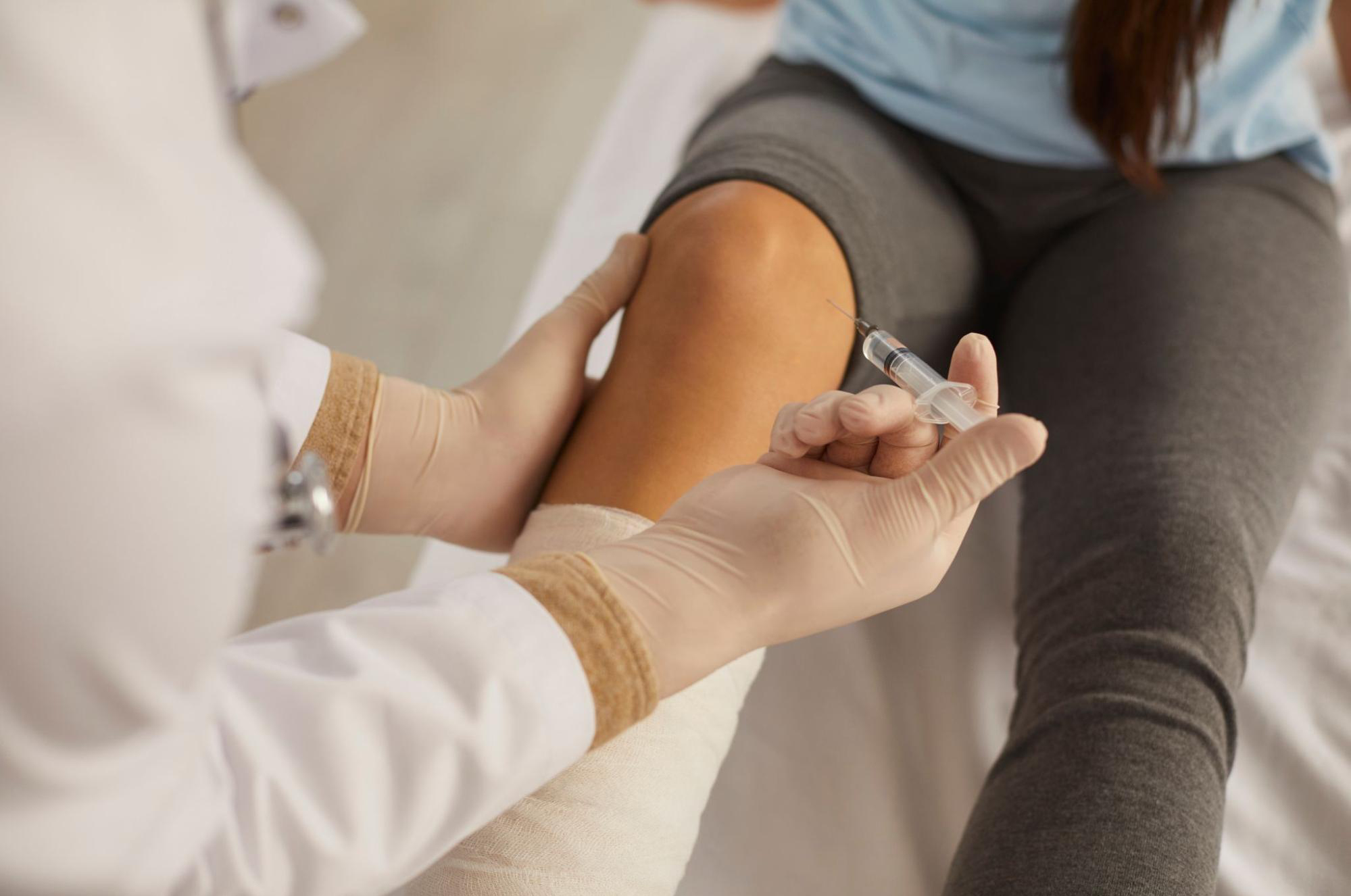
The enthesis has poor vascular supply, and chronic microinflammation and degeneration coexist there. Growth factors such as TGF-β, IGF-1, FGF, and VEGF, together with miRNA carried by extracellular vesicles, are thought to act on fibroblast and tenocyte metabolism as well as on inflammatory cytokine expression. In chronic tendinopathy, stem cell conditioned media can therefore lower the pain baseline and support the reparative environment around the tendon as a conservative option. In this condition, injection is delivered carefully around the enthesis under ultrasound guidance, with attention to differential targeting of adjacent structures such as the synovium and pes anserine bursa. Please also see our page on stem cell conditioned media peri-articular injection for more detail.
What it cannot address: anatomy, alignment, and lifestyle itself
On the other hand, injection cannot directly correct hamstring tightness, lower-limb malalignment (excessive tibial internal rotation or varus tendency), or the mechanical stresses of running mileage and repetitive squatting. The anatomical course of the tendon, the bony morphology, and the lower-limb kinetic chain are the domain of physical therapy, exercise therapy, braces, and footwear. A realistic design pairs “lowering the inflammation cycle” via injection with “rebuilding the causal kinetic chain” via physical therapy; without this combination, the injection response tends to blur. Effect is judged over weeks to months on pain scale (NRS), provocation tests, and recovery of daily function; poor response prompts a shift to continue, change, or return for orthopedic re-evaluation. Response and course vary between individuals, and this is not a universal solution.
Frequently Asked Questions
Q. Does semimembranosus tendinopathy resolve on its own?
Acute inflammation can subside with rest, cold, and activity modulation, but the enthesis is poorly vascularized, and once chronic, pain often persists for several months or longer. If pain has not eased after three months, it is time to review the combination of conservative options — exercise therapy, injection, and bracing.
Q. How many peri-articular conditioned media injections are needed?
There is no single number that fits everyone. A typical design is a few sessions at intervals of several weeks during the induction phase, then progressively longer intervals in the maintenance phase. Response is assessed objectively via pain (NRS), provocation tests, and recovery of daily activities; a poor response prompts a shift to continue, change, or return for orthopedic re-evaluation with your physician.
Q. How does it differ from steroid or hyaluronic acid injection?
Steroids have strong anti-inflammatory action but carry a risk of tendon degeneration with repeat administration. Hyaluronic acid mainly supplements intra-articular lubrication and is not aimed at inflammation at the enthesis. Stem cell conditioned media aims at a different axis — calming inflammation while acting on the surrounding metabolic environment — and can be chosen for chronic enthesopathies. Response varies between individuals and it is not a universal cure.
Q. Can I keep running?
In the acute phase, load management comes first — shortening distance, avoiding downhills, and reviewing running surfaces to reduce the repetitive stretch-and-contract stress on the tendon. Once pain subsides, distance can be restored in stages, alongside restoration of hamstring, gluteal, and core flexibility and coordination for recurrence prevention. Because “only rest” and “only movement” both fail, injection paired with exercise therapy is the realistic setup.
Q. Which specialty should I see first?
Orthopedic imaging (X-ray, MRI) and differential diagnosis form the foundation. Once the diagnosis is firm, regenerative options can be considered — either based on an existing orthopedic diagnosis or after we perform the imaging and differential ourselves before judging suitability for stem cell conditioned media peri-articular knee injection.
──────────────
Supervising Physician: Dr. Shin Moriwaki
Member, Japan Society of Aesthetic Surgery (JSAS) / Member, American Academy of Aesthetic Medicine
ECFMG Certificate
──────────────
📍AVAN TOKYO 銀座 関節再生医療
AVAN TOKYO Ginza Joint Regenerative Medicine
English / 中文 / Tiếng Việt available
Inquiries welcome via DM / LINE / Website / Phone.