


Sit-to-Stand Knee Pain: Why the First Step from a Chair Hurts and the Intra-Articular Environment2026.10.15
A sharp pain in the inner or anterior knee on the very first step when getting up from a chair or sofa — this sit-to-stand knee pain is a textbook complaint from the early to middle stages of knee osteoarthritis. Because the pain usually eases after a few steps, patients tend to postpone care, thinking “it feels better once I move.” Yet behind the pain at the moment of rising lies a sudden shift in the intra-articular environment driven by the postural change from sitting to standing. In this article, Dr. Moriwaki explains why this symptom appears, how joint fluid, synovium, and subchondral bone are involved, and what joint injection therapy can realistically address.
Key Points of This Article
・Sit-to-stand knee pain arises when the posture change from sitting to standing abruptly switches the pressure, load, and shear stress inside the knee joint.
・It overlaps with the broader starting pain seen after rest, but the deep flexion angle and strong quadriceps contraction unique to rising from a chair concentrate load on the patellofemoral joint and the medial compartment.
・Three intra-articular environment factors — joint fluid pooling, synovitis, and subchondral bone response — are closely tied to the persistence and worsening of this symptom.
・Intra-articular injection of stem cell conditioned media can be a stage-appropriate option, aimed at calming synovitis and supporting repair of the intra-articular environment.
The Unusual Load Sit-to-Stand Places on the Knee
Mechanical Features of the Sit-to-Stand Movement
Standing up from a chair (sit-to-stand, STS) is one of the daily activities that places the heaviest load on the knee. Compressive forces of 2.5 to 3 times body weight have been reported in healthy adults, rising to 3 to 4 times body weight in patients with knee osteoarthritis. Compared with gait, which generates about 2 to 2.5 times body weight at the knee, the first step up from a chair is clearly a far more demanding motion.
In addition, the early phase of standing drives the knee rapidly from roughly 90 degrees of deep flexion into extension. The switch between flexion and extension generates complex compression and shear stress at both the patellofemoral joint (between the kneecap and the femur) and the tibiofemoral joint (between the tibia and the femur).
Concentrated Compression on the Patellofemoral Joint and Joint Fluid Behavior
The patellofemoral joint is built so that the deeper the flexion, the harder the patella is pressed against the femoral condyle. The early phase of rising from a chair happens exactly at this deep flexion position with strong quadriceps contraction, and the compressive load on the patellofemoral joint has been estimated at 5 to 7 times body weight.
At the molecular level, the joint fluid (synovial fluid) covering the cartilage surface is squeezed out by the sudden pressure change and then returns as the loading cycle repeats. In a healthy joint this flow is smooth, but in a knee with synovitis or effusion, joint fluid distributes unevenly, pools in specific regions, and expands the surrounding tissue from inside — which triggers sit-to-stand knee pain.
Three Intra-Articular Factors Behind Sit-to-Stand Knee Pain
1. Fluid Pooling and Pressure Shift
As knee osteoarthritis progresses, the character and volume of synovium-produced joint fluid change. Normally rich in hyaluronic acid and viscous, under inflammation the fluid becomes diluted and increases in volume, producing effusion. During prolonged sitting with the knee flexed, the fluid temporarily collects in the posterior compartment or the suprapatellar pouch; on standing, it rushes abruptly forward and medially. This sudden movement mechanically stimulates nerve endings in the joint capsule and is perceived as pain “the instant I stand.”
2. Synovitis and Synovial Impingement
The synovium in knee osteoarthritis often thickens and becomes hypervascular as it captures cartilage debris and inflammatory cytokines. This thickened synovium is more likely to be caught between the joint surfaces at the moment the knee switches from deep flexion to rapid extension. This is called synovial impingement, and standing up from a chair is a textbook trigger. For joint disease information, see the Japanese Orthopaedic Association.
3. Subchondral Bone Response
Articular cartilage itself has no pain-sensing nerves, but the subchondral bone beneath it is richly innervated. As knee osteoarthritis advances, MRI often shows bone marrow edema and microfracture-like changes in the subchondral bone. The abrupt compressive load at standing directly stimulates this weakened subchondral bone and produces sharp pain — a load-transition-specific pain that cannot be explained simply by “the cartilage has worn down.”
Telling It Apart from Other “First-Step” Pains
Difference from Morning Stiffness
Stiffness or pain felt on waking in the morning comes from the joint fluid becoming more viscous overnight and synovial edema accumulating; it fades within a few steps. In contrast, sit-to-stand pain is tightly linked to how long you have been sitting, and it reappears at the moment of rising even after short periods of sitting.
Overlap and Distinction with Starting Pain
The broader starting pain seen when walking after rest is understood as a mainly synovitis-driven phenomenon. Sit-to-stand pain is part of that family, but it adds two factors beyond simply starting to walk: a rapid extension from deep flexion and a strong quadriceps contraction. If walking itself is fine but standing up from a chair alone provokes pain, it is a meaningful clue pointing to patellofemoral joint pathology or early medial compartment cartilage degeneration.
What Joint Injection Can and Cannot Do
Rebalancing the Intra-Articular Environment with Stem Cell Conditioned Media
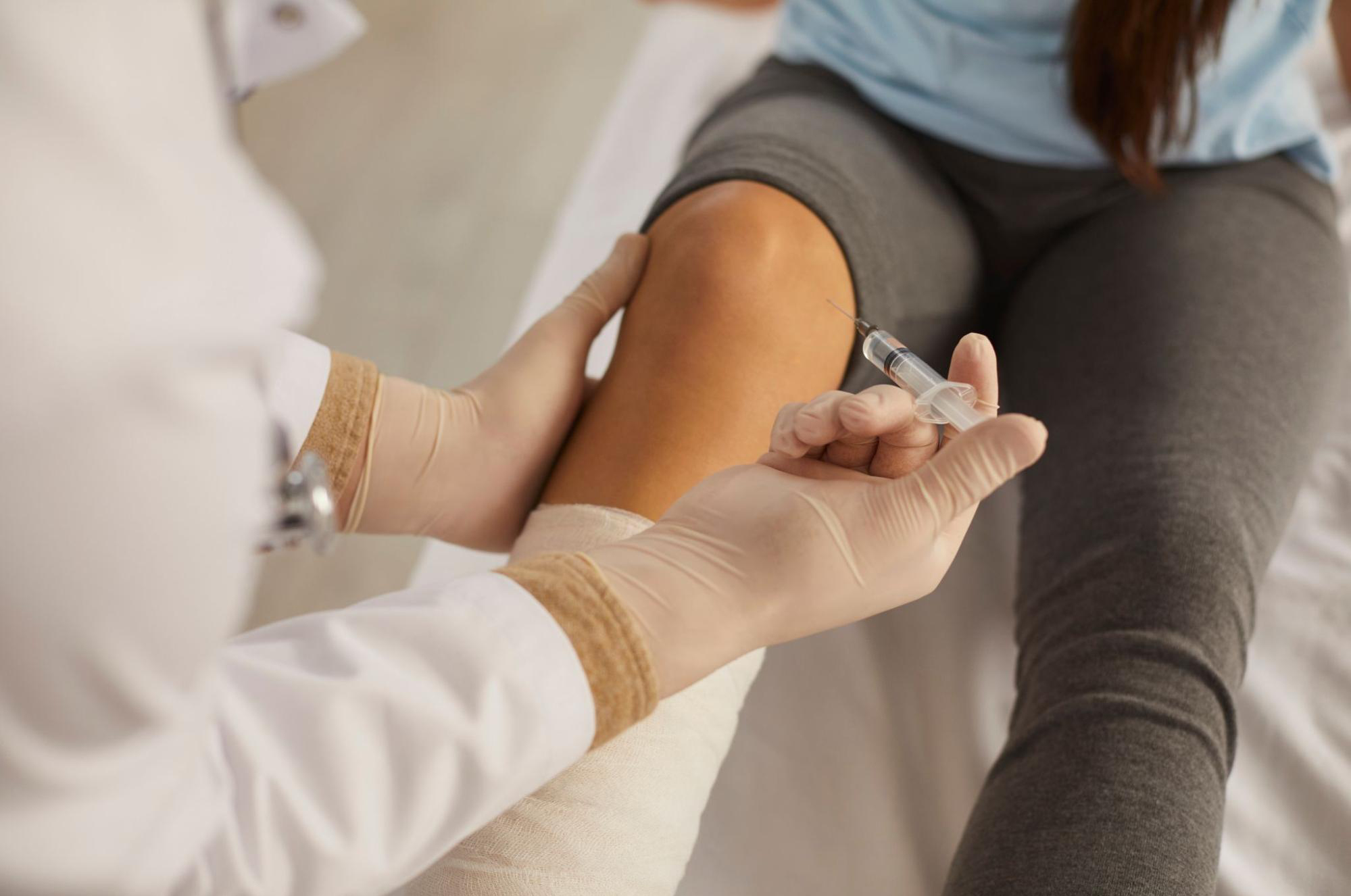
Joint injection directly addresses the intra-articular disturbance behind sit-to-stand knee pain. Hyaluronic acid and corticosteroid injections have long been the mainstays, and in recent years intra-articular injection of stem cell conditioned media has been added to the toolkit, aimed at calming synovitis and supporting tissue repair. Stem cell conditioned media contains proteins that suppress inflammatory cytokines and growth factors involved in tissue repair and normalization of microvasculature. These components can help settle synovial hypervascularity and return joint fluid viscosity and volume toward the normal range.
Indications and Limits
Injection therapy, however, is not a cure-all. In end-stage knee osteoarthritis where bones are already in broad contact, there is a ceiling to what injections can relieve, and surgical options such as total knee replacement enter the conversation. If the pain at standing is actually driven by a meniscal root tear, osteonecrosis, or a crystal arthropathy, those diagnoses must be addressed first. For more detail, see our page on stem cell conditioned media joint injections.
Daily Steps to Settle the Intra-Articular Environment
Simply raising the seat height eases the compressive load on the knee at standing. Rising from a sofa or low floor seat places disproportionate stress on the patellofemoral joint, so a higher chair with armrests, used with a light push from both hands, is a wise habit. Strengthening the quadriceps — the vastus medialis in particular — improves knee stability and helps reduce sit-to-stand knee pain.
Frequently Asked Questions
Q. If the pain disappears once I walk, can I just leave it alone?
Even if the pain briefly eases, pain at the moment of rising from a chair is a sign of chronic disturbance in the intra-articular environment. If left alone, that disturbance can reach the subchondral bone and progress to rest pain and night pain. An orthopaedic evaluation sooner rather than later is recommended.
Q. Walking is fine, I only hurt when I stand up, yet I was told I have knee osteoarthritis. Why?
In early-to-middle knee osteoarthritis, it is common for symptoms to show only in specific movements such as rising from deep flexion. The pathology may be limited to the patellofemoral joint or part of the medial compartment, where the shallow flexion angles of walking do not provoke pain. Treat it as an early sign and use it as an opportunity to intervene actively.
Q. How many sessions of stem cell conditioned media injection are needed to feel an improvement?
Individual variation is wide depending on the stage of knee osteoarthritis, the presence of effusion, and the severity of synovitis, so no single answer applies. In early-to-middle stages, many patients report change over a series of several sessions, but response has to be judged by combining interview and movement assessment each visit. We design the frequency and interval after evaluating the current state at consultation.
Q. Can stretching before standing up prevent the pain?
A preparatory routine of a few knee flexion-extension cycles and a light contraction of the quadriceps just before rising can even out joint fluid distribution and soften the abrupt mechanical input to the synovium. Stretching alone, however, does not correct the underlying intra-articular disturbance. If symptoms persist, medical intervention should be considered.
──────────────
Medical Supervisor: Shin Moriwaki, MD
Member, Japan Society of Aesthetic Surgery (JSAS) / Member, American Academy of Aesthetic Medicine
ECFMG Certificate
──────────────
📍AVAN TOKYO Ginza Joint Regenerative Medicine
AVAN TOKYO Ginza Joint Regenerative Medicine
English / 中文 / Tiếng Việt supported
Inquiries welcome via DM / LINE / Website / Phone.