


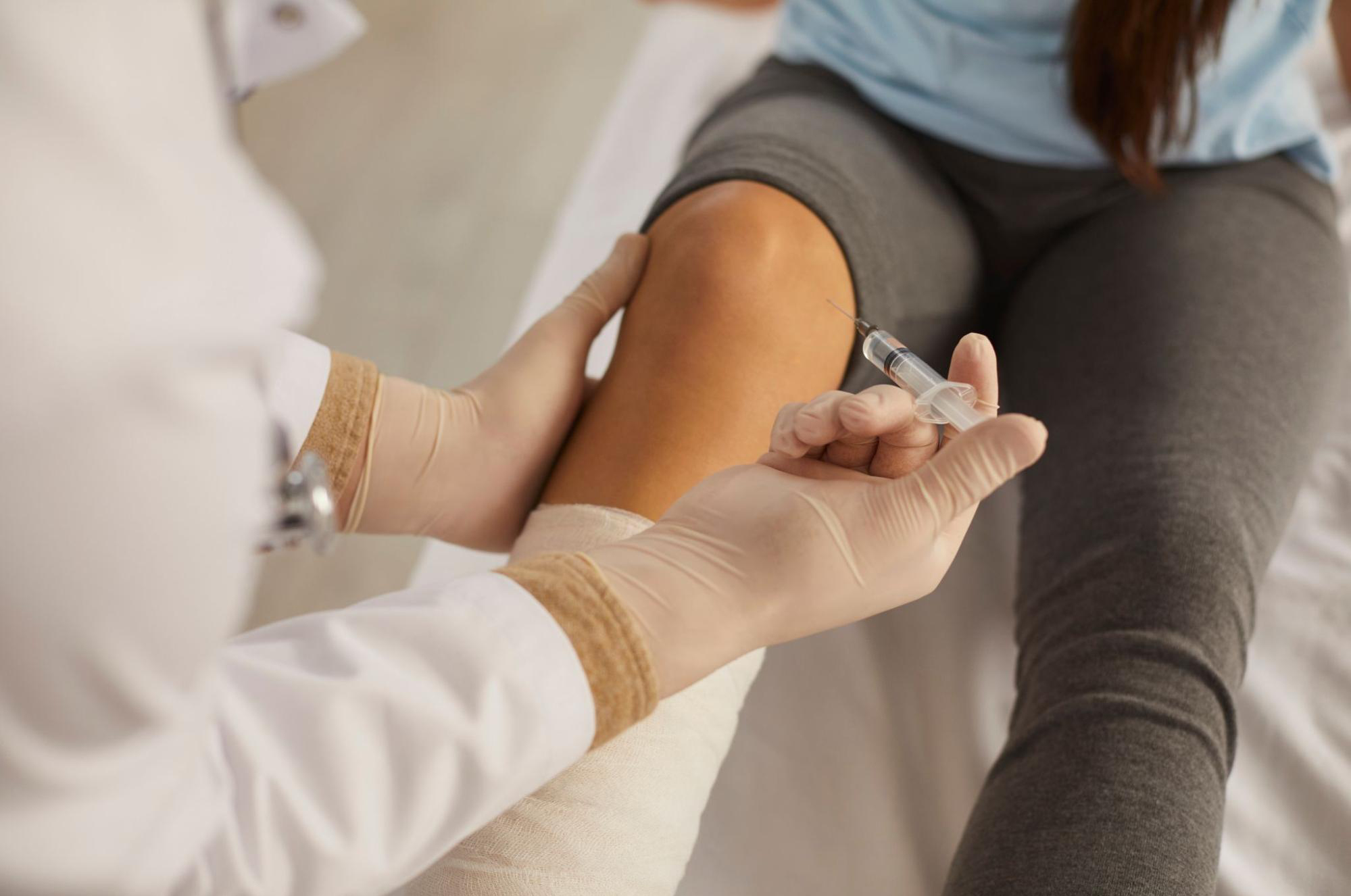
Why Knees Swell in the Evening After Standing Work: Effusion and Static Load2026.09.29
“I was fine in the morning, but by evening the inner side of my knee is tight and it throbs on the way downstairs” — retail staff, hairdressers, nurses, cooks and factory workers who stand for long hours increasingly bring us this kind of complaint.
An X-ray comes back with “not yet a surgical stage,” and the patient is sent home with a patch and a painkiller. Yet the same spot swells again by evening and eases a little the next morning — patients caught in this pattern share a common problem: a vicious cycle of knee joint effusion and static load.
This article explains why the knee swells and aches in the evening after standing work, and clarifies what a stem-cell conditioned media joint injection can and cannot address, from Dr. Moriwaki’s perspective.
Key points
・Evening swelling and pain in the standing worker’s knee reflects overproduction of inflammatory synovial fluid that outpaces daytime clearance — this is knee joint effusion
・Cartilage is “nourished by movement,” so standing still (static load) can be harder on cartilage and synovium than walking (dynamic load) in certain scenarios
・At the root of knee joint effusion is synovitis, and a stem-cell conditioned media joint injection targets the inflammatory cycle
・Do not try to solve it with injections alone — pair them with adjustments to weight-bearing time, footwear and posture for stable results
・Sudden redness, fever, severe pain or inability to straighten the knee may signal septic or crystal arthritis and requires orthopedic evaluation before any injection
Why does the knee swell in the evening after standing?
Joint fluid is a balance of “how much is produced” and “how much is absorbed”
The inside of the knee joint is lined by a thin synovial membrane that secretes synovial fluid to nourish the cartilage. A normal knee holds only a few milliliters, with production and absorption in near equilibrium.
When the synovium becomes inflamed, however, production surges while absorption cannot keep up, and fluid accumulates in the joint cavity. This is what knee joint effusion actually is — “water on the knee” in lay terms. Fluid that builds up during the day is slowly reabsorbed at night through unloading and position changes, easing by morning. This rhythm is exactly why symptoms cluster in the evening for standing workers.
Static load can be worse for the synovium than dynamic load
Counterintuitively, articular cartilage tends to stay healthier when moving than when still. Cartilage has no blood supply and depends on fluid exchange for nutrition, so walking — with its alternating loading and unloading — acts like a pump for cartilage.
Standing still, by contrast, keeps a static load on one point and stalls synovial blood flow, so fluid exchange barely happens. This mechanism explains why “standing without moving” invites knee joint effusion more readily than “walking-around” standing work.
Why the pain peaks in the evening
Rising synovial fluid does not translate into pain the moment it accumulates. Pain is only registered once the joint capsule is stretched past an internal-pressure threshold, or once local levels of inflammatory cytokines (IL-1β, TNF-α and others) climb.
Starting from a low fluid volume in the morning, 6–10 hours of standing gradually stacks up effusion and inflammation — this timeline is exactly the swelling and ache that peaks in the evening.
Sorting out the conditions behind knee joint effusion
Early- to mid-stage knee osteoarthritis with synovitis
The most common cause in standing workers over 40 is synovitis accompanying early- to mid-stage knee osteoarthritis. Even when X-rays show only mild osteophytes or joint space narrowing, synovial-level inflammation can be already underway, and knee joint effusion may be the first outward sign.
The familiar gap of “X-rays looked mild, but symptoms are clearly present” is often explained by this time lag.
Meniscal degeneration and mechanical irritation
By middle age, the meniscus gradually degenerates even without a history of trauma, developing microtears and fraying. Repetitive knee twisting during standing work causes this degenerated meniscus to mechanically irritate the synovium and provoke inflammatory effusion.
Typically the posterior horn of the medial meniscus is affected, with medial pain on descending stairs or on light knee bend with body weight.
The “dangerous water” that needs to be ruled out
Most knee joint effusions arise from knee osteoarthritis, but rarely from septic arthritis, gout/pseudogout or rheumatoid arthritis — for which injection therapy is either inappropriate or outright contraindicated.
Redness, warmth, fever above 38°C, inability to extend the knee fully, severe pain on light touch — with any of these red flags, joint aspiration with culture and crystal analysis at an orthopedic clinic must precede any consideration of a conditioned media injection. See also the Japanese Orthopaedic Association for further information on joint diseases.
What a stem-cell conditioned media joint injection can target
The mechanism is “rewriting the inflammatory environment”
Stem-cell conditioned media contains numerous cytokines, growth factors and exosomes secreted by the cells; against synovitis it is thought to suppress inflammatory cytokines and shift the local milieu toward an anti-inflammatory state.
Because the root cause of knee joint effusion is synovitis, “intervening in the synovial inflammatory cycle” is a mechanism well-matched to this condition. See our page on stem-cell conditioned media joint injection for details.
What it cannot do, and what not to misread
That said, a conditioned media joint injection is not a treatment that restores worn cartilage to its original thickness. Injection alone offers little to end-stage joint destruction or knee pain driven mainly by clear deformity and malalignment.
Also, repeating injections without changing the static load itself allows knee joint effusion to recur. Think of it in a time-axis frame: “use the injection to quiet inflammation, and use that window to reduce loading in daily life.”
Choosing between self-care and medical treatment for standing workers
Even when workload cannot be reduced, fine adjustments — flexing/extending the knee on each break, avoiding weight-shift to one leg, using cushioned insoles, wearing compression stockings to aid calf return — can lower the recurrence rate of knee joint effusion.
When the evening swelling comes back several times a week, when the knee already feels heavy on rising, or when you sense giving-way descending stairs — any of these is a sign that self-care alone is no longer enough.
Frequently asked questions
Q. My knee swells only in the evening and resolves by morning. Can I just leave it?
If it fully resolves within the same day on rare occasions, observation is fine, but if it recurs three or more days a week, the swelling area gradually spreads, or discomfort lingers into the morning, that is a sign that knee joint effusion is becoming chronic. Leaving it thickens the synovium and lowers treatment response, so an early visit is recommended.
Q. I can’t quit standing work — can injections alone cure it?
Injections can quiet the inflammatory cycle, but as long as the cause — static load — continues, recurrence remains a risk. Pairing injections with distributed weight-bearing time, better footwear/insoles, and quadriceps maintenance yields more stable and durable results than injection alone.
Q. Is aspirating water from the knee the same as a stem-cell conditioned media injection?
No. Joint aspiration mechanically reduces effusion to relieve intra-articular pressure and does not intervene in the underlying inflammation. A conditioned media injection targets rewriting the inflammatory environment, and the two are sometimes combined.
Q. How many sessions before I feel results?
Individual differences exist, but a typical design is several sessions at 2–4 week intervals in the induction phase, then moving to maintenance intervals guided by progress. Rather than an immediate response after the first injection, picture it as slow cumulative change in the synovial environment across multiple sessions.
Q. My knee suddenly became hot and swollen. Can I get an injection right away?
If you have redness, warmth, fever above 38°C or severe pain on light touch, septic arthritis or crystal arthritis is possible; first receive joint fluid culture and crystal analysis at an orthopedic clinic. If infection is present, a conditioned media injection would worsen the situation.
──────────────
Supervising physician: Shin Moriwaki, MD
Member, Japan Society of Aesthetic Surgery (JSAS) / Member, American Academy of Aesthetic Medicine
ECFMG Certificate
──────────────
📍AVAN TOKYO Ginza Joint Regenerative Medicine
AVAN TOKYO 銀座 関節再生医療
English / 中文 / Tiếng Việt supported
Inquiries: DM / LINE / Website / Phone