


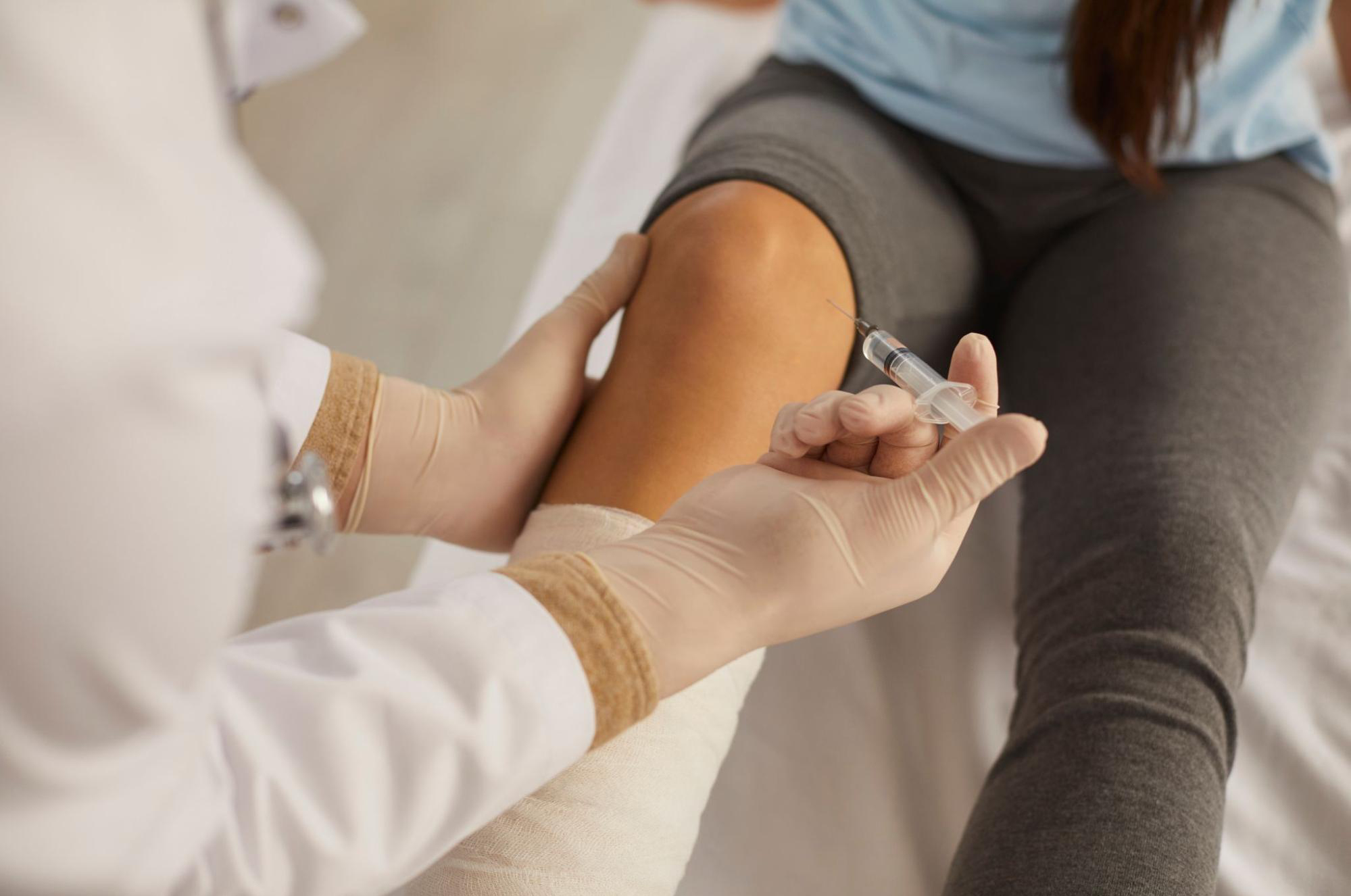
How to Hold the Line Against Knee Osteoarthritis in People with Long-Standing Work — Dr. Moriwaki on Chronic Compressive Load on the Medial Meniscus and Cartilage from Static Standing, and What Intra-Articular Stem Cell Conditioned Media Injection Can and Cannot Address2026.08.07
“After years of a job where I’m on my feet all day, once I passed 40 the inside of my knee started feeling heavy and painful in the evenings.” Hairdressers, cooks, nurses, sales staff, factory-line workers — we are seeing more consultations from people whose jobs involve long periods of standing. Here, Dr. Moriwaki of AVAN TOKYO Ginza organizes what could be called standing-work knee osteoarthritis: the pathology of knee OA associated with prolonged standing, and the boundary between what intra-articular stem cell conditioned media injection into the knee can and cannot address.
Key Points
・Long-standing work continuously applies compressive load to the knee joint, accumulating chronic stress on the medial meniscus and articular cartilage.
・Standing-work knee osteoarthritis arises not from a single injury but from the accumulation of static standing, micro-vibration, and body-weight loading — a chronic-stress mechanism.
・Intra-articular stem cell conditioned media injection into the knee is considered as an approach to regulate the chronic synovitis and inflammatory cytokine cascade inside the joint.
・What the injection can address is correction of the intra-articular inflammatory environment; it cannot reduce the mechanical load itself or restore cartilage morphology.
・To sustain the effect, parallel load-dispersion design during work (insoles, shoes, standing posture) is essential.
What Kind of Pathology Is “Standing-Work Knee Osteoarthritis”?
Medically, there is no independent disease named “standing-work knee osteoarthritis.” Yet in clinical practice, we often see patterns in which early- to mid-stage knee osteoarthritis appears in relatively young patients (40s–50s) whose occupations involve long, sustained standing.
Typical complaints include:
・The first step in the morning is fine, but the inside of the knee becomes heavy and painful from the evening onward
・The sense of swelling in the knee grows stronger toward the end of the week
・Holidays offer some relief, but the same pattern repeats from Monday
X-rays often show slight joint-space narrowing and mild osteophytes corresponding to Kellgren-Lawrence grade I–II; MRI can pick up degenerative signals in the posterior horn of the medial meniscus, joint effusion, and findings suggestive of localized bone-marrow edema. Unlike a single sprain or sports injury, the characteristic feature is the absence of any clear moment of trauma.
Why Long-Standing Positions Damage the Knee
In standing, the full body-weight load continuously transmits through both knees to the soles. During walking, the load switches cyclically between single-leg and double-leg support, and the “cartilage nutrition cycle” — in which joint fluid soaks into cartilage — is maintained. In static standing, however, this load variation is scarce, and the pump mechanism supplying nutrients to cartilage and clearing waste does not work well.
Chronic compressive stress on the medial meniscus and cartilage
Many Japanese people have a slight physiological varus (bow-legged) tendency, and about 60–70% of body weight concentrates on the medial compartment of the knee. Under long-standing positions, this medial-dominant compressive stress is continuously applied, and chronic microscopic damage accumulates in the posterior horn of the medial meniscus and the medial femoral condyle cartilage.
Synovitis and deterioration of joint fluid
Chronic micro-damage promotes production of inflammatory cytokines (IL-1β, TNF-α, IL-6, etc.) inside the joint and sustains synovitis. When synovitis occurs, the viscoelasticity of the joint fluid drops, and the lubrication of the cartilage surface further declines — a vicious cycle. The sensation that “the knee feels heavy in the evening” coincides with the peak of joint effusion and local inflammation from this synovitis.

What Intra-Articular Stem Cell Conditioned Media Injection Can Target
At the core of standing-work knee osteoarthritis is a chronic inflammatory cycle inside the joint. Stem cell conditioned media is reported to contain TGF-β, IGF-1, HGF, VEGF, and various anti-inflammatory cytokine-like factors, and intra-articular administration is expected to have the following actions:
・Attenuation of the inflammatory cytokine cascade
・Suppression of excessive synovial cell activation
・Correction of the chronic inflammatory environment that has degraded joint-fluid viscoelasticity
・Adjustment of matrix metabolism balance in chondrocytes and meniscal cells
In other words, the main aim of intra-articular stem cell conditioned media injection into the knee is not to “rebuild damaged cartilage anew” but to “reset the intra-articular environment disrupted by inflammation.” If the chronic synovitis cycle can be reset once, the evening heaviness and swelling of the knee tend to ease, and tolerance against continuous load during work may be raised. For details of joint injection, please refer to this page on stem cell conditioned media joint injection.
Drawing the Line with What Cannot Be Addressed in Standing-Work Knee Osteoarthritis
On the other hand, we must clearly acknowledge the domains that injection alone cannot solve.
The mechanical load itself cannot be reduced
Intra-articular stem cell conditioned media injection into the knee does not reduce the body-weight load that falls on the knee during work. If the same prolonged standing continues from the following day, intra-articular inflammation is likely to flare up again. To sustain the effect, parallel measures for load dispersion (cushioned shoes, arch-support insoles, anti-fatigue mats, frequent short seated breaks) are essential.
Alignment abnormalities and bone morphology cannot be corrected
In cases where varus deformity is already prominent or the medial joint space has completely disappeared in advanced knee OA, the scope of intra-articular stem cell conditioned media injection is limited. At that stage, considering indications for high tibial osteotomy or total knee arthroplasty with an orthopedic surgeon takes priority. For general information on joint disease, please also refer to the Japanese Orthopaedic Association website.
Physical meniscal tears and loose bodies cannot be removed
If an organic meniscal tear fragment or an intra-articular loose body (joint mouse) is causing pain or locking, these physical problems cannot be removed by injection. A separate judgment about coexistence with, or division from, arthroscopic surgery is required.
Clinical Flow and Parallel Measures in Daily Life
Intra-articular stem cell conditioned media injection into the knee for standing-work knee osteoarthritis is not something to end as “injection alone.” At the initial visit, we confirm the pain site, range of motion, X-ray findings, and MRI findings as needed, and assess the degree of deformity and inflammation. In the induction period, several sessions at 2–4 week intervals are common, followed by maintenance injections every 3–6 months, but response varies among individuals and adjustment is based on effect judgment.
In parallel, combining load-dispersion design during work (appropriate shoes, insoles, switching standing positions), post-work cool-down stretching of the quadriceps, hamstrings, and gastrocnemius, and weight management when needed helps sustain the effect of the injection.
Frequently Asked Questions
Q. Can I continue standing work while receiving intra-articular stem cell conditioned media injections in the knee?
Yes, many people receive treatment while continuing to work. However, we recommend avoiding prolonged standing on the day of injection and refraining from sudden knee loading in the following days. Depending on the individual’s work content and disease stage, we discuss the design of a rest period on a case-by-case basis.
Q. What happens if standing-work knee osteoarthritis is left untreated?
If chronic synovitis persists, joint-fluid quality worsens and the vicious cycle disrupting cartilage metabolic balance tends to prolong. As a result, the progression speed of knee OA accelerates, and there is a rising risk of reaching a stage where total knee arthroplasty is considered within several years to over a decade. Early inflammation control combined with load dispersion is important.
Q. If I have the injection, can I continue standing work exactly as before?
“Pain reduction” and “reduction of mechanical load on the knee” are separate issues. Even if pain eases through injection, the compressive stress on the knee during work does not change. If anything, continuing longer standing time than before because “the pain has gone” makes intra-articular inflammation more likely to flare again. Parallel review of insoles, shoes, and standing posture is a prerequisite.
Q. Can just changing insoles or shoes bring improvement?
In mild or early cases, load-dispersion design alone may relieve symptoms. However, once the patient is already in a chronic synovitis cycle, mechanical measures alone often take time to subside inflammation. A realistic two-step approach is to first reset the inflammation cycle with intra-articular stem cell conditioned media injection, then prevent recurrence with mechanical measures.
Q. Can I bathe or exercise on the day of the knee injection?
On the day of injection, please limit yourself to a shower; avoid prolonged bathing in a tub, intense exercise, and alcohol. From the next day onward, if symptoms are stable, normal bathing and light exercise can be resumed, but we generally advise keeping prolonged standing and sudden stair climbing and other sharp knee loads modest for several days.
──────────────
Supervising Physician: Shin Moriwaki, MD
Member of the Japan Society of Aesthetic Surgery (JSAS) / Member of the American Academy of Aesthetic Medicine
ECFMG Certificate
──────────────
📍AVAN TOKYO 銀座 関節再生医療
AVAN TOKYO Ginza Joint Regenerative Medicine
English / 中文 / Tiếng Việt supported
Inquiries via DM / LINE / Website / Phone.