


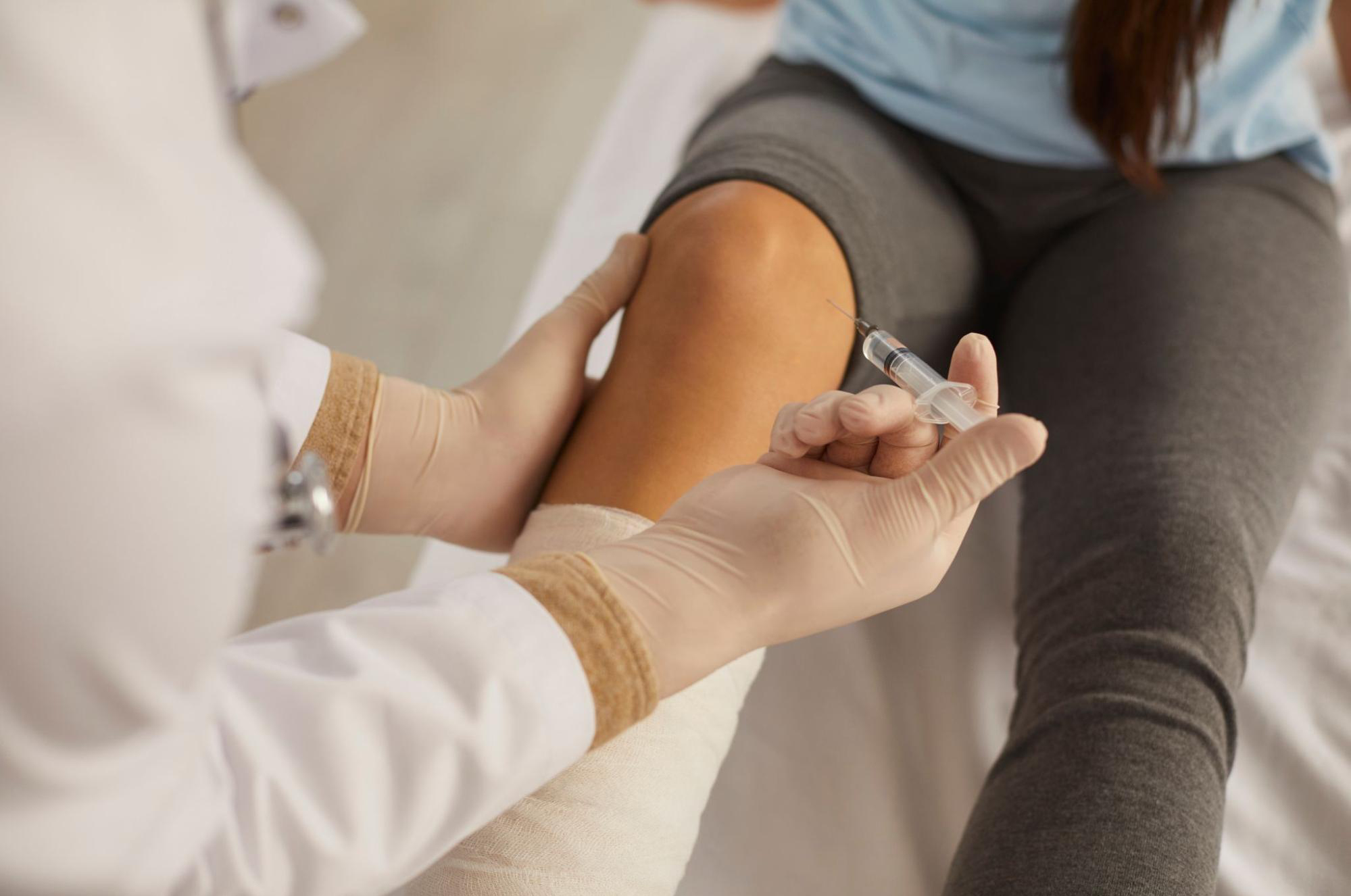
What Happens Inside the Knee as O-Leg Progresses: Varus Knee Osteoarthritis and the Limits of Injection2026.09.25
“I have always had slightly bowed legs, but recently only the inner side of my knee has started to hurt.” This is a common story we hear from patients in middle and older age. As O-leg (varus deformity of the knee) progresses, load shifts heavily onto the medial compartment of the knee joint, accelerating the development of varus knee osteoarthritis. Joint injections are a powerful tool for calming inflammation and pain, but they cannot reverse the bone alignment itself. In this column, we outline what actually happens inside a knee as O-leg progresses, and what injections can and cannot stop, from the perspective of our supervising physician.
Key Points of This Article
・As O-leg progresses, load concentrates on the medial compartment of the knee and accelerates varus knee osteoarthritis.
・Joint injections can quiet the inflammation cycle, improve joint fluid quality, and reduce medial-dominant pain.
・However, injections cannot correct the bony varus alignment itself.
・In early to mid stages (KL grades I–III), injections offer meaningful daily-life control; end-stage disease demands comparison with braces, osteotomy, or arthroplasty.
・Weight management, quadriceps training, and lateral wedge insoles expand the range that injections can hold.
What Actually Happens Inside the Knee as O-Leg Progresses
The degree of varus or valgus at the knee is described by the femorotibial angle (FTA). Healthy adults measure roughly 174–176 degrees, close to a straight line between femur and tibia. Deviation into valgus (X-leg) shifts load to the lateral compartment, while deviation into varus (O-leg) shifts it to the medial compartment. If peak load per step during gait is set at 100%, a healthy knee distributes about 60% medially and 40% laterally, but only a few degrees of varus progression can push the medial share above 80–90%.
Under sustained medial-dominant load, the posterior horn of the medial meniscus experiences continuous compression, and its collagen fibers gradually fray. The meniscus is designed to cushion and distribute load; when it can no longer withstand the pressure and extrudes outward (medial meniscal extrusion), the effective cushion is lost, and the medial femoral condyle begins to contact the medial tibial plateau directly. From this point, cartilage wear accelerates and the medial joint space narrows.
Subchondral bone under this persistent load develops bone marrow edema, bone metabolism becomes overactive, and osteophytes and subchondral cysts form. The joint capsule contracts, and flexion contracture becomes more likely. This chain of changes, built on the foundation of O-leg, is the real substance of varus knee osteoarthritis.
What Joint Injections CAN Stop
Injections act on the intra-articular inflammation cycle triggered by mechanical load. Under sustained medial-dominant loading, the synovium secretes inflammatory mediators such as IL-1β, TNF-α, and MMPs, which drive both pain and cartilage degeneration. Hyaluronic acid restores joint fluid viscoelasticity and lubrication, softening mechanical stress. Corticosteroids strongly suppress synovitis and dramatically reduce short-term pain. Stem cell-conditioned media delivers anti-inflammatory and tissue-repair signals through growth factors, cytokines, and exosomes.
For patients with varus knee osteoarthritis, these injections meaningfully ease everyday symptoms such as start-up pain, medial pain during walking, and a sense of buckling, helping them maintain activity levels. Especially in KL grades I–III, injections can often provide months to years of symptom control. See our page on stem cell-conditioned media joint injections for more details.
What Joint Injections CANNOT Stop
Injections have physical limits. First, injected fluid cannot move bone. Varus alignment that has already progressed by several degrees represents a bony malalignment between tibia and femur, and no number of injections will restore a straight leg. Similarly, a meniscus that has extruded outward or subchondral bone exposed by cartilage loss cannot be physically restored by injection.
Therefore, in end-stage deformity approaching KL grade IV, marked varus (FTA well beyond 180 degrees), or fixed flexion contracture, surgical options such as high tibial osteotomy (HTO), unicompartmental knee arthroplasty (UKA), or total knee arthroplasty (TKA) come into consideration. For a broader view of joint disease, see the guidelines of the Japanese Orthopaedic Association. The decision between continuing injections and moving to surgery depends not only on pain, but also on the degree of deformity, deviation of the weight-bearing line, and how much daily life is disrupted.
Combined Strategies to Maximize Injection Effect in Varus Knee Osteoarthritis
Relying on injections alone leaves the mechanical load unchanged, so the effect tends to fade quickly. To maximize what injections can hold, reducing medial load itself is essential.
First, weight management. Every additional kilogram of body weight adds an estimated 3–4 kg of load to the knee during gait, and in varus knee osteoarthritis this burden concentrates on the medial side. Second, training the quadriceps and gluteus medius. Improving knee extension support and lateral pelvic stability regulates gait and reduces medial load bias. Third, lateral wedge insoles and semi-rigid knee braces. Shifting the weight-bearing line slightly laterally has been reported to reduce medial load by around 10–20%.
Combining these with injections extends symptom control and buys time before surgical decisions must be made. Conversely, stacking injections without lifestyle measures often lets the medial-load-driven inflammation cycle flare back up.
Frequently Asked Questions
Q. Can injections cure O-leg?
No. Injections cannot restore bone alignment. Their role is to calm the medial-sided inflammation and pain caused by O-leg, not to straighten the leg itself. Straightening the leg requires surgical intervention such as high tibial osteotomy.
Q. Should I start injections even in early varus knee osteoarthritis?
In KL grade I–II with medial pain on start-up or long walks, injections combined with lifestyle guidance and exercise therapy can often hold symptoms for a long time. Earlier intervention helps prevent chronic synovitis and stabilizes the effect of injections.
Q. Does stem cell-conditioned media help a knee that has plateaued on hyaluronic acid?
Hyaluronic acid mainly provides lubrication and viscoelasticity; stem cell-conditioned media works through growth factors and cytokines for anti-inflammatory and tissue-repair effects. Even when hyaluronic acid response fades, conditioned media can sometimes quiet the inflammation cycle itself. Response varies by individual and by the degree of deformity.
Q. If I use insoles and braces, do I still need injections?
Lateral wedge insoles are a strong way to reduce medial load, but they cannot by themselves quiet synovitis or subchondral bone reactions that are already present. Using injections to calm the inflammation cycle while braces distribute the load is the most realistic design for varus knee osteoarthritis.
Q. Surgery has been recommended. Can I still buy time with injections?
When end-stage KL findings, marked varus deformity, fixed flexion contracture, and severe night pain all coincide, the condition is likely beyond what injections can control. It is time to evaluate the indications for HTO, UKA, or TKA together with an orthopaedic surgeon.
──────────────
Supervising physician: Shin Moriwaki, MD
Japan Society of Aesthetic Surgery (JSAS) Member / American Academy of Aesthetic Medicine Member
ECFMG Certificate
──────────────
📍AVAN TOKYO Ginza Joint Regenerative Medicine
AVAN TOKYO Ginza Joint Regenerative Medicine
English / 中文 / Tiếng Việt supported
Consultations available via DM / LINE / Website / Phone.