


Does Your Knee Really Hurt More on Rainy Days? The Science of Barometric Pressure, Temperature and Joint Pain2026.09.21
“My knee feels heavy before it rains,” “The deeper part of my joint aches when a typhoon is approaching” — we hear this in the clinic almost every week. At the same time, many patients say it while doubting themselves: “Is it just in my head?” Weather-related knee pain has long been dismissed as a subjective complaint, but recent studies linking barometric pressure, temperature, and humidity fluctuations with joint symptoms suggest that it is not merely imagination. In this article, Dr. Moriwaki explains why the knee aches when the weather changes, from the standpoint of observational studies and the physiological mechanisms inside the joint, and outlines four practical measures for rainy days as well as the range that stem cell conditioned media joint injections can realistically address.
Key Points of This Article
・Weather-related knee pain is not something to dismiss as “all in your head”; several observational studies suggest a link between barometric pressure and temperature changes and joint pain.
・The knee’s reactivity to weather is best explained by a combination of intra-articular pressure shifts, changes in synovial blood flow, lowered nerve thresholds, and muscle stiffening.
・A knee already carrying the seeds of synovitis — such as osteoarthritic knees — is especially prone to have pain surface under external triggers.
・A large portion can be relieved by lifestyle measures such as warmth, gentle movement, and appropriate use of analgesics, though synovitis-driven pain that cannot be pushed back remains in some cases.
・For synovitis-dominant knee pain that lifestyle adjustments cannot control, stem cell conditioned media joint injection becomes a treatment option.
It Is Not “All in Your Head” — What the Research Shows
The relationship between knee pain and weather has been discussed since ancient Greek medical texts, but scientific verification is a surprisingly recent field. Some earlier studies concluded that “weather and pain are unrelated,” but most were limited in sample size or observation period. In recent years, large-scale smartphone-app studies with thousands of participants recording pain in real time, and observational studies following osteoarthritis patients over several months, have reported significant correlations between falling pressure or temperature changes and joint pain scores.
Observational Studies Linking Pressure Drops and Pain Scores
A representative body of work has patients with osteoarthritis record daily pain scores for several months, then cross-references those with concurrent weather data. Many studies show a statistically significant tendency for joint pain scores to rise on days when pressure falls or humidity is high. That said, the effect size is not large — weather alone does not make you completely unable to move for a day. “Weather slightly nudges the border between days you can move and days you cannot” is closer to the clinical reality.
Temperature and Humidity Cannot Be Ignored
Pressure gets most of the attention, but sudden drops in temperature and high humidity have independently been reported to correlate with joint pain. Especially in transitional seasons with large day–night temperature swings, and during the rainy or typhoon seasons when pressure, temperature, and humidity all shift at once, complaints of knee pain tend to cluster. For general information about joint disease, the public-facing materials of the Japanese Orthopaedic Association are also a useful reference.
Three Mechanisms by Which Weather Triggers Knee Pain
A single decisive mechanism explaining why weather changes make the knee ache has not been established, but several plausible mechanisms are proposed. Understanding weather-related knee pain requires viewing them in combination.
Intra-articular Pressure and Synovial Blood Flow
The knee joint is a closed space bounded by the joint capsule, and it carries a slight internal negative pressure. When external pressure falls, this inside-outside gradient widens slightly, and the sensory receptors embedded in the capsule and synovium are stretched. In a knee where the synovium is already thickened and inflamed from osteoarthritis, this mechanical stimulus is more likely to cross the pain threshold. Low pressure is also associated with reduced peripheral blood flow and altered capillary permeability, which further disturb the metabolic environment inside the synovium.
Neural Threshold and Autonomic Balance
Rapid changes in pressure and temperature deliver stress input to the autonomic nervous system via inner-ear pressure receptors and skin thermoreceptors. When sympathetic tone dominates for a prolonged period, the descending pain-inhibitory system weakens, and the brain more readily interprets the same joint-level stimulus as “painful.” Rather than “pressure change itself creates pain,” a better clinical model is that “the brain simply picks up existing inflammatory signals from the joint more strongly.”
Muscle and Soft-Tissue Stiffening from Cold
On cold days, the flexibility of muscles, ligaments, and the joint capsule around the knee decreases, and the first steps of movement place greater stress on those tissues. In particular, if the quadriceps starts walking while cold and tense, compressive stress on the patellofemoral joint rises, worsening morning pain and pain going downstairs. Pressure and temperature act on the knee independently, and on rainy days they overlap, amplifying symptoms.
Four Practices to Protect the Knee on Rainy Days, and the Role of Joint Injection
Weather itself cannot be changed, but the load on the knee can be reduced meaningfully. Below are the practices we most often share in clinic.
First, warmth the day before and on the day itself. The knee is protected only by thin skin and the joint capsule and is easily influenced by external temperature. On days with a cold forecast, keeping the deep temperature around the knee up with leg warmers at night or a thin supporter can make the first movement of the day noticeably easier.
Second, light movement is better than none. Resting because it hurts allows synovial fluid circulation to stagnate and worsens joint stiffness the next day. Low-load exercise such as seated knee bending indoors or a short slow walk on flat ground helps preserve synovial blood flow.
Third, plan analgesic use with your doctor in advance. Using NSAIDs short-term only on days with a bad-weather forecast, or covering with acetaminophen, gives peace of mind if agreed beforehand. Because long-term use burdens the stomach and kidneys, keeping analgesics as an as-needed tool is important.
Fourth, weight management and quadriceps training as a medium-term strategy. Less loading reduces the absolute amplitude of weather-driven perturbation, and an active quadriceps preserves the knee’s shock-absorbing function.
Weather-Related Knee Pain and Stem Cell Conditioned Media Joint Injection
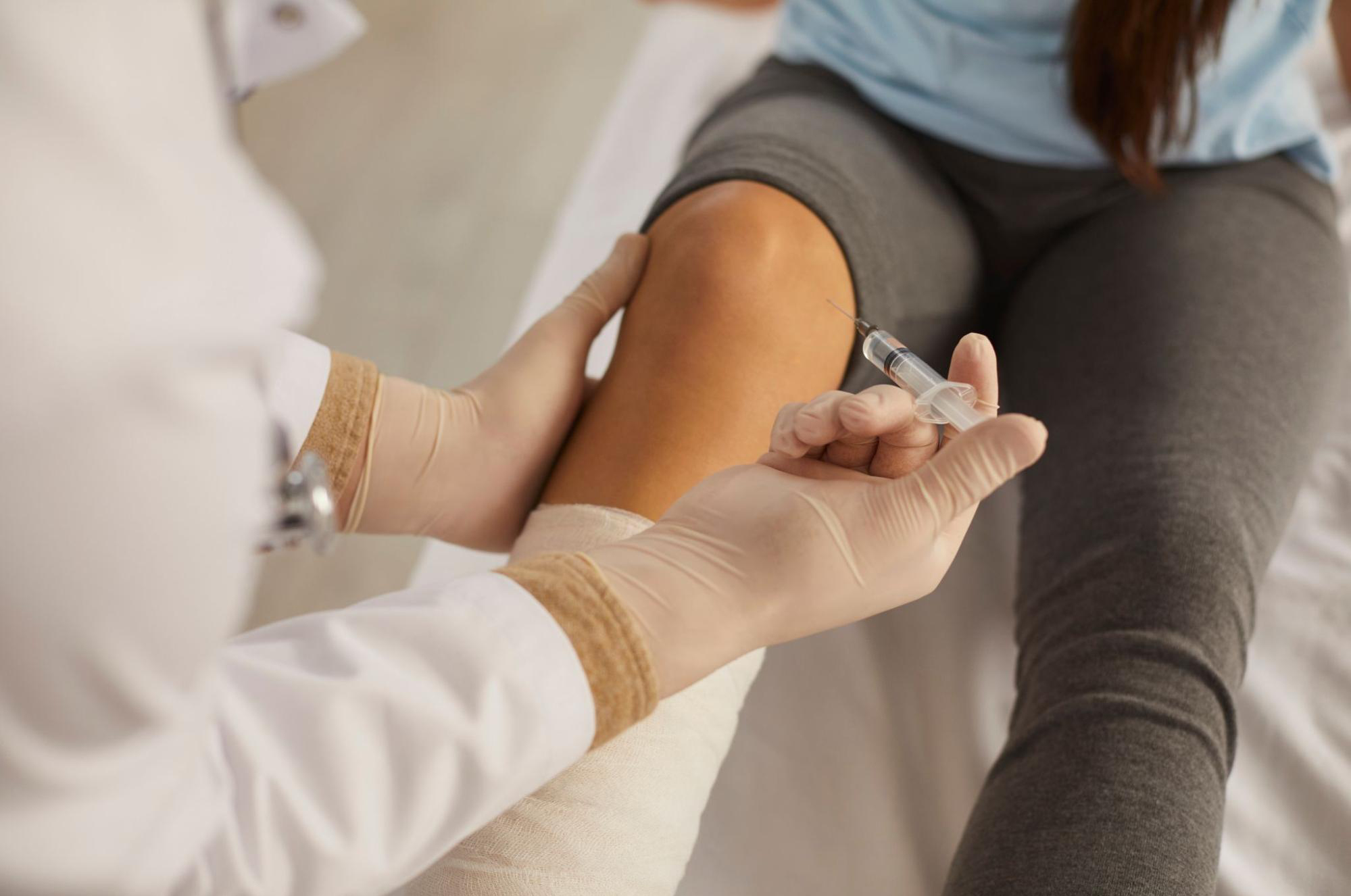
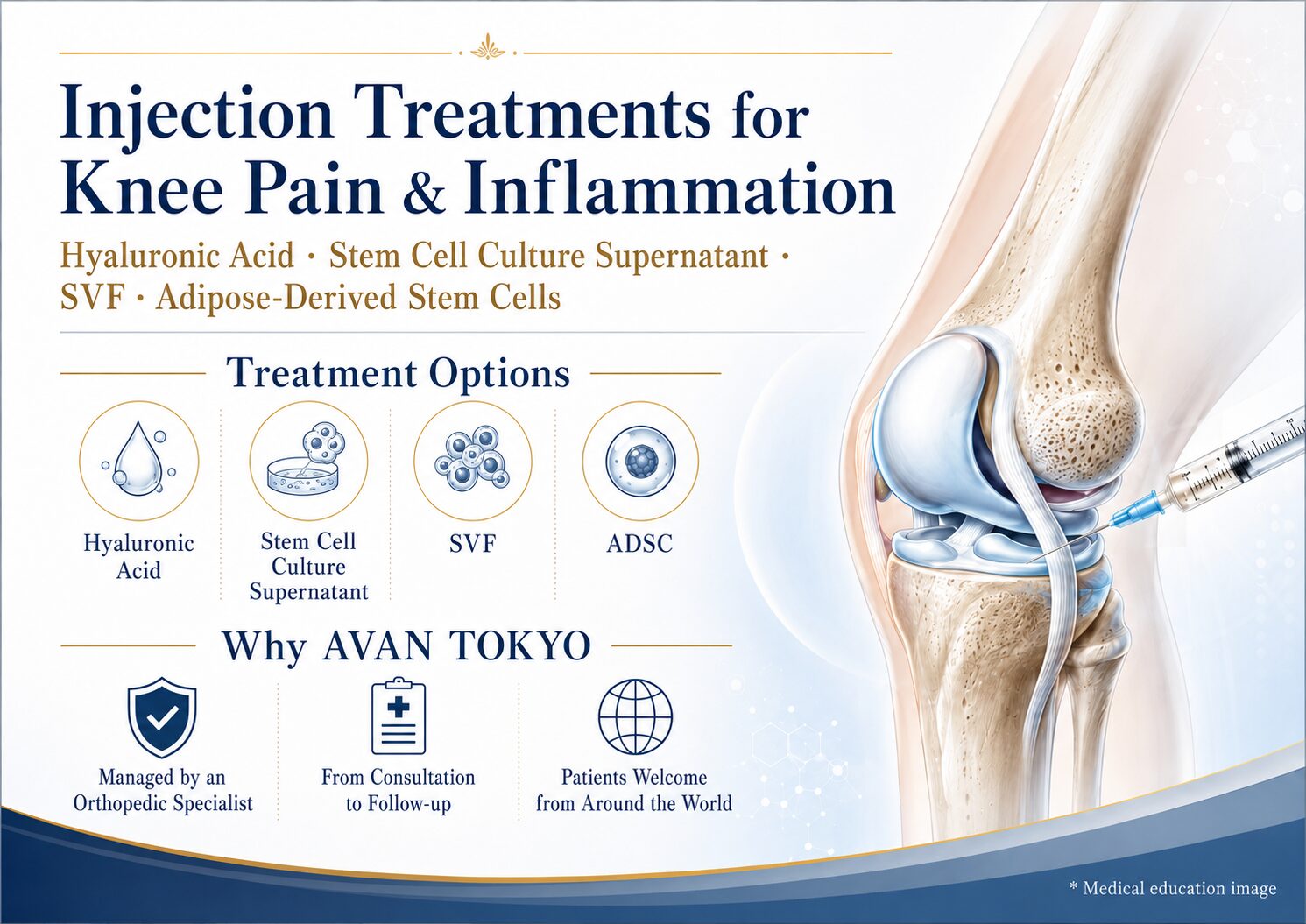
If, despite all these lifestyle adjustments, pain remains at the level of “I still cannot move on rainy days” or “my knee stays heavy throughout the rainy season,” it often means the seeds of synovitis persist deeply in the background. In such cases, delivering the growth factors and anti-inflammatory cytokines contained in stem cell conditioned media into the knee joint cavity can be expected to ease the cycle of synovitis itself, lowering the knee’s “reactivity” to weather changes. Its axis of action differs from hyaluronic acid or steroid injections: it aims to recalibrate the intra-articular environment rather than temporarily suppress pain. It is not a cure-all — end-stage joint destruction and active infection, for example, are not indications. For more details, see our page on stem cell conditioned media joint injection.
Frequently Asked Questions
Q. Is it useful to check the barometric forecast and prepare in advance?
Knowing the pressure trajectory in advance lets you take proactive measures such as warming, adjusting activity, and readying as-needed analgesics, which helps blunt the peak of symptoms. Many patients also use weather-pain apps. That said, over-focusing on it can amplify anxiety, so it works best as one health-management tool among others.
Q. Is weather-triggered knee pain a sign of knee osteoarthritis?
Not necessarily, but it is true that people whose knees hurt easily with weather changes often have some underlying inflammation or change inside the joint. If symptoms last longer than half a year, or coexist with start-up pain when walking or pain going downstairs even on weather-independent days, it is worth having an orthopedic imaging evaluation.
Q. Are hot springs and bathing good for the knee on rainy days?
Often yes — they improve blood flow and relax muscle tension. However, when acute swelling or heat is present, warming can worsen inflammation and become counterproductive. Use them selectively based on the state of the knee.
Q. Should joint injections be avoided on rainy days?
There is no clear medical evidence that weather substantially changes the risk or efficacy of joint injection. In fact, since patients often perceive treatment benefit more clearly when weather-related knee pain is at its peak, deliberately timing an injection to a symptomatic period is often reasonable.
Q. Is it normal for young people to have knee pain triggered by weather?
Young individuals with a history of ligament injury, meniscal injury, or sports injury do tend to be sensitive to weather changes. When the joint is intact, weather alone rarely produces strong pain, so if a young person has persistent weather-dependent pain, it is worth taking a closer look inside the knee.
──────────────
Supervising Physician: Shin Moriwaki / 森脇 進
Member of the Japan Society of Aesthetic Surgery (JSAS)
Member of the American Academy of Aesthetic Medicine
ECFMG Certificate
──────────────
📍AVAN TOKYO Ginza Joint Regenerative Medicine
English / 中文 / Tiếng Việt available
Inquiries welcome via DM / LINE / Website / Phone.