


Is Fat Retention Worse in Slim Patients?2026.06.17
What Patients with a BMI Below 17.5 Should Know Before Fat Transfer Breast Augmentation
“I want a larger bust, but I don’t want silicone implants.”
This is a common request among patients considering fat transfer breast augmentation.
Fat grafting offers several advantages:
- Natural appearance
- Natural feel
- No permanent implant
However, one important reality is often overlooked:
Fat retention varies significantly from patient to patient.
Not everyone will achieve the same level of long-term volume retention.
Two Major Factors That Can Reduce Fat Retention
Based on our experience performing numerous fat transfer breast augmentations, two factors are particularly important:
✔ BMI below 17.5
✔ Smoking or frequent exposure to secondhand smoke
Patients who fall into either category often face greater challenges with fat survival.
Why Do Slim Patients Have Lower Fat Retention?
Fat cells require:
- Adequate blood supply
- Adequate nutrition
to survive after transfer.
Patients with very low BMI often have:
- Less donor fat available
- Less tissue volume within the breast
As a result, blood flow may not adequately support large amounts of transferred fat.
This can increase the percentage of fat that is absorbed over time.
How Smoking and Secondhand Smoke Affect Fat Survival
Successful fat grafting depends on healthy microcirculation.
Nicotine and tobacco exposure can constrict blood vessels and reduce blood flow.
When blood flow decreases, oxygen and nutrients may not adequately reach newly transferred fat cells.
This can negatively impact fat retention.
For this reason, AVAN TOKYO strongly recommends avoiding smoking before and after surgery whenever possible.
Case Presentation
The patient featured in this case was:
- 19 years old
- BMI 17
She underwent:
- Circumferential arm liposuction
- Fat transfer breast augmentation
Because of her work environment, she was also frequently exposed to secondhand smoke.
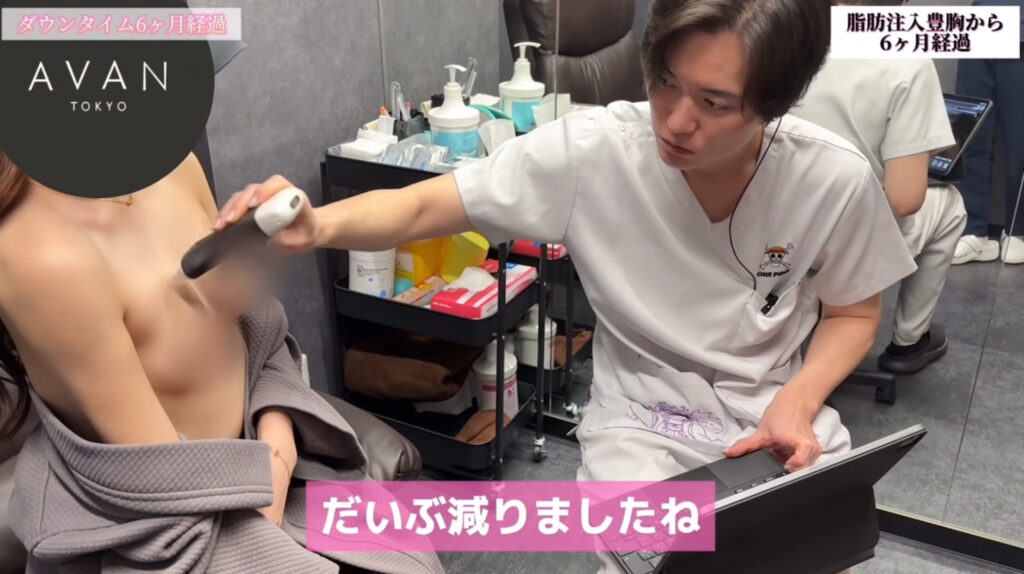
At 6 months postoperatively, a significant portion of the transferred fat had been absorbed.
This case highlights that long-term results depend not only on injection volume but also on biological and lifestyle factors.
Better Options for Slim Patients
For patients with a low BMI, AVAN TOKYO often recommends:
Option 1: Multiple Fat Transfer Sessions
Rather than attempting a dramatic increase in a single procedure, gradual augmentation through two or three sessions may improve outcomes.
The second procedure may benefit from:
- Increased vascularity
- Expanded tissue capacity
which can improve fat retention.
Option 2: Hybrid Breast Augmentation
Hybrid Breast Augmentation combines:
- Silicone implants for reliable volume
- Fat grafting for softness and natural contour
For slim patients, this approach often provides the most predictable and satisfying result.
The AVAN TOKYO Philosophy
Fat transfer breast augmentation is not about injecting the largest possible volume.
The true goal is:
- Maximizing fat survival
- Creating a natural breast shape
- Achieving long-term satisfaction
Every treatment plan should be tailored to the patient’s anatomy, BMI, lifestyle, and goals.
Case Information
Patient: 19-Year-Old Female
BMI: 17
Procedure: Circumferential Arm Liposuction + Fat Transfer Breast Augmentation
Follow-Up: 6 Months
Risks and Complications
Fat Transfer Breast Augmentation:
Infection, palpable lumps, fat necrosis, calcification, asymmetry, variable fat retention, volume loss, and scarring.
Liposuction:
Swelling, bruising, fibrosis, contour irregularities, pigmentation changes, sensory changes, and scarring.