


Is More Fat Always Better in Fat Transfer Breast Augmentation?2026.06.24
How to Achieve Natural Breast Enhancement While Reducing the Risk of Lumps
During consultations for fat transfer breast augmentation, many patients ask:
“I want as much fat injected as possible.”
“I want to increase my breast size by more than two cup sizes in one procedure.”
However, fat transfer breast augmentation is not a procedure where more volume always means better results.
In fact, using an appropriate injection volume is essential for both fat survival and safety.
Why Does Not All Transferred Fat Survive?
After fat is injected into the breast, the fat cells must receive oxygen and nutrients from newly formed blood vessels.
If too much fat is injected at once, blood supply may not reach the central part of the grafted fat.
As a result, the fat may:
● Be absorbed by the body
● Become a palpable lump
● Develop fat necrosis
What AVAN TOKYO Focuses On
At AVAN TOKYO, we do not focus only on how much fat is injected.
We focus on:
How much fat actually survives.
Based on our clinical experience, many cases with good fat retention tend to involve injection volumes of approximately 200–240cc per breast.
Of course, the ideal volume varies depending on each patient’s body type, skin elasticity, breast capacity, and tissue condition.
However, in many cases, careful multi-layer injection of an appropriate volume produces better long-term results than excessive fat injection.
Why Can Excessive Fat Injection Cause Lumps?
Fat cells begin fighting for oxygen immediately after being transferred.
When too much fat is injected at once, several problems can occur.
- New Blood Vessels Cannot Reach the Fat
If fat cells are packed too densely, blood vessels cannot reach the deeper areas. - Internal Pressure Increases
Excessive injection can raise pressure inside the breast tissue, compressing small blood vessels. - Fat Necrosis May Occur
When fat cells do not receive enough oxygen and nutrients, they may die and remain as lumps or hardened areas.
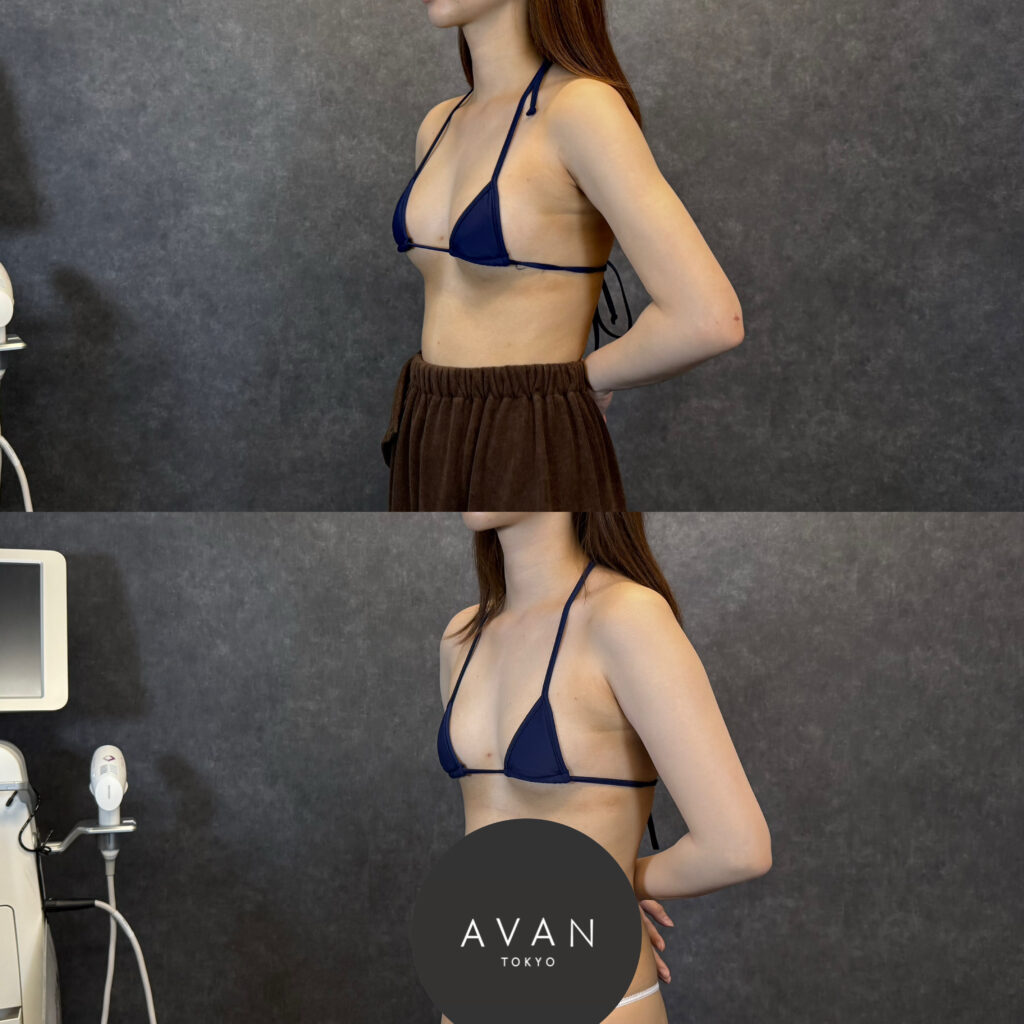
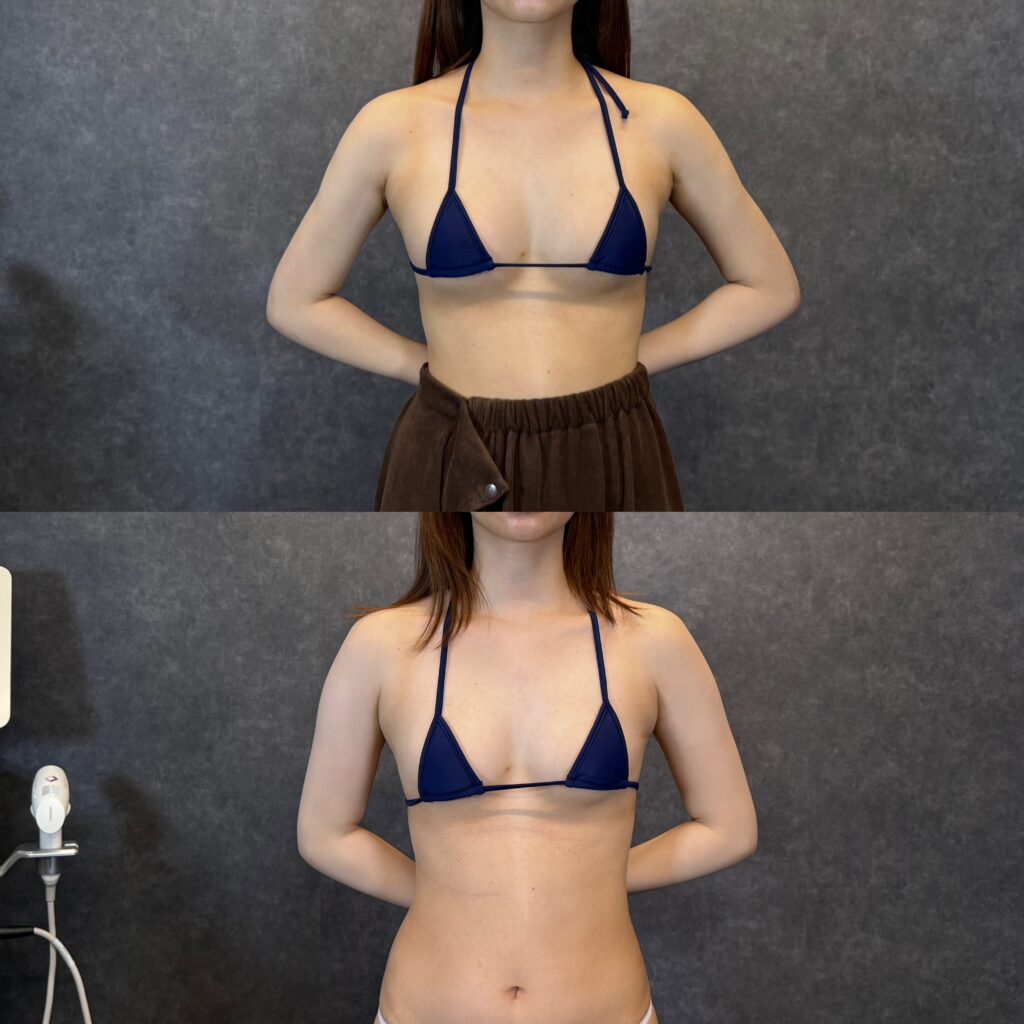
Case Study
This patient is a 24-year-old woman who underwent fat transfer breast augmentation.
The injection volume was:
● Right breast: 220cc
● Left breast: 200cc
She had good skin tension, which made her a suitable candidate for this injection volume.
She also followed postoperative nutritional guidance carefully.
At 1 month after surgery, a very favorable amount of fat volume has been maintained.
How Much Breast Enlargement Can Fat Transfer Achieve?
In general, one fat transfer breast augmentation procedure can provide approximately:
1 to 1.5 cup sizes of enhancement.
While some patients may achieve more, increasing more than two cup sizes with one procedure is not typical.
What If You Want More Than Two Cup Sizes?
For patients who want a more reliable increase of more than two cup sizes, there are two main options.
Option 1: Multiple Fat Transfer Sessions
By performing fat transfer in stages, the breast tissue environment can be gradually expanded and improved.
Option 2: Hybrid Breast Augmentation
Hybrid Breast Augmentation combines silicone implants with fat transfer.
The implant provides reliable volume, while fat grafting improves softness, cleavage, and natural contour.
This is one of the most popular approaches at AVAN TOKYO for patients seeking both size and natural appearance.
The AVAN TOKYO Philosophy
Fat transfer breast augmentation is not about competing over injection volume.
What matters most is:
● Where the fat is injected
● Which tissue layers are used
● How much fat survives
● How natural the breast shape becomes
At AVAN TOKYO, we carefully evaluate each patient’s anatomy and goals to design a treatment plan that prioritizes both safety and long-term satisfaction.
Case Information
Procedure:
Fat Transfer Breast Augmentation
Patient:
24-Year-Old Female
Injection Volume:
Right 220cc / Left 200cc
Follow-Up:
1 Month Postoperative
Risks and Complications
Infection, lumps, fat necrosis, calcification, asymmetry, volume loss, and scarring.
This post is intended for medical education purposes.