


Breast Reduction with Breast Lift2026.06.30
A procedure that reduces breast volume while improving sagging, shape, position, and overall balance
Breast reduction surgery is not simply a procedure to make the breasts smaller.
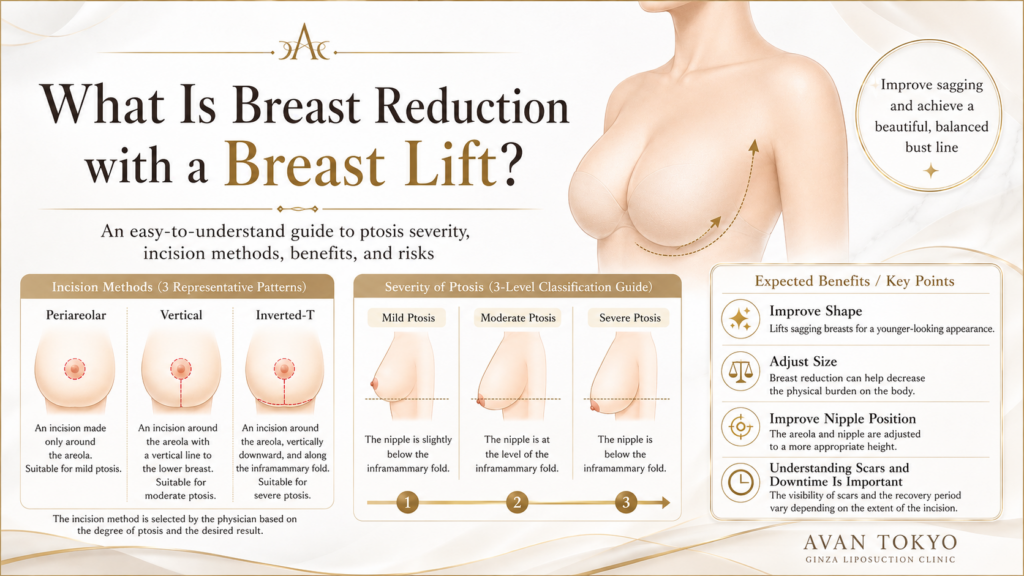
For patients with breast ptosis, or sagging breasts, it is important not only to reduce excess skin, breast tissue, and fat, but also to lift the nipple-areola complex and reshape the entire breast.
This type of surgery may be referred to as breast reduction, breast lift, mastopexy, or reduction mammoplasty.
At AVAN TOKYO, we do not aim only to reduce breast size. We evaluate the patient’s body shape, skin laxity, degree of sagging, nipple-areola position, asymmetry, and tolerance for scars in order to design a natural and balanced breast contour.
The Difference Between Breast Reduction and Breast Lift
Breast reduction and breast lift are closely related procedures, but their main goals are slightly different.
Breast Reduction
Breast reduction is a procedure that reduces breast volume.
Excess breast gland tissue, fat, and skin are removed to decrease breast weight.
It may be suitable for patients who experience shoulder stiffness, neck pain, back pain, bra strap indentation, skin irritation under the breasts, or difficulty finding clothes due to large breasts.
Breast Lift
A breast lift is a procedure that elevates sagging breasts and lifts the nipple-areola complex to a more appropriate position.
Rather than significantly reducing volume, the main purpose is to improve breast position and shape.
Breast Reduction with Lift
When the breasts are both large and sagging, breast reduction and breast lift are often performed together.
This allows us to reduce excess volume while repositioning the nipple-areola complex and reshaping the breast.
Classification of Breast Ptosis
Breast ptosis is generally evaluated by the position of the nipple in relation to the inframammary fold.
The inframammary fold is the natural crease where the lower breast meets the chest wall.
Mild Ptosis
The nipple is located around the level of the inframammary fold.
The degree of sagging is mild, and excess skin is usually limited.
In these cases, a periareolar incision may be considered.
Moderate Ptosis
The nipple is located below the inframammary fold.
Sagging and excess skin are more noticeable, and a periareolar incision alone may not provide enough lift.
A vertical incision or inverted-T incision may be considered.
Severe Ptosis
The nipple is positioned close to the lowest part of the breast.
There is usually significant excess skin, breast weight, and loss of shape.
In these cases, a more extensive skin removal and breast reshaping are often required, and an inverted-T incision is commonly selected.
Pseudoptosis
In pseudoptosis, the nipple position is not significantly low, but the lower part of the breast has descended or lost fullness.
This can occur after pregnancy, breastfeeding, or significant weight loss.
The surgical plan is decided not only by nipple position but also by the overall distribution of breast volume.
Main Incision Patterns for Breast Lift and Breast Reduction
There are several incision patterns used in breast lift and breast reduction surgery.
The appropriate method depends on the degree of sagging, breast size, skin excess, areola size, desired breast size, and the patient’s tolerance for scars.
- Periareolar Incision
This method involves an incision around the areola.
Excess skin is removed around the areola, and the nipple-areola complex is lifted.
Indications
This method may be suitable for mild ptosis, enlarged areolas, mild asymmetry, or patients with minimal excess skin.
Advantages
The scar follows the border of the areola and may be relatively less noticeable.
The areola size can also be reduced at the same time.
Disadvantages
The lifting effect is limited.
For moderate or severe ptosis, this approach may not provide enough correction.
Because the tension is concentrated around the areola, there is a risk of areolar widening, thick scars, or a flattened breast appearance. - Vertical Incision
This method combines an incision around the areola with a vertical incision from the lower areola toward the inframammary fold.
It is sometimes called a lollipop incision.
Indications
This method may be suitable for mild to moderate ptosis, patients who need moderate skin removal, or those who want a more three-dimensional breast shape.
Advantages
It allows more lift than a periareolar incision alone.
It can improve sagging while reshaping the breast.
Since there is no horizontal scar along the inframammary fold, the total scar length may be shorter than an inverted-T incision.
Disadvantages
A vertical scar remains below the areola.
In the early postoperative period, wrinkles, firmness, or irregularity may appear in the lower breast.
For severe ptosis or significant skin excess, this method may not provide enough correction. - Inverted-T Incision
This method combines an incision around the areola, a vertical incision below the areola, and a horizontal incision along the inframammary fold.
It is also called an anchor incision or Wise pattern incision.
Indications
This method is often suitable for moderate to severe ptosis, large breasts, significant skin excess, or patients who desire a larger reduction.
Advantages
It allows sufficient removal of excess skin and is highly effective for reshaping severely sagging breasts.
It can reduce breast volume while significantly lifting the nipple-areola complex.
It is also useful for improving breast width, lower pole heaviness, and overall breast shape stability.
Disadvantages
The scars are longer than other methods.
The T-junction, where the vertical and horizontal incisions meet, may take longer to heal.
Swelling, firmness, and redness of the scars may take time to settle.
Basic Surgical Flow
Breast reduction and breast lift surgery generally follow these steps.
- Preoperative Design
The breast position, nipple-areola height, asymmetry, skin excess, and inframammary fold are assessed while the patient is standing.
Because breast shape changes between standing and lying positions, preoperative marking is extremely important. - Anesthesia
The surgery is usually performed under intravenous sedation or general anesthesia.
At AVAN TOKYO, we work with board-certified anesthesiologists to provide careful anesthesia management. - Removal of Excess Skin, Breast Tissue, and Fat
Depending on the desired breast size and degree of sagging, excess breast tissue, fat, and skin are removed.
The goal is not simply to reduce volume, but also to reshape the breast. - Repositioning of the Nipple-Areola Complex
The nipple-areola complex is moved to a more natural height.
Preserving blood flow is extremely important during this step.
Excessive movement or excessive tissue tension can increase the risk of circulatory problems, so careful preoperative evaluation and intraoperative judgment are essential. - Breast Reshaping
The remaining breast tissue is rearranged to reconstruct roundness, projection, and height.
When necessary, the upper pole, inner breast, lower pole support, and asymmetry are adjusted. - Closure and Fixation
The skin is carefully sutured, and postoperative fixation is applied to stabilize the breast shape.
A surgical bra or compression garment may be used after surgery.
Benefits of Breast Reduction with Lift
Breast reduction and lift surgery may improve both appearance and daily comfort.
Lifts the Breast Position
Repositioning the nipple-areola complex can create a more youthful and balanced breast appearance.
Reduces Breast Weight
For patients with large breasts, this may help reduce shoulder, neck, and back strain, as well as bra strap indentation.
Makes Clothing Easier to Wear
Improving breast size and position may make it easier to wear fitted clothing, dresses, swimwear, and underwear.
Can Reduce Areola Size
If the areola has become enlarged, the diameter can be reduced during surgery.
Can Improve Asymmetry
Although perfect symmetry is not possible, differences in breast size and nipple-areola position may be improved.
Disadvantages and Important Considerations
Breast reduction and breast lift surgery also have limitations and disadvantages that must be understood before surgery.
Scars Are Unavoidable
Because this is an incisional surgery, scars will remain.
In inverted-T surgery, scars are placed around the areola, vertically below the areola, and horizontally along the inframammary fold.
Scars are usually red during the early healing phase and gradually fade over time.
Final Results Take Time
At one month after surgery, swelling, firmness, asymmetry, and scar redness may still remain.
Breast shape usually continues to settle over 3 to 6 months or longer.
Scar maturation may take 6 months to over 1 year.
Nipple-Areola Sensation May Change
Temporary or long-term changes in nipple or areola sensation can occur.
Sensation may become reduced, increased, or different between the left and right sides.
Breastfeeding May Be Affected
Because breast tissue is removed and the nipple-areola complex is repositioned, future breastfeeding may be affected.
Patients planning future pregnancy or breastfeeding should discuss this carefully before surgery.
Recurrent Sagging May Occur
Aging, weight fluctuation, pregnancy, breastfeeding, and skin quality can cause the breasts to sag again over time.
Downtime and Recovery
Recovery varies from patient to patient, but the general timeline is as follows.
First Few Days
Swelling, pain, bruising, and tightness are common.
Patients should avoid strenuous movement and raising the arms excessively.
1 Week After Surgery
Pain usually begins to improve, but swelling and bruising may remain.
The wound is checked, and appropriate care is provided if needed.
2 Weeks After Surgery
Some patients may return to desk work.
However, heavy lifting, intense exercise, and activities that strongly move the breasts should still be avoided.
1 Month After Surgery
Daily life is often much easier, but the breasts are not yet fully healed.
Swelling, firmness, asymmetry, and scar redness may still remain.
3 to 6 Months After Surgery
The breast shape gradually becomes more natural, and scar redness slowly improves.
6 Months to 1 Year After Surgery
The scars mature, and the final breast shape becomes more stable.
Depending on the patient’s constitution, redness or firmness of the scars may persist longer.
Risks and Complications
Breast reduction and breast lift are incisional surgeries and may involve the following risks:
● Swelling
● Bruising
● Pain
● Infection
● Hematoma
● Seroma
● Delayed wound healing
● Red scars, hypertrophic scars, or keloids
● Asymmetry
● Irregular breast shape
● Nipple-areola position asymmetry
● Reduced nipple or areola sensation
● Circulatory problems of the nipple-areola complex
● Partial or complete nipple-areola necrosis
● Skin necrosis
● Fat necrosis
● Palpable lumps
● Possible impact on breastfeeding
● Recurrent sagging
● Possible need for revision surgery
● Anesthesia-related risks
● Systemic complications such as deep vein thrombosis or pulmonary embolism
The risk of circulatory problems and delayed wound healing may be higher in patients requiring large nipple-areola movement, patients with very large breasts, smokers, and patients with medical conditions such as diabetes.
Features of Breast Reduction and Breast Lift at AVAN TOKYO
At AVAN TOKYO, we do not consider breast reduction and lift surgery to be simply a size-reduction procedure.
Our goal is to reduce, lift, reshape, and perform the procedure safely.
- Anesthesia Management by Board-Certified Anesthesiologists
Breast reduction and breast lift surgery are incisional procedures that may require a longer operating time.
For this reason, anesthesia management is extremely important.
At AVAN TOKYO, we work with board-certified anesthesiologists to provide careful and safety-conscious anesthesia care. - Surgery Performed by a Plastic Surgeon Specializing in Body Incisional Procedures
At our clinic, surgery is performed by Dr. Fujimoto Avelino, a plastic surgeon affiliated with a university hospital who specializes in body incisional procedures.
Breast reduction and breast lift surgery require advanced plastic surgical knowledge, including skin excision, nipple-areola repositioning, breast tissue reshaping, scar design, and blood flow management.
Because this is an incisional procedure, surgical planning must consider both breast shape and scar quality. - Procedure Selection Based on the Degree of Sagging
The appropriate technique differs depending on whether the ptosis is mild, moderate, or severe.
At AVAN TOKYO, we select from methods such as periareolar incision, vertical incision, and inverted-T incision based on each patient’s condition.
We do not prioritize scar reduction alone. Instead, we choose the method by considering the desired degree of change and long-term stability of the breast shape. - Balance with the Entire Body
We do not decide breast size by looking at the breasts alone.
Shoulder width, chest wall shape, waist, hips, height, and body weight are also considered.
At AVAN TOKYO, we apply our experience in liposuction and body contouring to design the breast as part of the overall body silhouette. - Postoperative Follow-Up
Breast reduction and breast lift surgery are not completed immediately after the operation.
Swelling, firmness, scars, and asymmetry continue to change over time.
At AVAN TOKYO, we support patients with postoperative visits, wound care, scar care, and lifestyle guidance throughout the healing process.
Who May Be a Good Candidate?
Breast reduction with lift may be suitable for patients who have the following concerns:
● Large and heavy breasts
● Shoulder, neck, or back discomfort
● Bra strap indentation
● Sagging breasts
● Low nipple-areola position
● Breast sagging after pregnancy or breastfeeding
● Excess skin after weight loss
● Desire to reduce breast size while improving shape
● Enlarged areolas
● Asymmetry
● Preference for shape improvement even if scars are necessary
What We Evaluate During Consultation
During consultation, we assess:
● Desired breast size
● Degree of ptosis
● Nipple-areola position
● Asymmetry
● Skin laxity
● Breast weight
● Ratio of breast tissue and fat
● Medical history
● Smoking history
● Future pregnancy or breastfeeding plans
● Tolerance for scars
● Time available for recovery
Based on these factors, we propose the most suitable surgical plan.
Frequently Asked Questions
Can breast reduction and breast lift be performed together?
Yes. In many cases, they are performed together.
When the breasts are both large and sagging, it is necessary to reduce volume while lifting and reshaping the nipple-areola complex.
Will scars remain?
Yes. Because this is an incisional surgery, scars will remain.
The visibility of scars depends on the surgical method and individual healing tendency.
Scars are often red for several months after surgery but usually fade gradually over time.
Does the inverted-T incision leave larger scars?
Compared with periareolar or vertical incisions, the inverted-T incision leaves longer scars.
However, for severe sagging or large breast reduction, it may allow more reliable skin removal and shape stabilization.
It is important to choose the technique based not only on scar length, but also on the degree of correction and long-term shape stability.
Will nipple sensation remain?
Sensation often improves gradually, but temporary or long-term sensory changes can occur.
The risk may be higher when the nipple-areola complex must be moved a long distance.
Can I breastfeed in the future?
Breastfeeding may be affected depending on the surgical technique and amount of tissue removed.
If you plan future pregnancy or breastfeeding, please discuss this before surgery.
When can I return to work?
Some patients can return to desk work after about 1 to 2 weeks.
However, jobs requiring physical labor, heavy lifting, or large arm movements may require a longer recovery period.
When is the final result?
The breast shape gradually becomes more natural over 3 to 6 months.
Scar maturation may take 6 months to over 1 year.
Summary
Breast reduction with breast lift is not simply a procedure to make the breasts smaller.
It is a surgery designed to lift sagging breasts, reposition the nipple-areola complex, reduce excess skin and volume, and create a natural breast shape that suits the whole body.
Surgical options include periareolar incision, vertical incision, and inverted-T incision. The most suitable method depends on the degree of sagging and the desired level of change.
At AVAN TOKYO, surgery is performed under safety-conscious anesthesia management in collaboration with board-certified anesthesiologists. The procedure is performed by Dr. Fujimoto Avelino, a university hospital-affiliated plastic surgeon specializing in body incisional procedures.
We consider breast size, sagging, nipple position, scars, downtime, and safety comprehensively in order to propose the most appropriate treatment for each patient.
This article is intended for medical education purposes. Results and recovery vary between individuals.