


How to Avoid Unevenness After Liposuction2026.07.05
Designing How Much Subcutaneous Fat to Leave Based on BMI
“I want liposuction, but I don’t want unevenness.”
“I want to become slimmer, but I don’t want unnatural muscle grooves or contour irregularities.”
Many patients have this concern before liposuction.
Liposuction is not simply a procedure where removing more fat always creates a better result.
The most important point is where to remove fat thoroughly and where to intentionally preserve it.
In particular, how much superficial subcutaneous fat is left just beneath the skin has a major impact on how smooth the final result appears.
At AVAN TOKYO, we evaluate each patient’s BMI, subcutaneous fat thickness, muscle structure, bone structure, and skin quality to aim for liposuction that looks thinner while minimizing contour irregularities.
Very Aggressive Liposuction Can Increase the Risk of Unevenness
Recently, more patients are requesting liposuction that creates a very thin and defined appearance.
They may want:
● Slimmer upper arms
● A thinner abdomen
● Reduced outer thigh fullness
● A sharper body line
Removing fat aggressively can create a larger visual change.
However, if too much superficial fat is removed, the grooves of the muscles and the unevenness of the underlying structure may become visible through the skin.
Postoperative unevenness can also occur due to fibrosis during the contracture phase.
However, in very aggressive “ultra-thin” liposuction, much of the visible unevenness comes from muscle grooves and muscle contours showing through the surface.
This means that avoiding unevenness requires not only the skill to remove fat, but also the skill to know how much fat should be preserved.

The Amount of Fat That Should Be Left Depends on BMI
Even for the same upper arm liposuction, we do not remove fat to the same thickness in every patient.
Patients with higher BMI and lower BMI have different subcutaneous fat thickness, muscle visibility, bone structure, and skin laxity.
Based on our experience following many postoperative cases at AVAN TOKYO, we use the following as one reference guideline.
BMI Over 22
As a general guide, we aim to leave at least 1 cm of subcutaneous fat in all areas.
In patients with higher BMI, fat is not only present under the skin. Fat may also be distributed within and around the muscles, similar to marbling.
If only the subcutaneous fat is made extremely thin in this situation, the thicker underlying muscle may become more visible and create an unnatural appearance.
For this reason, it is important not only to reduce volume, but also to preserve a smooth overall contour.
BMI Around 18–20
As a general guide, we may leave approximately:
● Upper arms: 6 mm
● Abdomen: 8 mm
● Thighs: 10 mm
In this body type, it may be possible to remove fat more aggressively while still maintaining a natural appearance, depending on skin quality and muscle visibility.
However, the skin, muscle structure, and fat distribution differ by area, so we do not use the same thickness for every part of the body.
BMI Below 18
As a general guide, we may leave approximately:
● Upper arms: 2.5 mm
● Abdomen: 5 mm
● Thighs: 6 mm
In slimmer patients, the amount of subcutaneous fat is already limited, so even a small difference in technique can greatly affect the final appearance.
Especially in the upper arms, leaving only a very thin layer of fat can help create a delicate line where the humeral head and deltoid contour appear naturally.
However, if too much is removed, muscle grooves or skin unevenness can become more noticeable. Therefore, very delicate adjustment is required.
Ultrasound Can Help Measure Subcutaneous Fat Thickness
In liposuction, subcutaneous fat thickness can be evaluated not only by visual inspection and palpation, but also by ultrasound.
This is especially important for revision cases.
It helps us determine where fat still remains and where the tissue is already too thin.
Even when a patient feels that an area is still thick, there may actually be very little subcutaneous fat left, and the thickness may be caused by muscle volume or postoperative fibrosis.
On the other hand, some areas that look slim may still have localized fat that can be treated.
At AVAN TOKYO, we use ultrasound when necessary to carefully assess whether revision liposuction or additional liposuction is appropriate.
For Patients With Higher BMI, Liposuction and Diet Should Be Combined
For patients with higher BMI, it may be difficult to create a very thin and smooth result with liposuction alone.
This is because fat may not only exist under the skin, but also within and around the muscles.
If the subcutaneous fat is made extremely thin while the underlying muscle remains thick, the muscle shape may become visible on the surface.
In these cases, liposuction can reduce the outer volume, while postoperative diet and weight management can help create a smoother and more refined line.
In other words, for patients with higher BMI, forcing the body to become too thin through liposuction alone is not always ideal.
Combining liposuction with lifestyle management can help create a more natural and beautiful result.
Key Points to Reduce Unevenness After Liposuction
To reduce the risk of unevenness after liposuction, the following points are important:
● Adjust the amount of fat removal based on BMI
● Change the remaining fat thickness depending on the body area
● Avoid over-removing fat where muscle grooves are likely to appear
● Consider skin quality and skin laxity
● Measure subcutaneous fat thickness with ultrasound when needed
● Combine postoperative diet management when appropriate
● Balance thinness and smoothness
Liposuction should not be planned based on numbers alone.
Even with the same BMI, muscle volume, bone structure, skin thickness, and fat distribution differ from person to person.
Therefore, the final decision must be made by carefully evaluating each patient’s body.
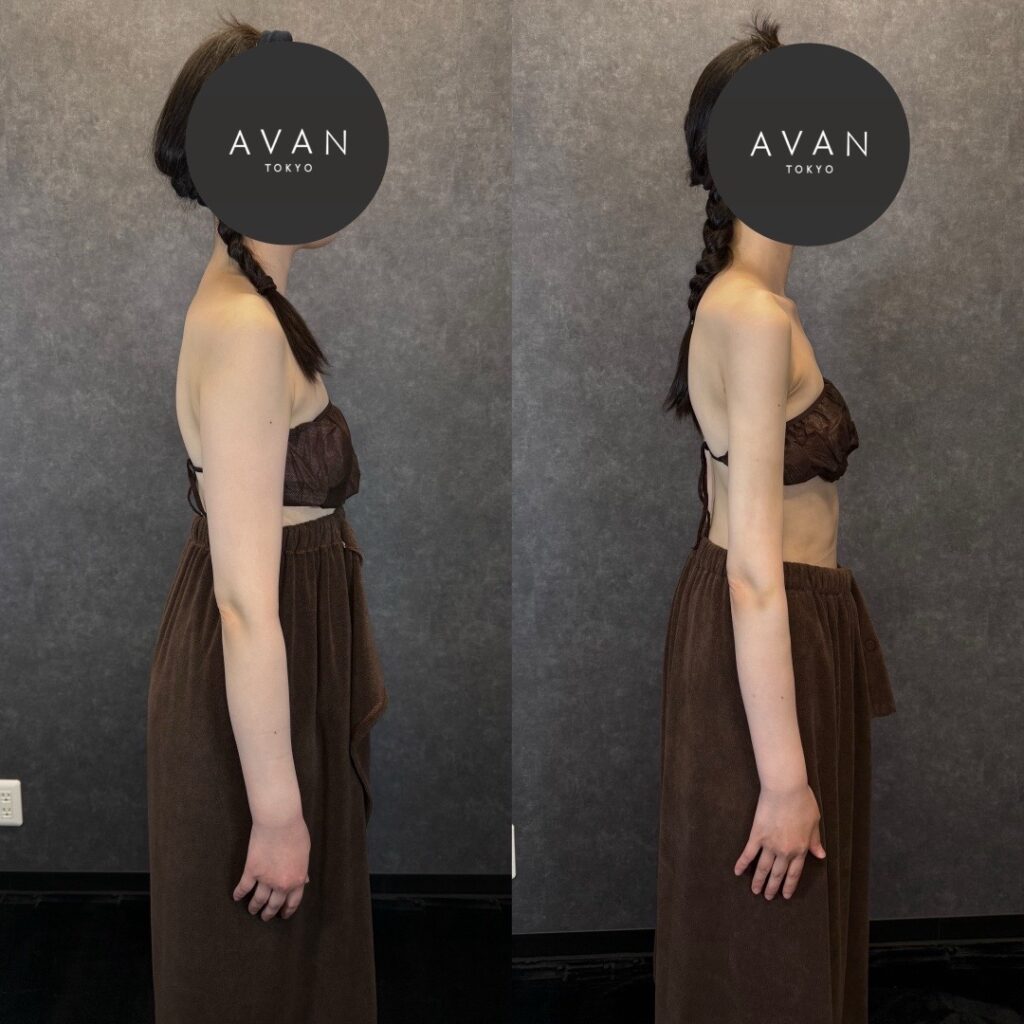
Case Introduction: 3 Months After Circumferential Arm and Forearm Liposuction
This case shows a patient 3 months after circumferential upper arm liposuction and forearm liposuction.
The liposuction was performed with the goal of leaving approximately 2 to 2.5 mm of superficial subcutaneous fat.
Rather than simply making the arms thinner, we designed the continuous line from the upper arms to the forearms, the transition from the shoulders to the arms, and how the muscles would appear during movement.
The patient also paid careful attention to postoperative diet management.
By combining liposuction with lifestyle management, the result shows a balance between thinness and smoothness.
At 3 months after surgery, some fibrosis and firmness may still remain. However, the overall line from the upper arms to the forearms has become slimmer and more delicate.
The Type of Liposuction AVAN TOKYO Aims For
At AVAN TOKYO, our goal is not simply to make the body thinner.
We aim to create a body line that is thin, smooth, and suitable for each patient’s body type.
For upper arm liposuction, we consider:
● The connection from the shoulder to the upper arm
● Thinness of the front side of the upper arm
● Fullness near the arm root
● Balance with the forearm
● How the muscles appear when the patient moves
● A delicate appearance when wearing sleeveless clothing
We do not aim to remove too much fat and create an unnatural appearance.
Instead, we remove unnecessary thickness while preserving the fat that is needed to maintain a smooth surface.
This judgment is essential for refined and natural-looking liposuction.
It Is Not About “Removing More,” but About “Preserving Beautifully”
In liposuction, a larger fat removal volume does not always mean a better result.
Of course, removing unnecessary fat thoroughly is important.
However, what is even more important is preserving the necessary fat so that the skin surface looks smooth.
This judgment becomes more difficult in slim patients and in patients who request an ultra-thin result.
Remove too much, and unevenness may appear.
Leave too much, and the change may be too subtle.
Finding that balance is the essence of high-quality liposuction.
At AVAN TOKYO, we evaluate BMI, subcutaneous fat thickness, ultrasound findings, muscle visibility, skin quality, and the patient’s desired result to design liposuction for each individual.
Summary
To avoid unevenness after liposuction, it is important not simply to remove as much fat as possible, but to decide how much subcutaneous fat should remain based on BMI and body area.
At AVAN TOKYO, we use the following as one general reference:
● BMI over 22: leave at least 1 cm in all areas
● BMI 18–20: leave approximately 6 mm in the upper arms, 8 mm in the abdomen, and 10 mm in the thighs
● BMI below 18: leave approximately 2.5 mm in the upper arms, 5 mm in the abdomen, and 6 mm in the thighs
These are only guidelines, and the final plan is adjusted according to each patient’s body type, skin quality, and desired outcome.
Liposuction is not simply a procedure to become thinner.
It is a procedure to design the body line.
If you want a thinner, smoother, and more refined body contour while reducing the risk of unevenness, please feel free to consult AVAN TOKYO.
Case Information
Procedures
Circumferential upper arm liposuction
Forearm liposuction
Follow-Up
3 months after surgery
Design Point
Liposuction was performed with the goal of leaving approximately 2 to 2.5 mm of superficial subcutaneous fat, while designing a continuous line from the upper arms to the forearms.
Risks and Complications
Swelling, bruising, pain, fibrosis, firmness, edema, contour irregularities, asymmetry, pigmentation, scarring, sensory changes, numbness, infection, hematoma, seroma, skin laxity, and possible need for revision surgery.
This article is intended for medical education purposes. Results and recovery vary between individuals.