


When Should Silicone Breast Implants Be Replaced? A Doctor Explains Aging Changes and the Capsule2026.07.08
Silicone breast augmentation is a widely chosen procedure for slim patients and for those who want a definitive size increase. However, one of the most common questions we receive is: “Once implants are in, do they last a lifetime?” In reality, the time to consider silicone implant replacement arrives for many patients. Dr. Moriwaki, a member of the Japan Society of Aesthetic Surgery (JSAS), explains the relationship between aging changes and the surrounding capsule, and organizes the medical criteria used to decide on silicone implant replacement.
Key Points of This Article
・The need for silicone implant replacement is judged along two axes: presence of symptoms and years since surgery.
・The body always forms a capsule around the implant, and its thickness and firmness change over time.
・Capsular contracture is classified by the Baker grading system; grades III and above are candidates for reoperation.
・In silicone implant replacement surgery, capsule management and redesign of the pocket determine the outcome.
・Even without symptoms, regular follow-up with annual breast ultrasound and MRI every 5 to 10 years is recommended.
Why Silicone Implant Replacement Is Considered
Current silicone implants continue to evolve and are far more durable than earlier generations. However, no medical device can be called “lifetime.” The reasons silicone implant replacement is discussed fall into three main categories. First, the silicone shell itself is a foreign body inside the body for a long period, and undergoes slight age-related changes. Second, the surrounding capsule changes. Third, changes on the body’s side—weight, pregnancy, breastfeeding, and aging—can shift the balance away from the original design. These factors interact with each other, so there is no universal rule that says “replace every X years.”
How to Think About Implant Durability
Many manufacturers cover “replacement in case of rupture” as a warranty item, which does not mean “mandatory replacement every 10 years.” Still, because the implant is a foreign body, periodic imaging follow-up is recommended.
The Capsule Always Forms
The body forms a fibrous capsule around any implanted foreign body. This is not a disease but an immunologically normal reaction. The capsule is initially thin and soft, but on a 5 to 10 year time scale, its thickness and firmness can change with individual variation.
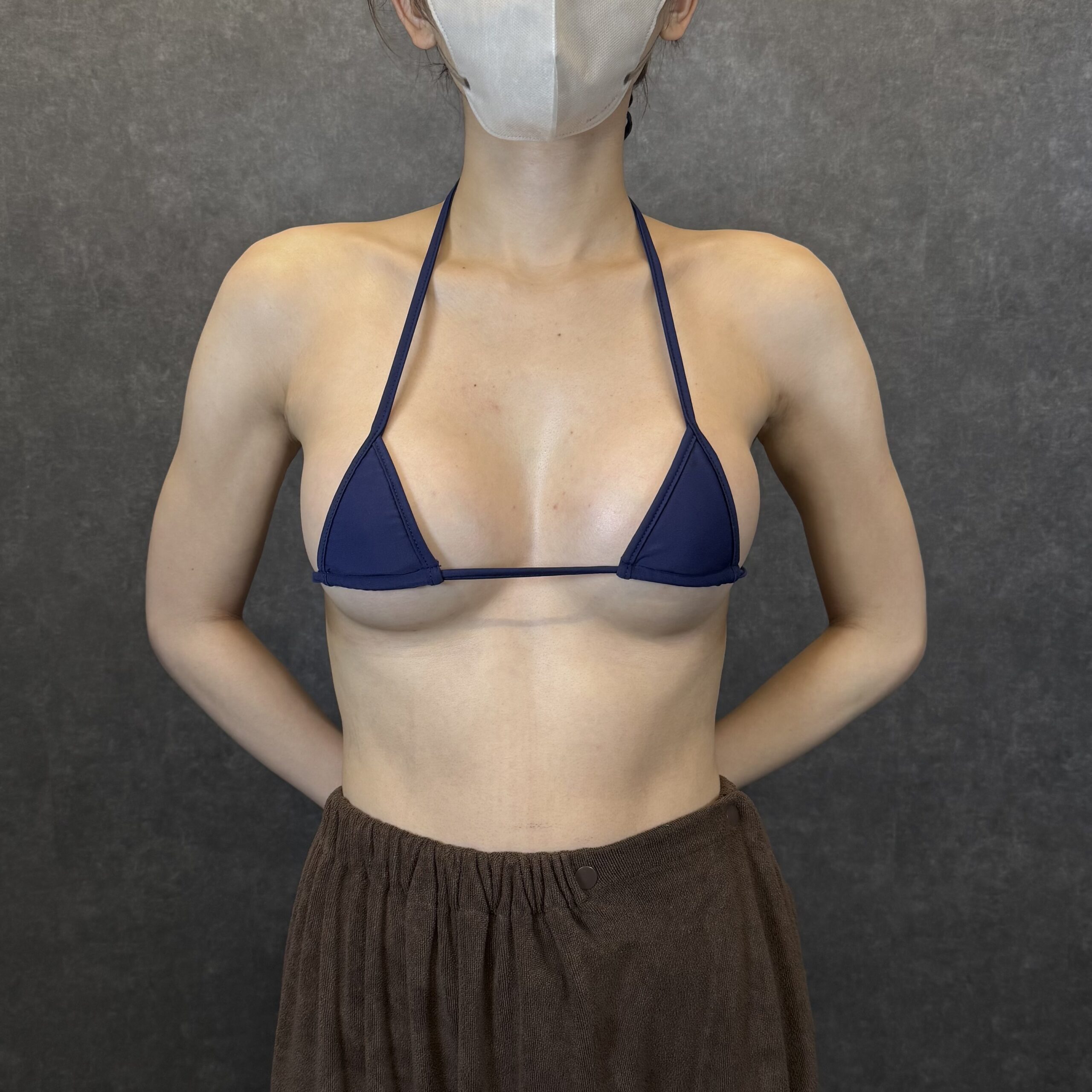
Capsular Contracture and the Baker Classification
As long as the capsule remains uniformly thin, the softness and natural shape of the breast are preserved. In some patients, however, the capsule thickens locally and constricts the implant from within—so-called capsular contracture. Clinically, the Baker classification is used:
Grade I: Normal appearance and feel.
Grade II: Slight firmness on palpation, no visible change.
Grade III: Firmness accompanied by shape change.
Grade IV: Pain with clear deformity.
Grades I and II are usually observed, while grades III and IV cause significant discomfort and aesthetic problems, making reoperation—including capsule management—a candidate. Mechanisms of contracture involve implant surface texture (smooth vs. textured), history of hematoma or infection, and possibly microbial biofilm formation.
Gravity, Lifestyle, and Age-Related Ptosis
Even when the implant itself has no problem, gravity gradually causes ptosis. Patients who chose larger implants, those with thin skin, those who have been pregnant or breastfed, and those with large weight fluctuations tend to see the original design shift over time. The implant itself may be intact while the relationship among skin, mammary gland, and implant changes—altering the contour, cleavage, and lower pole.
Signs That Silicone Implant Replacement Should Be Considered
We recommend consulting for silicone implant replacement when the following changes appear.
・Clearly increased firmness compared to before (suspected capsular contracture)
・Asymmetry between the two breasts
・Visible implant contour or rippling under the skin
・Persistent pain or discomfort
・Suspected shell damage or content change on ultrasound or MRI
・Progressive ptosis that disrupts the original design
Even without these signs, if more than 10 years have passed since implantation, we recommend an imaging check at least once.
The Three Key Steps of Replacement Surgery
Silicone implant replacement surgery is not simply swapping an old implant for a new one. Three steps determine the outcome and safety.
First, capsule management. A thickened capsule is partially excised or completely removed to create a pocket in which the new implant sits at the correct position and softness. Second, pocket redesign. The current thoracic wall, skin, and mammary gland are assessed to decide which layer—subpectoral, subfascial, or subglandular—is optimal. Third, adjunctive fat cover injection when indicated. For slim patients concerned about rippling or contour visibility, combining fat grafting as hybrid breast augmentation can achieve a more natural, softer finish. For safety standards in aesthetic surgery, please refer to the Japan Society of Aesthetic Surgery (JSAS).
The Importance of Regular Checkups and Self-Monitoring
Even when asymptomatic, we recommend annual breast ultrasound and MRI every 5 to 10 years after silicone implant surgery. Combined with breast cancer screening, this catches quietly progressing changes early. At our clinic, long-term postoperative follow-up is a priority, and we tailor judgments to each patient’s aging changes. Please also refer to our liposuction column index for related content.
Frequently Asked Questions
Q. After how many years must silicone implants be replaced?
There is no firm rule of “X years to mandatory replacement.” Many patients pass 10 years or more without symptoms and without imaging abnormalities. Still, because the implant is a foreign body inside the body, regular checks—annual ultrasound and MRI every 5 to 10 years—are important.
Q. Does capsular contracture require immediate surgery?
Baker grade I (normal appearance and feel) can be observed. In grade II or higher with bothersome firmness or shape change, or with persistent pain, reoperation including capsule management becomes a candidate. Symptoms, palpation, and imaging are considered together.
Q. Can size or shape be changed at replacement?
Yes. After evaluating the current chest wall, skin, mammary gland, and degree of ptosis, size or shape can be changed to fit more naturally. Slim patients with visible contour can also consider hybrid breast augmentation with cover fat grafting.
Q. Is downtime for replacement longer than the first surgery?
Depending on the extent of capsule management, return to daily life takes about 1 to 2 weeks, and swelling and shape usually settle over 3 to 6 months. Because individual variation is large, we explain individualized expectations at preoperative consultation.
Q. How many times can implants be replaced?
In theory, multiple replacements are possible, but scar tissue accumulates with each surgery and the surrounding tissue changes, so risks gradually rise. From a long-term perspective, planned follow-up that avoids unnecessary reoperation—and careful pocket design at the first surgery—matter greatly.
──────────────
【監修】森脇 進 / Shin Moriwaki(監修医師)
日本美容外科学会(JSAS)会員 / American Academy of Aesthetic Medicine 会員
ECFMG Certificate
──────────────
📍AVAN TOKYO 銀座脂肪吸引クリニック
AVAN TOKYO GINZA LIPOSUCTION CLINIC
English / 中文 / Tiếng Việt 対応可能
ご予約・ご相談は
DM / LINE / Website / Phone より承っております。