


Body Skin Tightening: RF vs HIFU — Applications and Limitations Explained by a Physician2026.07.15
“I’m noticing some looseness in my skin after liposuction” or “With age, the skin on my abdomen and upper arms has started to lose its firmness” — these concerns are increasingly common, and one of the treatment categories drawing attention is body skin tightening. Rather than surgical excision, it refers to non-invasive treatments that deliver thermal energy to the collagen fibers of the dermis and subcutaneous tissue, causing immediate contraction and stimulating neocollagenesis through the wound-healing process. The two most representative devices are radiofrequency (RF) and high-intensity focused ultrasound (HIFU), and because they act at different depths and suit different cases, correct selection largely determines the outcome. In this article we review the mechanism of action, how to choose between them on the body, and the true limits of these therapies from a medical standpoint.
Key Points of This Article
・Body skin tightening refers to non-invasive treatments that thermally remodel collagen in the dermis and subcutaneous tissue, inducing contraction and new collagen synthesis.
・Radiofrequency (RF) acts broadly across the dermis and superficial subcutaneous layer, while HIFU delivers point-focused energy down to the SMAS and deep fascia.
・Mild post-liposuction laxity and mild-to-moderate age-related sagging are the main indications on the body.
・When skin excess is significant or the dermis has lost its elasticity, non-surgical treatments reach their limit and surgical lifts must be considered.
・A single session is rarely sufficient; multiple treatments over several months are the standard of care.
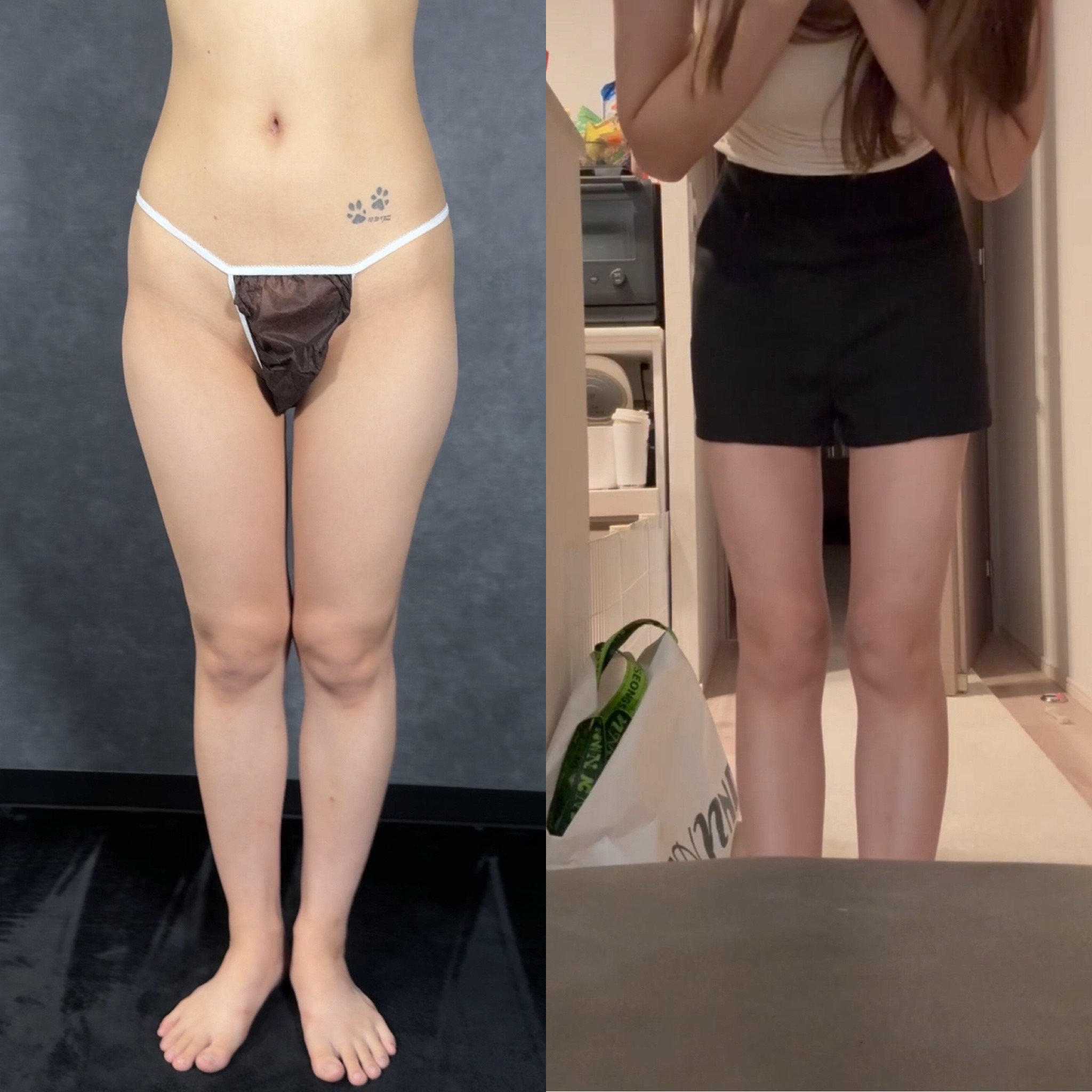
What Is Body Skin Tightening? — Rebuilding Collagen with Heat
Body skin tightening applies laser, RF, or focused ultrasound energy selectively to the skin and subcutaneous tissue. This thermally denatures collagen fibers to achieve immediate contraction, while the subsequent wound-healing response drives neocollagenesis for long-term firming. That is the fundamental principle behind these treatments.
Collagen fibers are known to begin unwinding and contracting around 65°C. The art lies in delivering enough heat to achieve this reaction safely, while minimizing damage to surrounding tissue. However, the depth and area of thermal delivery vary greatly between devices — and this variation dictates which indications each device best serves.
An Approach Designed to Firm Without Cutting
Unlike surgical excision, these therapies do not remove excess skin. They tighten the existing collagen network and stimulate new fiber production to restore visible firmness. For that reason, the indication is limited to mild-to-moderate laxity.
Radiofrequency (RF): Warming the Dermis and Superficial Subcutaneous Layer as a “Plane”
Radiofrequency (RF) is a form of electromagnetic energy that generates heat through tissue resistance as it flows through the skin. Different electrode configurations — bipolar, monopolar, multipolar — allow relatively predictable control over the depth of thermal delivery.
Depth of action typically ranges from the superficial dermis to about 1 cm into the subcutaneous layer, warming the superficial fat and overlying dermis as a broad plane. This makes RF particularly effective for the fine surface laxity that can appear after liposuction, and for the softness at the interface between subcutaneous fat and dermis.
Representative platforms include InMode BodyFX and the Morpheus8 series, both of which we use at our clinic as post-liposuction finishing treatments in selected cases. Many RF devices deliver continuous energy, making the sessions relatively comfortable with minimal downtime — a meaningful clinical advantage.
Ideal Indications for RF
・Superficial laxity following liposuction
・Areas with thin dermis such as the inner upper arms, lower abdomen, and inner thighs
・Mild cellulite and skin surface irregularity
High-Intensity Focused Ultrasound (HIFU): Reaching the SMAS and Deep Fascia as “Points”
HIFU concentrates ultrasound energy at a single tissue point, forming a local thermal coagulation point (TCP) at approximately 65–70°C. What makes it distinctive is the ability to heat deep structures with minimal warming of the skin surface.
Depending on the device and cartridge, penetration depths of 1.5 mm, 3.0 mm, and 4.5 mm can be selected — reaching the SMAS (superficial musculoaponeurotic system) on the face and the deep fascia or deep subcutaneous plane on the body. Rather than heating a broad plane, HIFU produces discrete coagulation points in the deep tissue, and the surrounding wound-healing response generates new collagen, creating a lifting effect from below.
Ideal Indications for HIFU
・Deep subcutaneous laxity (lower abdomen, flanks)
・Truncal cases with weakened deep-fascial support
・Cases where the surface is intact but the deep supporting tissue is the main source of laxity
How to Choose Between the Two for Body Skin Tightening
RF and HIFU are not competitors; they work at different depths, so in real clinical practice they are chosen based on the case — and often combined.
When used as a finishing treatment after liposuction, RF is the first choice if the laxity is primarily superficial. Where deeper subcutaneous softness or truncal weakness at the deep fascial level dominates, HIFU is added.
The key to selection is careful assessment — through palpation and inspection — of which layer is actually loose. If the dermis itself has lost its elasticity entirely, no amount of heat will yield sufficient contraction, and those patients fall outside the reach of non-surgical modalities and become candidates for surgical skin excision.
The Limits of Body Skin Tightening and When to Choose a Surgical Lift
No device is universal. When the dermal elastic network has broken down widely, the tissue’s contraction response to heat is weak and the expected firming does not appear. Typical examples include skin after major weight loss, the postpartum abdomen, and pronounced age-related skin excess.
For these patients, surgical lifts — brachioplasty, abdominoplasty, thigh lift — become the final option. Because body skin tightening is inherently a treatment for mild-to-moderate laxity, it is clinically essential to assess the degree of skin excess objectively and identify the crossover point between non-surgical and surgical management. For safety standards in aesthetic surgery, information from the Japan Society of Aesthetic Surgery (JSAS) is also a useful reference.
Evaluation Must Be Long-Term and Multi-Session
Neocollagenesis is not complete immediately after treatment; it progresses gradually over weeks to months. In most cases a single session is not sufficient, and multiple treatments at 3–6 month intervals, evaluated over time, are the standard approach. Expecting a dramatic change from a single session is unrealistic, so the treatment plan should be built with a long-term perspective in consultation with your physician.
Related columns may also be useful — visit our liposuction and breast augmentation column archive for more articles on techniques, downtime, and devices.
Frequently Asked Questions
Q. When can I start body skin tightening after liposuction?
Generally, treatment is considered from around three months after surgery, once the contracture phase has settled. Applying heat at the peak of contracture risks an exaggerated skin response. The exact timing depends on the device, indication, and individual recovery, so please consult your treating physician.
Q. Which should I choose, RF or HIFU?
If superficial laxity dominates, RF is the first choice; if the deeper supporting tissue is the primary issue, HIFU is preferred. The two are not competitors, and combining them at different depths is common. The decision is made at consultation, after palpating the actual condition of the skin.
Q. Will one session be enough?
A single session may produce a temporary contraction effect, but long-term firming from new collagen synthesis appears gradually over 3–6 months. In most cases, a planned series of multiple sessions yields more stable and lasting results.
Q. Can I have these treatments during pregnancy or while breastfeeding?
As a general rule, treatment is not recommended during pregnancy or lactation. Hormonal changes make skin responses unpredictable, and safety evidence in these populations is limited. We recommend waiting until pregnancy and breastfeeding have ended and the body has stabilized.
Q. Can body skin tightening alone completely firm the upper arms?
Mild laxity can improve meaningfully, but non-surgical treatments reach their limit when significant skin excess is present. In such cases, surgical brachioplasty or combined liposuction should be considered.
──────────────
Supervising Physician: Shin Moriwaki, MD
Member of the Japan Society of Aesthetic Surgery (JSAS)
Member of the American Academy of Aesthetic Medicine
ECFMG Certificate
──────────────
📍AVAN TOKYO GINZA LIPOSUCTION CLINIC
English / 中文 / Tiếng Việt supported
Reservations and consultations available via
DM / LINE / Website / Phone.