


Secondary Hybrid Breast Augmentation: One of the Most Satisfying Ways to Refine Breast Augmentation Results2026.06.12
Want More Natural Results After Breast Implants?
Breast implants remain one of the most reliable ways to achieve significant breast enlargement.
However, many patients eventually reach a point where they feel:
“I love the size, but I wish it looked a little more natural.”
Common concerns include:
- Upper pole hollowness
- Wide cleavage
- Visible implant edges
- Less natural softness
This is where Secondary Hybrid Breast Augmentation can make a significant difference.
What Is Secondary Hybrid Breast Augmentation?
Secondary Hybrid Breast Augmentation refers to fat grafting performed after a previous breast implant procedure.
The implant provides volume.
The fat provides contour, softness, and refinement.
Rather than replacing implants, fat grafting enhances the overall result.
Why Is Patient Satisfaction So High?
1. Even Small Amounts of Fat Can Make a Big Difference
Because the implant already provides volume, fat grafting is primarily used for contour enhancement.
In many patients, even 100–150cc of fat per side can noticeably improve the result.
This is particularly beneficial for thinner patients.
2. Improves the Décolletage and Cleavage
Fat grafting can be strategically placed in:
- The décolletage
- The cleavage area
- Around visible implant edges
This helps reduce the artificial appearance that some patients experience after implant surgery.
3. Creates a Softer, More Natural Feel
Fat acts as a natural cushion around the implant.
This often improves both the visual appearance and tactile softness of the breast.
4. Lower Risk Than Large-Volume Fat Transfer Alone
One of the biggest advantages of Hybrid Breast Augmentation is that implants create the size while fat creates the shape.
Because less fat is required, the risks of:
- Fat necrosis
- Palpable lumps
- Infection
may be lower compared with large-volume fat grafting alone.
The Most Important Factor for Fat Survival
Many patients focus on:
- Condensed fat
- Exosomes
- Growth factors
However, at AVAN TOKYO, we believe the most important factor is postoperative blood supply and nutrition.
No matter how carefully fat is processed, transplanted fat cells cannot survive without adequate nutrients and oxygen.
For this reason, we strongly emphasize:
- Soy milk
- Tofu
- Edamame
- Fish
- Eggs
as part of postoperative nutritional support.
Smoking cessation and avoiding aggressive dieting are equally important.
Case Presentation
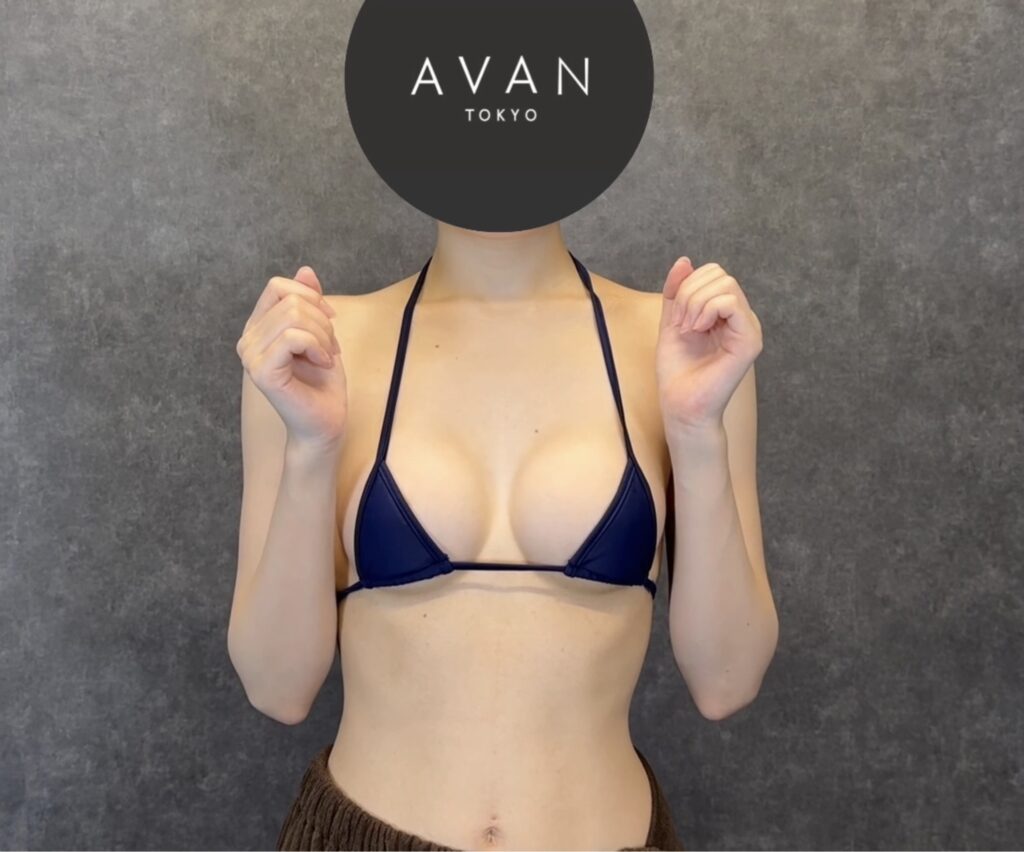
This patient is a 25-year-old female who previously underwent breast implant augmentation at another clinic.
She later underwent:
- Circumferential Arm Liposuction
- Fat Grafting Breast Augmentation
at AVAN TOKYO.
Approximately 400cc of purified fat was harvested.
Fat grafting volume:
- Right breast: 140cc
- Left breast: 120cc
Despite the relatively conservative injection volume, excellent retention was observed in the areas where volume was most desired, particularly the décolletage and cleavage.

The Ultimate Breast Augmentation Strategy
At AVAN TOKYO, we believe fat grafting is most effective when used to refine shape rather than maximize volume.
Implants create size.
Fat grafting creates softness, contour, and natural aesthetics.
The combination of both techniques allows us to achieve results that neither method can consistently deliver alone.
For many patients, Hybrid Breast Augmentation represents the highest level of breast enhancement currently available.
Risks and Potential Complications
Fat Grafting:
Infection, fat necrosis, calcification, lumps, asymmetry, and variable fat survival.
Breast Implants:
Capsular contracture, implant malposition, infection, asymmetry, and scarring.
Hybrid Breast Augmentation:
Includes the risks associated with both procedures.